Energy Conservation Building Code-2017
Energy Conservation Building Code Energy Conservation Building Code (Code) is to provide minimum requirements for the energy-efficient design and construction of buildings. Super ECBC ECBC+ Energy Conservation Building Code 2017 §1 to §14 • Scope §2 • Compliance Approaches- Mandatory, Prescriptive, WBP §3 • Technical Scope: MEPS (§4 ...
Download Energy Conservation Building Code-2017

Information
Domain:
Source:
Link to this page:
Documents from same domain
4. HVAC AND REFRIGERATION SYSTEM
beeindia.gov.in4. HVAC AND REFRIGERATION SYSTEM Bureau of Energy Efficiency 71 Syllabus HVAC and Refrigeration System:Vapor compression refrigeration cycle, Refrigerants, Coefficient of performance, Capacity, Factors affecting Refrigeration and Air conditioning
4. MATERIALAND ENERGY BALANCE
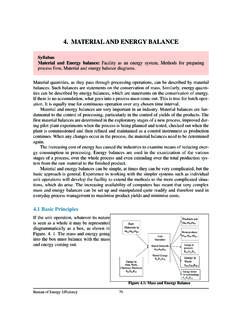
beeindia.gov.in4. MATERIALAND ENERGY BALANCE Syllabus Material and Energy balance:Facility as an energy system, Methods for preparing process flow, Material and energy balance diagrams. Material quantities, as they pass through processing operations, can be described by material balances. Such balances are statements on the conservation of mass.

1. ENERGY PERFORMANCE ASSESSMENT OF BOILERS
beeindia.gov.inmust be set up on the boiler-house floor. Samples must be taken and bagged throughout the test, the bags sealed and sent to a laboratory for analysis and calorific value determi-nation. In some more recent boiler houses, the problem has been alleviated by mounting the hoppers over the boilers on calibrated load cells, but these are yet uncommon.

List of Architects
beeindia.gov.inArchitects, Interior Designers 7, Malka Ganj, Opp. Hans Raj College, New Delhi New Delhi Tel: +91-11-27457241 +91-11-23857061 +91-11-23857824 Fax: +91-11-23859089 Email: spaceace.india@gmail.com 4. The Energy & Resource Institute (TERI) Darbari Seth Block IHC Complex, Lodhi Road New Delhi New Delhi Tel: +91-11-24682100 +91-11-41504900 extn.2139
6. PUMPS AND PUMPING SYSTEM
beeindia.gov.in6. Pumps and Pumping System Bureau of Energy Efficiency 115 Figure 6.5 Friction Head vs. Flow Figure 6.3 Static Head Figure 6.4 Static Head vs. Flow Friction head (sometimes called dynamic head loss) is the friction loss, on the liquid being moved, in pipes, valves and equipment in the system. Friction tables are universally available for
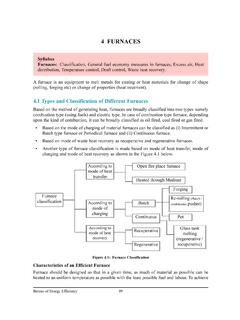
4 FURNACES - Bureau of Energy Efficiency
beeindia.gov.in• A refractory chamber constructed of insulating materials for retaining heat at the high operating temperatures. ... • Water cooling energy losses from the skids and stock supporting structure in top and ... Bureau of Energy Efficiency 93 Figure 4.4 Pusher Type Furnaces
Transmission and Distribution Losses (T&D Losses)
beeindia.gov.inThe technical losses are due to energy dissipated in the conductors , transformers and other equipments used for transmission, transformation, sub-transmission and distribution of power. These technical losses are inherent in a system and can be reduced to a certain level.
1. ELECTRICAL SYSTEM - Bureau of Energy Efficiency
beeindia.gov.inA typical plant single line diagram of electrical distribution system is shown in Figure 1.3 Efficiency ranges 28 – 35 % with respect to size of thermal plant, age of plant and capacity utilisation Step-up to 400 / 800 kV to enable EHV transmission Envisaged max. losses 0.5 % or efficiency of 99.5 % EHV transmission and substations at 400 kV ...

ENERGY
beeindia.gov.incode, ECBC 2017. I congratulate the Bureau of Energy Efficiency and the Ministry of Power on the launch of ECBC 2017. India is in a massive construction phase and the code can be a transformative tool for integrating energy efficient design and technologies in all new commercial buildings. U.S. Agency for International Development American Embassy
2. BASICS OF ENERGYAND ITS VARIOUS FORMS
beeindia.gov.inBureau of Energy Efficiency 37 Gravitational Energy Gravitational energy is the energy of place or position. Water in a reservoir behind a hydropow- ... example of the transformation of different types of energy into heat and power. It is difficult to imagine spending an entire day without using energy. We use energy to light our
Related documents

HAZARDOUS WASTE MANAGEMENT PROGRAM …
www.michigan.govPart 111 Administrative Rules Effective August 3, 2020 (cc) "Battery" means a device that consists of 1 or more electrically connected electrochemical cells and that is designed to receive, store, and deliver electric energy. An electrochemical cell is a

CHAPTER 8: Thermal Infrared Remote Sensing
www.gers.uprm.edu(AVHRR) collects thermal infrared local area coverage (LAC) data at 1.1 x 1.1 km and global area coverage (GAC) at 4 x 4 km. The routine collection of thermal infrared data are a part of each person’s daily life as we watch the nightly weather report.
Exploring Solar Energy Student Guide (7 Activities)
www1.eere.energy.govOnly a small portion of the energy radiated by the sun into space strikes the earth, one part in two billion. Yet this amount of energy is enormous. Every day enough energy strikes the United States to supply the nation's energy needs for one and a half years. About 15 percent of the radiant energy that reaches the earth is reflected back into ...

FORMS OF ENERGY – LESSON PLAN 2.1 Introduction ... - …
www.ngemc.comThermal energy, or heat, is the vibration and movement of the atoms and molecules within substances. As an object is heated up, its atoms and molecules move and collide faster. Geothermal energy is the thermal energy in the Earth. Nuclear energy. is energy stored in the nucleus of an atom – the energy that holds the nucleus together. Very

H1 Energy Efficiency
www.building.govt.nzbeen provided in Part 1. General. › Buildings with curtain walling have been excluded from the scope of H1/AS2. › Citations of NZS 4218: 2009 “Thermal insulation – Housing and small buildings” and NZS 4243.1: 2007 “Energy Efficiency – large buildings. Building thermal envelope” have been removed from the document.