
Engineering Handbook
1 ENGINEERING HANDBOOK STEELMAKING Basic descriptions of making carbon, alloy, stainless, and tool steel p. 4. METALS & ALLOYS Carbon grades, types, and numbering systems; glossary p. 13. CHEMICAL CONTENT Identification factors and composition standards p. 27. HEAT TREATMENT Quenching, hardening, and other thermal modifications p. 30. …
Download Engineering Handbook

Information
Domain:
Source:
Link to this page:
Documents from same domain
Engineering Handbook - Indian Statistical Institute
www.isibang.ac.in1 ENGINEERING HANDBOOK STEELMAKING Basic descriptions of making carbon, alloy, stainless, and tool steel p. 4. METALS & ALLOYS Carbon grades, types, and numbering systems; glossary p.

Pressure Relief Valve Engineering Handbook
www.isibang.ac.inTechnical Document No. TP-V300 Effective: May 1997 Crosby® Pressure Relief Valve Engineering Handbook Crosby Valve Inc. An FMC Corporation subsidiary
Certification Program for SIX SIGMA BLACK BELT
www.isibang.ac.inINDIAN STATISTICAL INSTITUTE SQC & OR Unit Bangalore Announces Certification Program for SIX SIGMA BLACK BELT (BB-12 Batch) Indian Statistical Institute,
DOE FUNDAMENTALS HANDBOOK - Indian …
www.isibang.ac.inDOE-HDBK-1015/1-93 JANUARY 1993 DOE FUNDAMENTALS HANDBOOK CHEMISTRY Volume 1 of 2 U.S. Department of Energy FSC-6910 Washington, D.C. 20585 Distribution Statement A. Approved for public release; distribution is unlimited.

Applied Statistics Handbook - Indian Statistical …
www.isibang.ac.inExample Preface Approach Used in this Handbook The Applied Statistics Handbook was developed to serve as a quick reference for undergraduate and graduate liberal arts students taking research methods courses.

Ramanujan’s route to roots of roots
www.isibang.ac.inx 2 K(d) n K(d¡1).Here, K(d) is generated by radicals over K(d¡1).In fact, K(d):= fx 2 K„ : xn 2 K(d¡1)g. For example, 6 q 7 3 p 20¡19 = 3 q 5 3 ¡ 3 q 2 3 shows that the element on the left side which is in Q(2) is actually contained in Q(1) itself. An element x 2 K„ is a nested radical over K if and only if there exists a Galois extension L of K and a chain of intermediate flelds
Applied Statistics Handbook - isibang.ac.in
www.isibang.ac.inExample Preface Approach Used in this Handbook The Applied Statistics Handbook was developed to serve as a quick reference for undergraduate and graduate liberal arts …
Pressure Relief Valve Engineering Handbook
www.isibang.ac.inthe design of the pressure relief valve be as simple as possible. The pressure relief valve must open at a predetermined set pressure, flow a rated capacity at a specified over-pressure, and close when the system pressure has returned to a safe level. Pressure relief valves must be designed with materials compatible with many process
Related documents

HARDENED STEEL AND HARD ALLOYS HARDNESS VS …
continentalht.comHARDNESS CONVERSION CHART SOFT STEEL,GREY AND MALLEABLE CAST IRON ANDMOSTNON-FERROUSMETALS The values shown are approximate only and this chart is intended primarily as a reference guide.

Fundamentals of Rockwell Hardness Testing
www.inspectiontechnologysystems.commaterials such as steel-copper alloys, aluminum and plastics to name a few. Rockwell testing falls into two categories: Regular Rockwell testing (e.g., C and B scales) and Rockwell superficial testing (e.g., 30 N and 30 T scales). High Rockwell hardness numbers represent hard materials and low numbers soft materials. d 2 www.wilsoninstruments.com

Hardenability of Steel: the Jominy Test - Materials Education
www.materialseducation.orgIron alloys vary on the amount of martensite that can be formed due to differences in alloying elements, so the idea of hardenability was developed. Hardenability is the ability of a metal to improve hardness and martensite formation through quenching. The extent of martensite formation in the steel at given distance from the quench, which can be
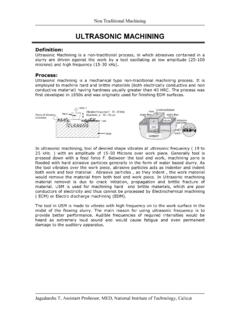
Ultrasonic Machining
www.nitc.ac.inemployed to machine hard and brittle materials (both electrically conductive and non conductive material) having hardness usually greater than 40 HRC. The process was first developed in 1950s and was originally used for finishing EDM surfaces. In ultrasonic machining, tool of desired shape vibrates at ultrasonic frequency ( 19 to 25 kHz.

MSC094 Final ver5d - MSC Industrial Direct
cdn.mscdirect.comStainless Steel 525 0.0003 0.0006 0.0010 0.0013 High Temp Alloys 100 0.0003 0.0006 0.0010 0.0013 Steel 600 0.0003 0.0006 0.0010 0.0013 Cast Iron 600 0.0003 0.0006 0.0010 0.0013 Important Disclaimer: The Accupro speed and feed rates are suggested by the manufacturer as a general guideline. Machine type, horsepower,

Experiment: Heat Treatment - Quenching & Tempering
imechanica.org• the 5140 steel is only hard near the quenched end (low hardenability) • the 4340 steel is relatively hard all along the bar (high hardenability) Figure 2 - CCT Diagram for a Eutectoid Steel. [Callister, 1991] In practice, most heat treatments for steels involve the continuous cooling of a specimen to room temperature.
Contents Copper-nickel alloys, properties and applications
nickelinstitute.orgto the alloys normally containing iron and manganese as used in marine applications. When the 70/30 alloy is ... Hardness HV10 N/mm 2 tonf/in2 Tube Annealed 140 9 320 21 40 85 250 16 Cold drawn (hard) 460 30 540 35 13 165 360 23 Temper annealed 190-320 12-21 360-430 23-28 38-30 115-140 280-320 18-21

Review of Wear and Galling Characteristics of Stainless Steel
nickelinstitute.orgvolume is inversely proportional to the hardness of the surface being worn away, and that this hardness is not the bulk hardness measured before the wear process, but rather that attained at the wear interface during sliding. This is why the high-strain-hardening alloys such as the austenitic stainless steels outwear some harder alloys like the

Correlation of Hardness Values to Tensile Strength
www.cabinc.comapproximations and therefore should be treated with caution.The Standard Hardness Conversion Tables for Metals, ASTM E140, give approximate conversion values for specific materials such as steel, austenitic stainless steel, nickel and high nickel alloys, cartridge brass, copper alloys, and alloyed white cast irons.The first two tables below, which

Stainless Steels and Super Alloys - EMJ
www.emjmetals.comType 304 is the basic “18 — 8” chromium-nickel stainless steel. It combines excel-lent mechanical properties with remarkable resistance to many corrosive agents encountered in domestic and industrial use. It is non-magnetic in the annealed condition and not hardenable by heat treatment. Both hardness and tensile strength