Entropy and Partial Differential Equations
In Chapter IV I follow Day [D] by demonstrating for certain linear second-order elliptic and parabolic PDE that various estimates are analogues of entropy concepts (e.g. the Clausius inequality). Ias well draw connections with Harnack inequalities. In Chapter V (conserva-
Download Entropy and Partial Differential Equations

Information
Domain:
Source:
Link to this page:
Documents from same domain
The Foundations of Geometry - UCB Mathematics
math.berkeley.eduthe foundations of geometry by david hilbert, ph. d. professor of mathematics, university of gÖttingen authorized translation by e. j. townsend, ph. d.
Teaching Geometry in Grade 8 and High School …
math.berkeley.eduTeaching Geometry in Grade 8 and High School According to the Common Core Standards H. Wu c Hung-Hsi Wu 2013 October 16, 2013 Contents Grade 8 6 1.Basic rigid motions and congruence (page 8)

Math 54: Linear Algebra and Differential Equations Worksheets
math.berkeley.eduA linear system corresponds to an augmented matrix, and the operations we use on a linear system to solve it correspond to the elementary row operations we use to change a matrix into row echelon form.

Teaching Fractions According to the Common Core Standards
math.berkeley.eduTeaching Fractions According to the Common Core Standards H. Wu c Hung-Hsi Wu 2013 August 5, 2011 (revised February 8, 2014) Contents Preface 2 Grade 3 5 Grade 4 17 Grade 5 33 Grade 6 59 Grade 7 80 I am very grateful to David Collins and Larry Francis for very extensive corrections. 1. ... the fractions 1 3 or 5, much less 1 11. At some point ...

Galois Theory - math.berkeley.edu
math.berkeley.eduGalois Theory David Corwin August 19, 2009 0 Preliminaries Remark 0.1 (Notation). jGjdenotes the order of a nite group G. [E: F] denotes the degree of a eld extension E=F. We write H Gto mean that H is a subgroup of G, and NE Gto mean that N is a normal subgroup of G. If E=F and K=F are two eld extensions, then when we say that K=F is

SOLUTION: ASSIGNMENT 5 - UCB Mathematics | Department …
math.berkeley.eduObserve that T(c) = t0 = 0 where c is any constant polynomial, and hence T is not an isomorphism because ker T ,f0g(e.g. it contains constant polynomials). Remark.

Basic Analysis: Introduction to Real Analysis
math.berkeley.eduIntroduction 0.1 About this book This book is a one semester course in basic analysis. It started its life as my lecture notes for teaching Math 444 at the University of …
THE CATEGORICAL LANGUAGE OF QUANTUM PHYSICS …
math.berkeley.eduTHE CATEGORICAL LANGUAGE OF QUANTUM PHYSICS 3 Example 2.8. If is a directed graph, then we can construct a category C whose objects are the vertices of and whose morphisms are possible paths between pairs of points (the

Math 55: Discrete Mathematics
math.berkeley.edu5.3.6 Determine whether each of these proposed de nitions is a valid recur- sive de nition of a function f from the set of all nonnegative integers to the set of integers.

Homework from Section 4.5 4.5.3. - UCB Mathematics
math.berkeley.eduHomework from Section 4.5 4.5.3. Find two positive numbers whose product is 100 and whose sum is a minimum. We want x and y so that xy = 100 and S = x + y is minimized.
Related documents

Runge-Kutta 4th Order Method for Ordinary Differential ...
mathforcollege.comOct 13, 2010 · 08.04.1 Chapter 08.04 Runge-Kutta 4th Order Method for Ordinary Differential Equations . After reading this chapter, you should be able to . 1. develop Runge-Kutta 4th order method for solving ordinary differential equations, 2. find the effect size of step size has on the solution, 3. know the formulas for other versions of the Runge-Kutta 4th order method
First-Order Differential Equations and Their Applications
assets.press.princeton.eduThe order of a differential equation is the order of the highest derivative of the unknown function (dependent variable) that appears in the equation. The differential equations in (1) are of first, second, and fourth order, respectively. Most of the equations we shall deal with will …
Second Order Differential Equation Non Homogeneous
bionics.seas.ucla.eduSecond Order Linear Differential Equations – Homogeneous & Non Homogenous v • p, q, g are given, continuous functions on the open interval I ¯ ® c ( ) 0 ( ) ( ) g t y p t y q t y Homogeneous Non-homogeneous
APPLICATIONS OF SECOND-ORDER DIFFERENTIAL …
www.math.pitt.edu4 APPLICATIONS OF SECOND-ORDER DIFFERENTIAL EQUATIONS FORCED VIBRATIONS Suppose that, in addition to the restoring force and the damping force, the motion of the spring is affected by an external force . Then Newton’s Second Law gives Thus, instead of the homogeneous equation (3), the motion of the spring is now governed
Second Order Linear Differential Equations
www.personal.psu.eduSecond Order Linear Homogeneous Differential Equations with Constant Coefficients For the most part, we will only learn how to solve second order linear equation with constant coefficients (that is, when p(t) and q(t) are constants). Since a homogeneous equation is easier to …
Runge-Kutta 4th Order Method for Ordinary Differential ...
mathforcollege.comOct 13, 2010 · 08.04.1 Chapter 08.04 Runge-Kutta 4th Order Method for Ordinary Differential Equations . After reading this chapter, you should be able to . 1. develop Runge-Kutta 4th order method for solving ordinary differential equations, 2. find the effect size of step size has on the solution, 3. know the formulas for other versions of the Runge-Kutta 4th order method
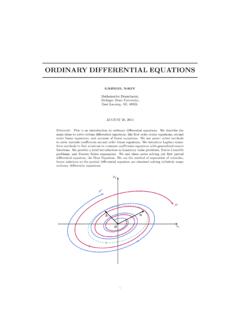
ORDINARY DIFFERENTIAL EQUATIONS
users.math.msu.eduORDINARY DIFFERENTIAL EQUATIONS GABRIEL NAGY Mathematics Department, Michigan State University, East Lansing, MI, 48824. AUGUST 16, 2015 Summary. This is an introduction to ordinary di erential equations. We describe the main ideas to solve certain di erential equations, like rst order scalar equations, second
Second Order Differential Equations
epsassets.manchester.ac.ukSecond Order Differential Equations 19.3 Introduction In this Section we start to learn how to solve second order differential equations of a particular type: those that are linear and have constant coefficients. Such equations are used widely in the modelling

Systems of First Order Linear Differential Equations
www.personal.psu.eduSystems of First Order Linear Differential Equations We will now turn our attention to solving systems of simultaneous homogeneous first order linear differential equations. The solutions of such systems require much linear algebra (Math 220). But since it is not a prerequisite for this course, we have to limit ourselves to the simplest

Neural Ordinary Differential Equations
arxiv.orgNeural Ordinary Differential Equations Ricky T. Q. Chen*, Yulia Rubanova*, Jesse Bettencourt*, David Duvenaud University of Toronto, Vector Institute {rtqichen, rubanova, jessebett, duvenaud}@cs.toronto.edu Abstract We introduce a new family of deep neural network models. Instead of specifying a