
ESP8266 Technical Reference - Espressif
1.3.1. General SPI (Master/Slave) 1.3.2. HSPI (Master/Slave) 1.4. I2C Interface ESP8266EX has one I2C used to connect with micro-controller and other peripheral equipments such as sensors. The pin definition of I2C is as below. Both I2C Master and I2C Slave are supported. I2C interface functionality can be realized via
Download ESP8266 Technical Reference - Espressif

Information
Domain:
Source:
Link to this page:
Documents from same domain

ESP32 Series - Espressif
www.espressif.comList of Tables 1 Pin Description 7 2 Description of ESP32 Power-up and Reset Timing Parameters 10 3 Strapping Pins 11 4 Memory and Peripheral Mapping 14

0A-ESP8266EX Datasheet EN - Espressif Systems - …
www.espressif.com1. Overview 1. Overview Espressif’s ESP8266EX delivers highly integrated Wi-Fi SoC solution to meet users’ continuous demands for efficient power usage, compact design and reliable performance

ESP32-WROVER - espressif.com
www.espressif.com1.Overview 1. Overview ESP32-WROVER is a powerful, generic WiFi-BT-BLE MCU module that targets a wide variety of applications, ranging from low-power sensor networks to the most demanding tasks, such as voice encoding, music streaming
0a-esp8266ex datasheet en - Espressif
www.espressif.com2. Pin Definitions 2. Pin Definitions Figure 2-1 shows the pin layout for 32-pin QFN package. $ Figure 2-1. Pin Layout (Top View) Table 2-1 lists the definitions and functions of each pin.

4a-esp8266 at instruction set en - Espressif
www.espressif.comESP8266 AT Firmware, officially launched by Espressif, is available for download and can be used directly. Also, users may find AT Project that Espressif specially created for users to customize AT firmware. This document introduces how to customize AT firmware and download AT firmware into flash. It also

ESP32 Bluetooth Architecture EN - Espressif
www.espressif.comadvantages including robustness, low power consumption and low cost. The Bluetooth system can be divided into two different categories: Classic Bluetooth and Bluetooth Low Energy (BLE). ESP32 supports dual-mode Bluetooth, meaning that both Classic Bluetooth and BLE are supported by ESP32.

Hardware Design Guidelines - Espressif
www.espressif.comamong which, ESP32-D0WD-V3, ESP32-D0WDQ6-V3, and ESP32-U4WDH are based on ECO V3 wafer. For details of part number and ordering information, please refer to ESP32SeriesDatasheet. For details on ECO V3 instructions, please refer to ESP32ECOV3UserGuide. Espressif Systems 1 Submit Documentation Feedback ESP32 …

ESP32S2MINI1 & ESP32S2MINI1U - Espressif
www.espressif.comThe ESP32-S2FH4 chip and the ESP32-S2FN4R2 chip falls into the same category, namely ESP32-S2 chip series. ESP32-S2 series of chips has an Xtensa® 32-bit LX7 CPU that operates at up to 240 MHz.

DESIGNS RECOMMENDED (NRND) NEW NOT - Espressif
www.espressif.comESP32-WROOM-32 is a powerful, generic Wi-Fi+BT+BLE MCU module that targets a wide variety of applications, ranging from low-power sensor networks to the most demanding tasks, such as voice encoding, music streaming and MP3 decoding. At the core of this module is the ESP32-D0WDQ6 chip*. The chip embedded is designed to be scalable and adaptive.

esp-wroom-02u esp-wroom-02d datasheet en
www.espressif.comOFDM, 6 Mbps - 37 - dB OFDM, 54 Mbps - 21 - dB HT20, MCS0 - 37 - dB HT20, MCS7 - 20 - dB Description Min Typ Max Unit! Note: For the module that uses an IPEX antenna, the output impedance is 50 Ω. Table 4-3. Power Consumption –!
Related documents
Master-Slave Communication via a CM PtP Using the …
cache.industry.siemens.comMaster-Slave Communication via Modbus RTU Entry ID: 68202723, V2.0.1, 01/2018 2 Security 2018 proof to your detriment. d Warranty and Liability Note The Application Examples are not binding and do not claim to be complete regarding the circuits shown, equipping and any eventuality. The Application
Micro800 Family of PLCs Brochure - Rockwell Automation
configurator.rockwellautomation.comDeviceNet Master/Slave — Slave only Master (1 Max) and Slave Master (1 Max) and Slave Isolated RS232/485 — Via Plug-In Via Plug-In Via Plug-In 2/4-ch Analog — Via Plug-In Via Plug-In Via Plug-In RTD/TC — Via Plug-In Via Plug-In Via Plug-In Trim Potentiometer — Via Plug-In Via Plug-In Via Plug-In Back-up Memory Module — No Via Plug ...
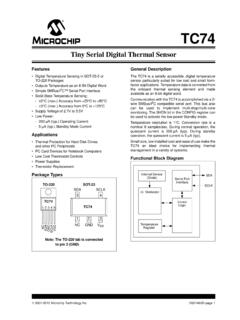
TC74 - Microchip Technology
ww1.microchip.comNov 29, 2012 · Communication with the TC74 is accomplished via a 2-wire SMBus/I2C compatible serial port. This bus also ... F = Acknowledge Bit Clocked into Master G = MSB of Data Clocked into Master H = LSB of Data Clocked into Master ... Slave The device addressed by the master. START A unique condition signaling the begin-ning of a transfer indicated by ...
Serial Peripheral Interface (SPI) with Audio Codec Support
ww1.microchip.comIn Normal mode operation, the SPI master controls the generation of the serial clock. The num-ber of output clock pulses corresponds to the transfer data width: 8, 16 or 32 bits, or depending upon variable data width configuration, from 2 to 32-bit. Figure 1-2 and Figure 1-3 illustrate SPI master-to-slave and slave-to-master device connections.

Automotive Audio Bus A2B Transceiver …
www.analog.comconnected to the slave transceivers via the I2C or SPI ports for I 2C to I C communication over distance between multiple nodes. All nodes in an A2B system are sampled synchronously in the same A 2B superframe. Synchronous I S/TDM downstream data from the master arrives at all slaves in the same A 2B superframe,

Modicon Modbus Protocol Reference Guide
www.modbus.orgrates, and parity checking. Controllers can be networked directly or via modems. Controllers communicate using a master–slave technique, in which only one device (the master) can initiate transactions (called ‘queries’). The other devices (the slaves) respond by supplying the requested data to the master, or by taking

BACnet MS/TP Overview Manual
www.neptronic.comThe BACnet Master Slave Token Passing (MS/TP) protocol is used to relay and exchange information between building devices. The MS/TP is a based on BACnet standard protocol SSPC-135, Clause 9. The BACnet MS/TP is a peer-to-peer, multiple master protocol based on token passing. A token is information packets in the form of
Introduction to Modbus TCP/IP
www.prosoft-technology.comModbus devices communicate using a master-slave (client-server) technique in which only one device (the master/client) can initiate transactions (called queries). The other devices (slaves/servers) respond by supplying the requested data to the master, or by taking the action requested in the query. A slave is any peripheral device (I/O transducer,