
Essentials of Stochastic Processes
Chapter 1 Markov Chains 1.1 Definitions and Examples The importance of Markov chains comes from two facts: (i) there are a large number of physical, biological, economic, and social phenomena that can be modeled in this way, and (ii) there is a well-developed theory that allows us to do computations.
Download Essentials of Stochastic Processes

Information
Domain:
Source:
Link to this page:
Documents from same domain

rd Grade Astronomy Lessons - Duke University
services.math.duke.edu3rd Grade Astronomy Lessons The following is a set of suggested activities for a third grade curriculum unit on the Earth/Sun/Moon system. The goal is to provide students with an understanding of the

Programming ActionScript 3 - Duke University
services.math.duke.eduProgramming ActionScript™ 3.0 If this guide is distributed with software that includes an end-user agreement, this guide, as well as the software described i n it, is furnished under license and may be used or copied only in accordance with the terms of such license.

Math 361S Lecture Notes Numerical solution of ODEs
services.math.duke.eduUsing ODE solvers in MATLAB and python: For example, ode45 is an adaptive method in MATLAB that is a workhorse of solving ODE’s, that often \just works." ... For our purposes, we will attempt to construct numerical solutions where the actual solution exists, so the theory is just there to ensure that the problem to solve is well-de ned.
MATH 545, Stochastic Calculus Problem set 2
services.math.duke.eduMATH 545, Stochastic Calculus Problem set 2 January 24, 2019 These problems are due on TUE Feb 5th. You can give them to me in class, drop them in my box. In all of the problems E denotes the expected value with respect to the specified probability measure P. Problem 0. Read [Klebaner], Chapter4 and Brownian Motion Notes (by FEB 7th)

Math 230.01, Fall 2012: HW 2 Solutions
services.math.duke.eduMath 230.01, Fall 2012: HW 2 Solutions This homework is due at the beginning of class on Thursday January 26th, 2011. You are free to talk with each other and get help. However, you should write up your own solutions and understand everything that you write. Problem 1. The 1987 World Series was tied at two games a piece before the St. Louis ...

Introduction to Stochastic Calculus
services.math.duke.edumodel the number of genetic mutations an animal species. We may also think about Nptqas the number of sick individuals in a population. Reasonable and widely applied models for the spread of infectious diseases are obtained by modifying (1.1), and observing its behavior. In all these cases, one may be interested in knowing if it is likely for the

Probability: Theory and Examples Rick Durrett Version 5 ...
services.math.duke.eduthe second focusing on Donsker’s theorem, etc. The material on the central limit theorem for martingales and stationary sequences deleted from the fourth edition has been reinstated. • The four sections of the random walk chapter have been relocated.
Lecture Notes on PDEs, part I: The heat equation and the ...
services.math.duke.edunical conditions hold on the boundary conditions. One can think of the ‘boundary’ of the solution domain to have three sides: fx= ag;fx= bg and ft= 0g;with the last side left …

Math 230, Fall 2012: HW 9 Solutions - Duke University
services.math.duke.eduf(x;y) : 0 <jxj+ jyj<1g. Find: a) the joint density of (X;Y); b) the marginal densities f X(x) and f Y(y). c) Are Xand Y independent? d) Find EXand EY. SOLUTION. The region is a square rotated by 45 degrees with corners at ( 1;0) and (0; 1). The area of this square region is 2, so the density is f(x;y) = (1 2 0 <jx + y 1 0 else: To nd the ...
Related documents

Chapter 1 Markov Chains - Yale University
www.stat.yale.edu2 1MarkovChains 1.1 Introduction This section introduces Markov chains and describes a few examples. A discrete-time stochastic process {X n: n ≥ 0} on a countable set S is a collection of S-valued random variables defined on a probability space (Ω,F,P).The Pis a probability measure on a family of events F (a σ-field) in an event-space Ω.1 The set Sis the state space of the …
Introduction to Stochastic Processes - Lecture Notes
web.ma.utexas.eduCHAPTER 1. PROBABILITY REVIEW 1.2 Countable sets Almost all random variables in this course will take only countably many values, so it is probably
Probability, Random Processes, and Ergodic Properties
ee.stanford.eduiv c 1987 by Springer Verlag. Revised 2001, 2006, 2007, 2008 by Robert M. Gray.

An introduction to Markov chains
web.math.ku.dkon Markov chains in order to be able to solve all of the exercises in Appendix C. I advise students to postpone these exercises until they feel familiar with the exercises in Chapters 2 and 3. For further reading I can recommend the books by Asmussen [2003, Chap. 1-2], Brémaud [1999] and Lawler [2006, Chap. 1-3]. My
Markov Chains and Transition Matrices: Applications to ...
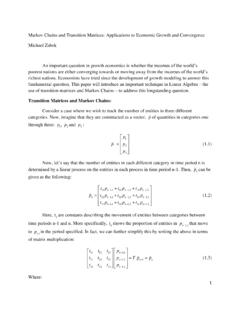
www2.kenyon.eduholds, and we may transition from time period m-1 to m for any m as we did above. Then we can say the following by induction: 1 1 k T p p k KK (1.5 ) The above equation is for a Markov Chain composed of transition matrix T. As we move on we will see that Markov chains are quite useful in a number of situations – especially our

Introduction to Probability Models
www.ctanujit.org4.8. Time Reversible Markov Chains 236 4.9. Markov Chain Monte Carlo Methods 247 4.10. Markov Decision Processes 252 4.11. Hidden Markov Chains 256 4.11.1. Predicting the States 261 Exercises 263 References 280 5. The Exponential Distribution and the Poisson Process 281 5.1. Introduction 281 5.2. The Exponential Distribution 282 5.2.1 ...
Foundations of Data Science - TTIC
home.ttic.eduFoundations of Data Science Avrim Blum, John Hopcroft, and Ravindran Kannan Thursday 27th February, 2020 This material has been published by Cambridge University Press as Foundations of Data Science by Avrim Blum, John Hopcroft, and Ravi Kannan.

Basic Life Insurance Mathematics
web.math.ku.dkCHAPTER 1. INTRODUCTION 7 total savings after 15 years amount to L55 S15, which yields an individual share equal to L55 S15 L70 (1.3) to each of the L70 survivors if L70 >0. By the so-called law of large numbers, the proportion of survivors L70=L55 tends to the individual survival probability 0:75 as the number of participants L55 tends to in nity. Therefore, as the

Markov Chains - University of Cambridge
statslab.cam.ac.uk1 Definitions, basic properties, the transition matrix Markov chains were introduced in 1906 by Andrei Andreyevich Markov (1856–1922) and were named in his honor.