
Example Policies / Protocols Guidelines & Procedures
assessment including vitals, document chief complaint, and the patient's Richmond Agitation Sedation Scale (RASS). A nonzero RASS has very good sensitivity and specificity for delirium (Han, AEM 2015). An older adult with a non-zero RASS should also have an ESI of 1 or 2. From our Jan 2018 data (most
Download Example Policies / Protocols Guidelines & Procedures

Information
Domain:
Source:
Link to this page:
Documents from same domain

Clinical Policy: Critical Issues in the Evaluation and ...
www.acep.orgdecisionmaking, there are no high-quality studies to guide the approach to diagnosis. As a result, the misdiagnosis of aortic ... Clinical presentation differs by type of aortic dissection. The ... Web of Science’s Cited Reference Search, and Scopus were performed. All searches were limited to English-language sources,

Public Education: Consent for Medical/Surgical Care ...
www.acep.orgConsent for Medical/Surgical Care/Emergency Treatment and Child’s Medical Information In presenting my son/daughter for diagnosis and treatment

Clinical Policy: Procedural Sedation and Analgesia in the ...
www.acep.orgPAIN MANAGEMENT AND SEDATION/CLINICAL POLICY. dexmedetomidine, alfentanil and remifentanil be safely administered? Aliterature search was performed, the evidence was graded, and recommendations were given based on the strength of the available data in the medical literature.
Clinical Policy for Well-Appearing Infants and Children ...
www.acep.orgClinical Policy for Well-Appearing Infants and Children Younger Than 2 Years of Age Presenting to the Emergency Department With Fever From the American College of Emergency Physicians Clinical Policies Subcommittee (Writing Committee) on Pediatric Fever:

Risk Assessment and Tools for Identifying Patients at High ...
www.acep.orgBelow is a list of currently available screening tools and pertinent information: A. The Centers for Disease Control and Prevention’s program “Workplace Violence Prevention for Nurses.” In this program, the CDC included Violence Risk Assessment Tools.

Risk Assessment and Tools for Identifying Patients at High ...
www.acep.orgBelow is a list of currently available screening tools and pertinent information: A. The Centers for Disease Control and Prevention’s program “Workplace Violence Prevention for Nurses.” In this program, the CDC included Violence Risk Assessment Tools.

GERIATRIC EMERGENCY DEPARTMENT GUIDELINES
www.acep.orgpractices from the perspectives of the American College of Emergency Physicians, Society for Academic Emergency Medicine, American Geriatrics Society, and Emergency Nurses Association. With implementation of the following recommendations, hospitals, regardless of size, will positively impact the care of the geriatric emergency patients.

Guideline for Ultrasound Transducer Cleaning and Disinfection
www.acep.orgshould undergo low-level disinfection with an agent that is active against hepatitis B virus, hepatitis C virus, HIV and tubercle bacilli. 5. Transducers used internally on mucous membranes and internal orifices should be covered with a high-quality single-use probe cover, where appropriate, followed by high-level disinfection between each use.

Evidence-Based Guideline: Treatment of Convulsive Status ...
www.acep.organd new clinical trial data have emerged relating directly to the treatment of this most feared type of seizure activity. Coupled with the acceptance of evidence-based rather than consensus-based guidelines, the Epilepsy Foundation in 2004 and the American Epilepsy Society in …

Emergency Department COVID-19 Management Tool
www.acep.org1 Step 2 - Risk Prognostication Patients with MILD and MODERATE Severity should be further assessed to determine their risk of disease progression. The PRIEST Score is a validated tool to predict a patient's risk for end organ failure and/or mortality using readily available data on initial presentation to the ED. Step 3 - Risk Assessment The CDC maintains a list of underlying …
Related documents

DRUGS USED IN ICU - Weebly
chestgmcpatiala.weebly.comsympathetic drive due to pain, agitation or delirium. ii) Patients in the recovery phase of acute renal failure are often hypertensive.. iii) Hypertension following an ... The following guidelines are used for 1 hour of nebulization. For prescribed dose of 10 mg/h at 15 …

Guidelines for the Overview of the New Pain, Agitation ...
ashpmedia.orgThe Pharmacist's Role in Implementing the New Pain, Agitation, and Delirium Guidelines in the Critical Care Setting 2. Perceived Barriers to Use of Daily Sedation Interruption: Engaging the Bedside RN is the Key! 6.0% 8.0% 11.0% ...

Management of Post Traumatic Brain Injury Agitation
medicine.uams.eduManagement of Post Traumatic Brain Injury (TBI) Agitation Author(s): Peer Reviewed: Finalized: Drafted: Date: Published: 2020 I. Definition, Assessment, Diagnosis A. Agitation Definitions: No consensus 1. Subtype of delirium unique to …
Guidelines for the Management of Excited Delirium / Acute ...
rcem.ac.ukGuidelines for the Management of Excited Delirium / Acute Behavioural Disturbance (ABD) 4 from mildly erratic to a state of extreme agitation and physical exertion. Patients have signs of hyper-adrenergic autonomic dysfunction such as significant tachycardia, marked metabolic acidosis and hyperthermia and
End-of-Life Care: Managing Common Symptoms
www.aafp.orgMar 15, 2017 · Delirium and agitation may be caused by reversible etiologies, which should ... Pain is a common symptom occurring in approximately ... clinical guidelines from …
PALLIATIVE CARE PAIN & SYMPTOM CONTROL GUIDELINES …
www.england.nhs.ukDELIRIUM AND CONFUSION 58 ANXIETY 61 DEPRESSION 64 CONTENTS. ... and/or agitation 106 ¡ Algorithm 6 – Respiratory tract secretions 107 ¡ Algorithm 7 – Breathlessness 108 ... PALLIATIVE CARE PAIN & SYMPTOM CONTROL GUIDELINES FOR ADULTS 9 PAIN 1. Pain assessment

Assessment Algorithm for Sedated Adult ICU Patients ICU ...
www.hqinstitute.orgJul 22, 2005 · ICU Sedation Guidelines of Care Is patient comfortable and at goal for Sedation and ... Intensive Care Delirium Screening Checklist (ICDSC) Pain Delirium Consider potential causes Consider potential ... TSet goal for sedation TARGET: Richmond Agitation Sedation Scale (RASS): 0 to -3 Riker Sedation-Agitation Scale (SAS): 3 to 4 Sedation ...
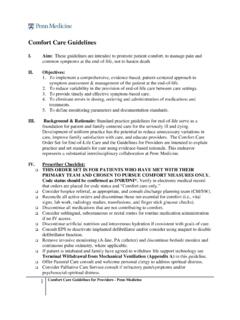
Comfort Care Guidelines
www.med.upenn.edu2 Comfort Care Guidelines for Providers - Penn Medicine *Evaluate each patient case individually as extubation may not be appropriate for every patient on comfort care. V. Nursing Orders: Comfort Care Measures Assess patient comfort q15-30 mins initially for pain, dyspnea, secretions, delirium/agitation, anxiety/fear and nausea/vomiting, constipation, and fever.

Essential Medicines in Palliative Care
www.who.intPain 8 Respiratory tract secretions 8 Table 1 – GRADE system 9 Table 2 – Summary of recommended medicines in palliative care 10 References for executive summary 13 Appendix - Monographs and Summary of the Evidence Anorexia 16 Anxiety 20 Constipation 24 Delirium 29 Depression 33 Diarrhoea 40