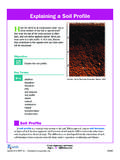
Explaining a Soil Profile
A soil profile is usually studied to a depth of 3 to 5 feet. To see the soil profile, soil cores may be taken or holes dug to expose the pro-file.
Download Explaining a Soil Profile

Information
Domain:
Source:
Link to this page:
Documents from same domain

Understanding Soil Texture and Structure
www.senecahs.orgSilt is the mid-size soil particle. Silt has good water-holding ability and good fertility char-acteristics. It feels like flour when dry and smooth like velvet when moist.
Plant Classification - Seneca High School
www.senecahs.orgCultivar Cultivars have distinguishing characteristics from the other plants in the species, but cultivars do not transfer those characteristics to offspring
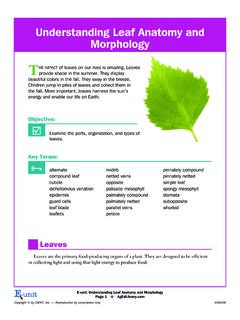
Understanding Leaf Anatomy and Morphology
www.senecahs.orgare responsible for most of the photosynthesis in the leaf and are called the palisade mesophyll. Located under the palisade mesophyll are loosely packed cells called the spongy mesophyll.

STHS Random Drug Testing Program Frequently Asked …
www.senecahs.orgFrequently Asked Questions Q: Why is this drug testing policy being put into place? A: Participation in extracurricular activities is a privilege, and participants need to be exemplars. The District also wants to foster health, safety, and the welfare of its students.
Plant Classification - Seneca High School
www.senecahs.orgPlant Divisions Tracheophyta or Spermophyta – Seed Producing plants that bear flowers – Pterodophyta - a class of Tracheophyta that does not produce seeds (Ferns, reproducing with spores) Thallophyta – Fungi and bacteria
Explaining a Soil Profile - senecahs.org
www.senecahs.orgA soil profile is a vertical cross section of the soil. The differences are developed from the interaction of such soil-forming factors as parent material, slope, native vegetation, weathering, and climate. As a soil ages, horizontal layers develop and changes result. The causes of these

Understanding Horticulture
www.senecahs.orgapples, and pears. Small fruits include strawberries, raspberries, and blueberries. Almonds, pecans, and walnuts are popular nut crops. OLERICULTURE The area of horticulture that involves the production of vegetable food crops is olericulture. Olericulture includes the planting, harvesting, storing, processing, and marketing of vegeta-ble crops.
Understanding Soil Texture and Structure
www.senecahs.orgSoil Structure Sand, silt, clay, and organic-matter particles in a soil combine with one another to form larger particles of various shapes and sizes. These larger particles, or clusters, are often referred to as aggregates. The arrangement of the soil particles into aggregates of various sizes and shapes is soil structure.

SPANISH I CURRICULUM GUIDE
www.senecahs.orgCurriculum Guide: SPANISH I Course of Study : Spanish Core Standard: Connections And Communities Level: 1 Standards for 21st Century Enduring Understandings Essential Questions 3.1 3.2 5.1, 5.2 ISBE 30A and 30B The study of language applies to many different content areas. In what ways are the other subject areas in the curriculum affected by
Understanding Leaf Anatomy and Morphology
www.senecahs.orgAxillary bud Stipule Stem Petiole Blade FIGURE 1. The major parts of a leaf. Dicots have leaves with veins that connect and branch from each other. Veins in a branch-ing pattern are called netted veins. A leaf with netted veins sometimes has several smaller
Related documents

April 2010 Guidance for Assessing Petroleum Hydrocarbons ...
epa.ohio.govThis guidance presents a risk-based approach for the assessment of soil impacted by petroleum hydrocarbons. This approach includes the evaluation of indicator …

CHAPTER 1. SOIL PHYSICAL PROPERTIES - UC Davis
lawr.ucdavis.eduSSC107-Fall 2000 Chapter 1, Page - 2 - Soils are extremely complex, hence we often simplify to study and understand soil physical

BASIC SOIL PROPERTIES: ANALYSIS AND INTERPRETATION …
www.arc.agric.zaBASIC SOIL PROPERTIES: ANALYSIS AND INTERPRETATION OF RESULTS COURSE DESCRIPTION & OUTLINE To introduce prospective farmers and other land users to the basic soil properties and their significance.
Appendix B The Unified Soil Classification System
www.areforum.orgUnified Soil Classification System B-1 Appendix B The Unified Soil Classification System The adoption of the principles of soil mechanics by the engineering
Guidelines for soil description
www.fao.orgGUIDELINES FOR SOIL DESCRIPTION Universität Halle-Wittenberg, Germany Technische Universität München, Germany ISRIC – World Soil Information, The Netherlands

Crosshole/Downhole Seismic (CS/DS) investigations provide ...
www.olsoninstruments.comGeophysical systems geo-37 SV P Triaxial Geophone Receivers Optional P-SV Source Receiver 1 Optional Receiver 2 Dummy Probes Dummy Probe Triple Port Manifold

Topic 6: Properties of Soil
www.soil-net.comTopic 6: Properties of Soil Introduction Soils have many different properties, including texture, structure or architecture, waterholding capacity and pH (whether the soils are acid or alkaline). These properties combine to make soils useful for a wide range

Chapter 5 Engineering Properties of Soil and Rock
www.wsdot.wa.govBack-analysis is used to tie the soil or rock properties to the quantifiable performance of the slope, embankment, wall, or foundation (see Section 5.7).