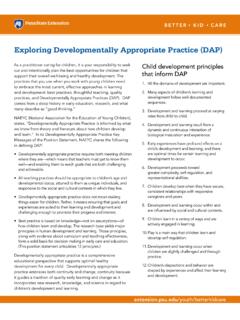
Exploring Developmentally Appropriate Practice (DAP)
Child development principles that inform DAP 1. All the domains of development are important. 2. Many aspects of children’s learning and development follow well-documented sequences. 3. Development and learning proceed at varying rates from child to child. 4. Development and learning result from a dynamic and continuous interaction of
Download Exploring Developmentally Appropriate Practice (DAP)

Information
Domain:
Source:
Link to this page:
Documents from same domain
Helping your children learn self-control
bkc-od-media.vmhost.psu.eduHelping your children learn self-control ... As the child grows the problems can grow as well and the ... The work of helping your child build self-control ...
Art – an opportunity to develop children’s skills
bkc-od-media.vmhost.psu.eduArt – an opportunity to develop children’s skills As young children explore paint by putting it all over their hands, or create collages with torn
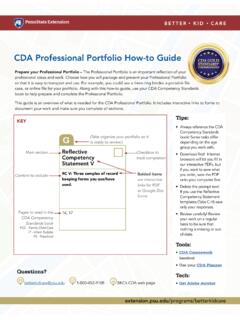
CDA Professional Portfolio How-to Guide
bkc-od-media.vmhost.psu.eduCDA Professional Portfolio How-to Guide Prepare your Professional Portfolio – The Professional Portfolio is an important reflection of your professional ideas and work. Choose how you will package and present your Professional Portfolio
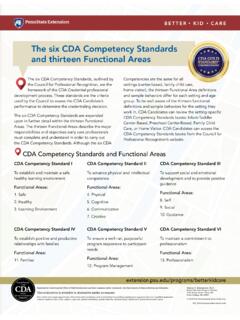
The six CDA Competency Standards P R OF E SI NAL and ...
bkc-od-media.vmhost.psu.eduAreas. The thirteen Functional Areas describe the major responsibilities and objectives early care professionals must complete and understand in order to carry out the CDA Competency Standards. Although the six CDA Competencies are the same for all settings (center-based, family child care, home visitor), the thirteen Functional Area definitions
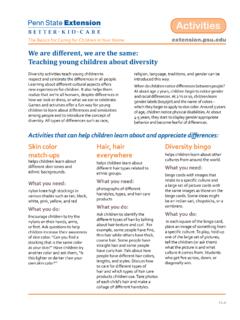
We are different, we are the same: Teaching young children ...
bkc-od-media.vmhost.psu.eduWe are different, we are the same: Teaching young children about diversity Diversity activities teach young children to respect and celebrate the differences in all people. Learning about different cultural aspects offers new experiences for children. It also helps them realize that we’re all humans, despite differences in

Developmental Milestones for School Age Children
bkc-od-media.vmhost.psu.edu• Wants to please friends • Likes pretend play with other children • Shows concern for others • Is aware of gender • Makes up games with simple rules • Has an understanding of right and wrong • Shows more independence • Uses a fork, spoon, and sometimes knife to eat • Skips and runs on tiptoe • Uses toilet on her own
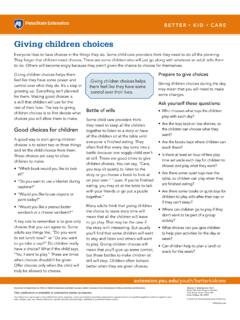
Giving children choices - Pennsylvania State University
bkc-od-media.vmhost.psu.edu• “Would you like to use crayons or paint today?” • “Would you like a peanut butter sandwich or a cheese sandwich?” A key rule to remember is to give only choices that you can agree to. Some adults say things like, “Do you want to eat lunch now?” or “Do you want to go take a nap?” Do children really have a choice?

CDA INFANT/TODDLER SAMPLE CURRICULUM
bkc-od-media.vmhost.psu.eduThe CDA Infant/Toddler Sample Curriculum provides a suggested list of specific lessons to take in ... activities and opportunities that encourage curiosity, explortation, and problem-solving appropriate to the developmental levels and learning styles of children.
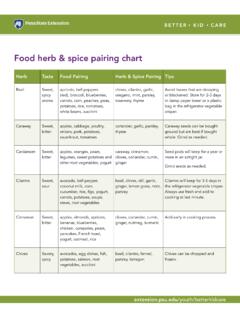
Food herb & spice pairing chart
bkc-od-media.vmhost.psu.edumost herbs and spices Choose unblemished, firm heads without signs of mold or sprouting. Ginger Sour apples, chicken, fish, passion fruit, pears, pineapple, mango basil, cilantro, coconut, garlic, lime, lemon grass, mint, scallions, turmeric Fresh ginger should be hard, plump and heavy. They keep well in the vegetable crisper of the
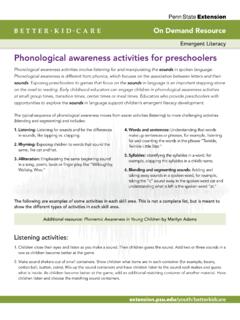
Phonological awareness activities for preschoolers
bkc-od-media.vmhost.psu.edu“The Itsy, Bitsy, Spider” and read rhyming books like Moose on the Loose or Fox in Socks. Emphasize the rhyming words. 2. Gather small props or pictures that represent rhyming objects (car- star, chair-bear, cat-hat, house-mouse, bell-shell). Hold up an object or picture. Pass around a rhyming box with three items or pictures in
Related documents
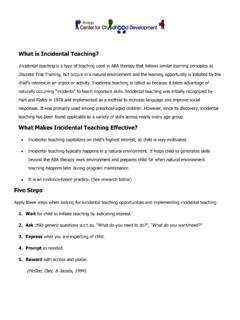
What is Incidental Teaching? - Knapp Center
knappcenter.orgIncidental teaching capitalizes on child’s highest interest, so child is very motivated. Incidental teaching typically happens in a natural environment. It helps child to generalize skills beyond the ABA therapy work environment and prepares child for when natural environment teaching happens later during program maintenance.

What is Your Image of the Child? - WAECE
www.waece.orgtransferring ‘important’ knowledge (e.g. literacy, math, science) from teacher to children, and which assumes that children are guided (in however ‘child-centred’ a way) towards a prescribed destination – early learning goals or similar normative and closed outcomes. The ‘rich’ child is a co-constructor of knowledge, learning

MSDH Approved Child Care Courses
msdh.ms.govThe creative arts emphasize the process, teaching kids in a ... writing, and math skills and for an . care. resources. The objective of this training is to . development. A . Offered by MSDH . Offered by MSDH Child Care ... How to care for your young child to develop them into respectable ...
STEM Teaching Kit for Web - Boston Children's Museum
www.bostonchildrensmuseum.orgyour child’s experience, there is no need to correct him/her right away. Change in thinking takes place over time, after many experiences. Help your child compare his/her own answers to evidence that already exists. Either you can show that your child is on the right track, or you can do some research together on the Internet or in the kitchen!

TEACHING PRESCHOOLERS ABOUT MEASURING LENGTH
www.eclearningil.orgin learning the U.S. system. Teaching young DLLs a new system involves helping them learn new vocabulary for the units of measurement (i.e., inch, foot, yard). When the home system for measuring length is the same as the US system, teachers can use several strate-gies to help young DLLs learn to bridge home language

2017-2018 | CATALOG ADDENDUM - El Camino
www.elcamino.eduCDEV 118 Science and Math for Young Children (3) CDEV 119 Language Arts for Young Children (3) 6 units from: CDEV 108 Principles and Practices of Teaching Young Children (3) CDEV 112 Teaching Young Children in a Diverse Society (3) CDEV 114 Observing and Assessing Young Children (3) CDEV 152 Curriculum and Strategies for Children with Special ...