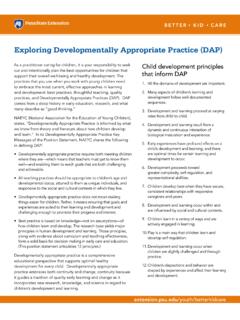
Exploring Developmentally Appropriate Practice (DAP)
and appropriate early learning goals for children and that supports individualized learning. • Assessing children’s development and learning. Link assessment to curriculum and early learning standards and use authentic assessment methods to measure a child’ s progress. • Establishing reciprocal relationships with families.
Download Exploring Developmentally Appropriate Practice (DAP)

Information
Domain:
Source:
Link to this page:
Documents from same domain
Helping your children learn self-control
bkc-od-media.vmhost.psu.eduHelping your children learn self-control ... As the child grows the problems can grow as well and the ... The work of helping your child build self-control ...
Art – an opportunity to develop children’s skills
bkc-od-media.vmhost.psu.eduArt – an opportunity to develop children’s skills As young children explore paint by putting it all over their hands, or create collages with torn
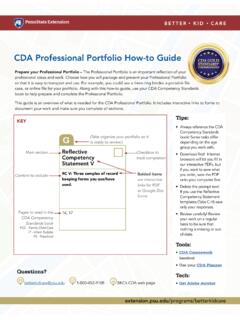
CDA Professional Portfolio How-to Guide
bkc-od-media.vmhost.psu.eduCDA Professional Portfolio How-to Guide Prepare your Professional Portfolio – The Professional Portfolio is an important reflection of your professional ideas and work. Choose how you will package and present your Professional Portfolio
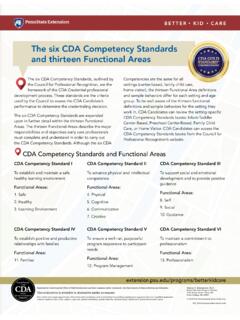
The six CDA Competency Standards P R OF E SI NAL and ...
bkc-od-media.vmhost.psu.eduAreas. The thirteen Functional Areas describe the major responsibilities and objectives early care professionals must complete and understand in order to carry out the CDA Competency Standards. Although the six CDA Competencies are the same for all settings (center-based, family child care, home visitor), the thirteen Functional Area definitions
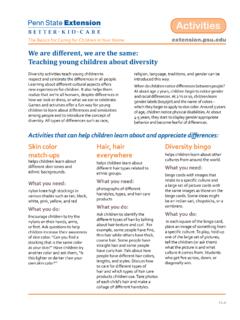
We are different, we are the same: Teaching young children ...
bkc-od-media.vmhost.psu.eduWe are different, we are the same: Teaching young children about diversity Diversity activities teach young children to respect and celebrate the differences in all people. Learning about different cultural aspects offers new experiences for children. It also helps them realize that we’re all humans, despite differences in

Developmental Milestones for School Age Children
bkc-od-media.vmhost.psu.edu• Wants to please friends • Likes pretend play with other children • Shows concern for others • Is aware of gender • Makes up games with simple rules • Has an understanding of right and wrong • Shows more independence • Uses a fork, spoon, and sometimes knife to eat • Skips and runs on tiptoe • Uses toilet on her own
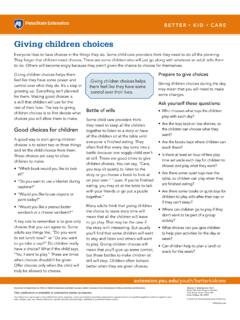
Giving children choices - Pennsylvania State University
bkc-od-media.vmhost.psu.edu• “Would you like to use crayons or paint today?” • “Would you like a peanut butter sandwich or a cheese sandwich?” A key rule to remember is to give only choices that you can agree to. Some adults say things like, “Do you want to eat lunch now?” or “Do you want to go take a nap?” Do children really have a choice?

CDA INFANT/TODDLER SAMPLE CURRICULUM
bkc-od-media.vmhost.psu.eduThe CDA Infant/Toddler Sample Curriculum provides a suggested list of specific lessons to take in ... activities and opportunities that encourage curiosity, explortation, and problem-solving appropriate to the developmental levels and learning styles of children.
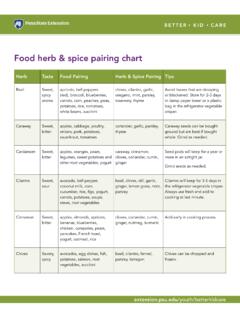
Food herb & spice pairing chart
bkc-od-media.vmhost.psu.edumost herbs and spices Choose unblemished, firm heads without signs of mold or sprouting. Ginger Sour apples, chicken, fish, passion fruit, pears, pineapple, mango basil, cilantro, coconut, garlic, lime, lemon grass, mint, scallions, turmeric Fresh ginger should be hard, plump and heavy. They keep well in the vegetable crisper of the
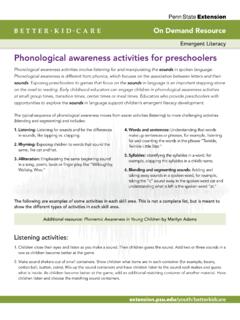
Phonological awareness activities for preschoolers
bkc-od-media.vmhost.psu.edu“The Itsy, Bitsy, Spider” and read rhyming books like Moose on the Loose or Fox in Socks. Emphasize the rhyming words. 2. Gather small props or pictures that represent rhyming objects (car- star, chair-bear, cat-hat, house-mouse, bell-shell). Hold up an object or picture. Pass around a rhyming box with three items or pictures in
Related documents
The Full-Day Early Learning – Kindergarten Program
edu.gov.on.caEarly child development sets the foundation for lifelong learning, behaviour, and health. 2. Partnerships with families and communities strengthen the ability of early childhood settings to meet the needs of young children. 3. Respect for diversity, equity, …
Common Core State StandardS
www.corestandards.orgMathematics experiences in early childhood settings should concentrate on (1) number (which includes whole number, operations, and relations) and (2) geometry, spatial relations, and measurement, with more mathematics learning time devoted to number than to other topics. Mathematical process goals should be integrated in these content areas.
THE IMPACT OF FAMILY INVOLVEMENT ON THE EDUCATION …
files.eric.ed.govhome visiting and (2) early childhood care and education. This commitment is underscored by President Obama’s Early Learning Initiative, with its focus on a continuum of high-quality early learning for every child in America from birth to age5 and its aim of “leveling the playing field” for children from lower-income families.
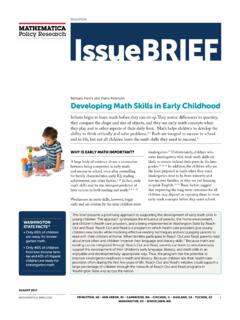
Developing Math Skills in Early Childhood - ed
files.eric.ed.govWHY IS EARLY MATH IMPORTANT? A large body of evidence shows a connection between being competent in early math and success in school, even after controlling for family characteristics, early IQ, reading achievement, and other factors.5-10 In fact, early math skills may be the strongest predictor of later success in both reading and math.6, 9, 11-12

THE ECONOMICS OF EARLY CHILDHOOD INVESTMENTS
obamawhitehouse.archives.govEarly childhood interventions can reduce the need for remedial education. Research shows that benefits in children’s development may also reduce the need for special education placements and remedial education, thereby lowering public school expenditures. The estimated benefits to society from investing in early childhood education are large ...
The New York State Prekindergarten Learning Standards
www.earlychildhoodny.orgThis resource was developed by the New York State Education Department’s ofces of Early Learning and Curriculum and Instruction. It is intended to be used as a reference tool by teachers, specialists, and administrators responsible for designing programs for four-year-old prekindergarten students.
The Early History of Pi - Texas A&M University
www.math.tamu.eduThe Early History of Pi Egypt In 1856 a Scotsman by the name of Henry Rhind purchased a papyrus in Egypt. A copy dating to 1,650 B.C., it consisted of a collection of mathematics problems prepared for a typical mathematics student of the day. Problems of algebra, linear systems, mensuration, and mathematical amuse-ments were assembled.
Tennessee Early Learning Developmental Standards
www.tn.govEarly experiences have both cumulative and delayed effects on each individual child’s development; optimal periods exist for certain types of development and learning. Four-year-old children are active, eager learners. A primary approach to learning is through purposeful, inquiry-based play. Optimal