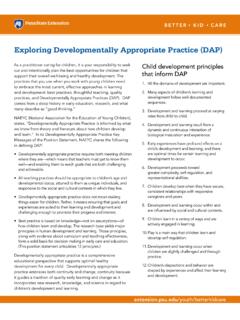
Exploring Developmentally Appropriate Practice (DAP)
3. Development and learning proceed at varying rates from child to child. 4. Development and learning result from a dynamic and continuous interaction of biological maturation and experience. 5. Early experiences have profound effects on a child’s development and learning, and there development to occur. 6. Development proceeds toward
Download Exploring Developmentally Appropriate Practice (DAP)

Information
Domain:
Source:
Link to this page:
Documents from same domain
Helping your children learn self-control
bkc-od-media.vmhost.psu.eduHelping your children learn self-control ... As the child grows the problems can grow as well and the ... The work of helping your child build self-control ...
Art – an opportunity to develop children’s skills
bkc-od-media.vmhost.psu.eduArt – an opportunity to develop children’s skills As young children explore paint by putting it all over their hands, or create collages with torn
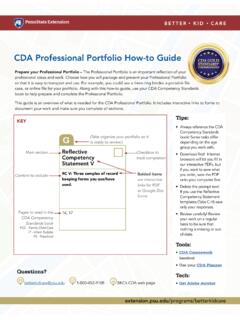
CDA Professional Portfolio How-to Guide
bkc-od-media.vmhost.psu.eduCDA Professional Portfolio How-to Guide Prepare your Professional Portfolio – The Professional Portfolio is an important reflection of your professional ideas and work. Choose how you will package and present your Professional Portfolio
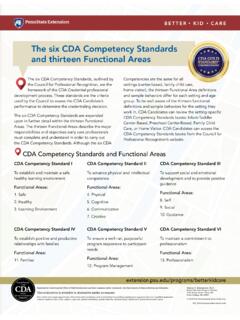
The six CDA Competency Standards P R OF E SI NAL and ...
bkc-od-media.vmhost.psu.eduAreas. The thirteen Functional Areas describe the major responsibilities and objectives early care professionals must complete and understand in order to carry out the CDA Competency Standards. Although the six CDA Competencies are the same for all settings (center-based, family child care, home visitor), the thirteen Functional Area definitions
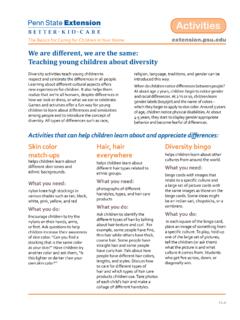
We are different, we are the same: Teaching young children ...
bkc-od-media.vmhost.psu.eduWe are different, we are the same: Teaching young children about diversity Diversity activities teach young children to respect and celebrate the differences in all people. Learning about different cultural aspects offers new experiences for children. It also helps them realize that we’re all humans, despite differences in

Developmental Milestones for School Age Children
bkc-od-media.vmhost.psu.edu• Wants to please friends • Likes pretend play with other children • Shows concern for others • Is aware of gender • Makes up games with simple rules • Has an understanding of right and wrong • Shows more independence • Uses a fork, spoon, and sometimes knife to eat • Skips and runs on tiptoe • Uses toilet on her own
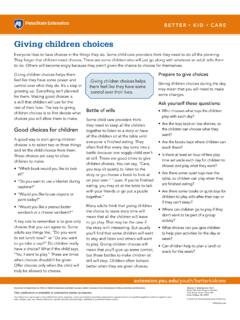
Giving children choices - Pennsylvania State University
bkc-od-media.vmhost.psu.edu• “Would you like to use crayons or paint today?” • “Would you like a peanut butter sandwich or a cheese sandwich?” A key rule to remember is to give only choices that you can agree to. Some adults say things like, “Do you want to eat lunch now?” or “Do you want to go take a nap?” Do children really have a choice?

CDA INFANT/TODDLER SAMPLE CURRICULUM
bkc-od-media.vmhost.psu.eduThe CDA Infant/Toddler Sample Curriculum provides a suggested list of specific lessons to take in ... activities and opportunities that encourage curiosity, explortation, and problem-solving appropriate to the developmental levels and learning styles of children.
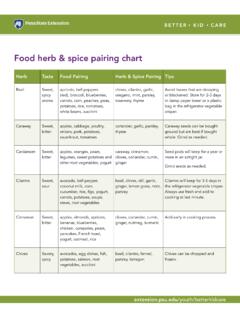
Food herb & spice pairing chart
bkc-od-media.vmhost.psu.edumost herbs and spices Choose unblemished, firm heads without signs of mold or sprouting. Ginger Sour apples, chicken, fish, passion fruit, pears, pineapple, mango basil, cilantro, coconut, garlic, lime, lemon grass, mint, scallions, turmeric Fresh ginger should be hard, plump and heavy. They keep well in the vegetable crisper of the
Phonological awareness activities for preschoolers
bkc-od-media.vmhost.psu.edu“The Itsy, Bitsy, Spider” and read rhyming books like Moose on the Loose or Fox in Socks. Emphasize the rhyming words. 2. Gather small props or pictures that represent rhyming objects (car- star, chair-bear, cat-hat, house-mouse, bell-shell). Hold up an object or picture. Pass around a rhyming box with three items or pictures in
Related documents
Geometry Chapter 2 - Math Problem Solving - Home
jaeproblemsolving.weebly.com©Glencoe/McGraw-Hill iv Glencoe Geometry Teacher’s Guide to Using the Chapter 2 Resource Masters The Fast FileChapter Resource system allows you to conveniently file the resources you use most often. The Chapter 2 Resource Mastersincludes the core materials needed for Chapter 2. These materials include worksheets, extensions, and assessment options.
THE RISING SEA Foundations of Algebraic Geometry
math.stanford.edu3.5. A base of the Zariski topology on SpecA: Distinguished open sets 118 3.6. Topological (and Noetherian) properties 119 3.7. The function I( ), taking subsets of SpecAto ideals of A 127 Chapter 4. The structure sheaf, and the definition of schemes in general 129 4.1. The structure sheaf of an affine scheme 129 4.2. Visualizing schemes II ...
Chapter 4 Triangle Congruence Terms ... - HONORS …
smacmathgeometry.weebly.comGeometry 73 Chapter 6 – Quadrilaterals Terms, Theorems & Postulates Section 6.2 Parallelogram: a quadrilateral with both pairs of opposite sides parallel. Theorem 6-1: Opposite sides of a parallelogram are congruent. Theorem 6-2: Opposite angles of a parallelogram are congruent. Theorem 6-3: Consecutive angles in a parallelogram are
Geometry Chapter 5 - Math Problem Solving
jaeproblemsolving.weebly.com©Glencoe/McGraw-Hill iv Glencoe Geometry Teacher’s Guide to Using the Chapter 5 Resource Masters The Fast FileChapter Resource system allows you to conveniently file the resources you use most often. The Chapter 5 Resource Mastersincludes the core materials needed for Chapter 5. These materials include worksheets, extensions, and assessment options.

Computational Geometry - ELTE
people.inf.elte.huChapter 2 introduces plane sweep algorithms, and it is best to read this chapter before any of the other chapters that use this technique. Similarly, Chapter 4 should be read before any other chapter that uses randomized algorithms. For a first course on computational geometry, we advise treating Chapters 1– 10 in the given order.
CHAPTER 3 SIGNING AND PAVEMENT MARKING DESIGN …
virginiadot.org8 [For example, a 25 Scale drawing should have a minimum text size of 3.125. (25/8 = 3.125)]. Title text should be approximately 3/16”. The MicroStation title text size for scales may be computed by multiplying the drawing scale by 3 and dividing by 16. A majority of text notes, legends, and call-outs are included in the VDOT Traffic

Chapter 7 Chemical Bonding and Molecular Geometry
web.ung.eduChapter 7 Chemical Bonding and Molecular Geometry Figure 7.1 Nicknamed “buckyballs,” buckminsterfullerene molecules (C60) contain only carbon atoms.Here they are shown in a ball-and-stick model (left). These molecules have single and double carbon-carbon bonds arranged to
GEOMETRY CHAPTER 2 Reasoning and Proof
www.sd308.orgGEOMETRY . CHAPTER 2 . Reasoning and Proof . 1 . Geometry . Section 2.5 Notes: Postulates and Paragraph Proofs . Example 1: Explain how the picture illustrates that the statement is true. Then state the postulate that can be used to show the statement is true. a) Points F and G lie in plane Q and on line m.