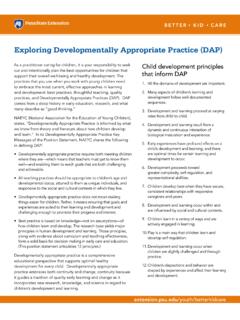
Exploring Developmentally Appropriate Practice (DAP)
principles in human development and learning. Those principles, along with evidence about curriculum and teaching effectiveness, form a solid basis for decision making in early care and education. (This position statement articulates 12 principles.) Developmentally appropriate practice is a comprehensive
Download Exploring Developmentally Appropriate Practice (DAP)

Information
Domain:
Source:
Link to this page:
Documents from same domain
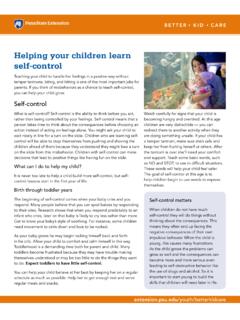
Helping your children learn self-control
bkc-od-media.vmhost.psu.eduHelping your children learn self-control ... As the child grows the problems can grow as well and the ... The work of helping your child build self-control ...
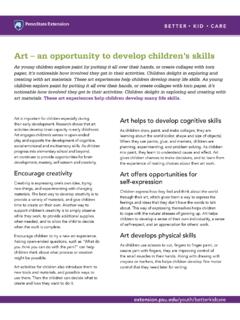
Art – an opportunity to develop children’s skills
bkc-od-media.vmhost.psu.eduArt – an opportunity to develop children’s skills As young children explore paint by putting it all over their hands, or create collages with torn
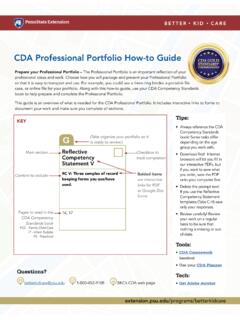
CDA Professional Portfolio How-to Guide
bkc-od-media.vmhost.psu.eduCDA Professional Portfolio How-to Guide Prepare your Professional Portfolio – The Professional Portfolio is an important reflection of your professional ideas and work. Choose how you will package and present your Professional Portfolio
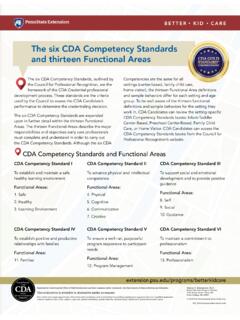
The six CDA Competency Standards P R OF E SI NAL and ...
bkc-od-media.vmhost.psu.eduAreas. The thirteen Functional Areas describe the major responsibilities and objectives early care professionals must complete and understand in order to carry out the CDA Competency Standards. Although the six CDA Competencies are the same for all settings (center-based, family child care, home visitor), the thirteen Functional Area definitions
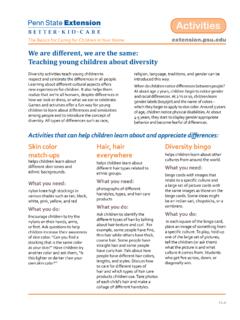
We are different, we are the same: Teaching young children ...
bkc-od-media.vmhost.psu.eduWe are different, we are the same: Teaching young children about diversity Diversity activities teach young children to respect and celebrate the differences in all people. Learning about different cultural aspects offers new experiences for children. It also helps them realize that we’re all humans, despite differences in

Developmental Milestones for School Age Children
bkc-od-media.vmhost.psu.edu• Wants to please friends • Likes pretend play with other children • Shows concern for others • Is aware of gender • Makes up games with simple rules • Has an understanding of right and wrong • Shows more independence • Uses a fork, spoon, and sometimes knife to eat • Skips and runs on tiptoe • Uses toilet on her own
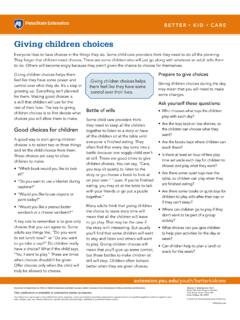
Giving children choices - Pennsylvania State University
bkc-od-media.vmhost.psu.edu• “Would you like to use crayons or paint today?” • “Would you like a peanut butter sandwich or a cheese sandwich?” A key rule to remember is to give only choices that you can agree to. Some adults say things like, “Do you want to eat lunch now?” or “Do you want to go take a nap?” Do children really have a choice?

CDA INFANT/TODDLER SAMPLE CURRICULUM
bkc-od-media.vmhost.psu.eduThe CDA Infant/Toddler Sample Curriculum provides a suggested list of specific lessons to take in ... activities and opportunities that encourage curiosity, explortation, and problem-solving appropriate to the developmental levels and learning styles of children.
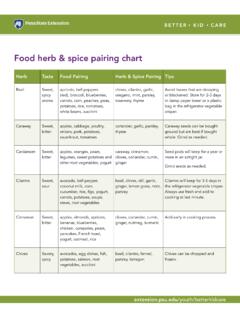
Food herb & spice pairing chart
bkc-od-media.vmhost.psu.edumost herbs and spices Choose unblemished, firm heads without signs of mold or sprouting. Ginger Sour apples, chicken, fish, passion fruit, pears, pineapple, mango basil, cilantro, coconut, garlic, lime, lemon grass, mint, scallions, turmeric Fresh ginger should be hard, plump and heavy. They keep well in the vegetable crisper of the
Phonological awareness activities for preschoolers
bkc-od-media.vmhost.psu.edu“The Itsy, Bitsy, Spider” and read rhyming books like Moose on the Loose or Fox in Socks. Emphasize the rhyming words. 2. Gather small props or pictures that represent rhyming objects (car- star, chair-bear, cat-hat, house-mouse, bell-shell). Hold up an object or picture. Pass around a rhyming box with three items or pictures in
Related documents

Guide for Developing Purpose, Guiding Principles, and ...
www.cms.govand practice. ••Guiding Principle #9: Our organization has a culture that encourages, rather than punishes, employees who identify errors or system breakdowns. Add any additional Guiding Principles that may be important to your nursing home. Review the five QAPI elements to ensure you identify and capture guiding principles for your ...

PRINCIPLES OF MANAGEMENT CHAPTER - NCERT
ncert.nic.inCorporation are driven by principles that serve as broad guidelines for stating the vision as well as the ways to achieve it. Similarly, many other business enterprises have followed various principles in their working Guiding Principles of Toyota Motor Corporation Ch_02.indd 30 24-09-2019 12:05:00 PM ±

Better Criteria for Better Evaluation - OECD
www.oecd.orgdevelopment and humanitarian projects, programmes and policies. Beyond development co -operation, evaluators and commissioners also use the criteria in other areas of public policy. 2. Building from learning gathered over 25 years of applying the criteria, the global evaluation community began discussing revisiting the criteria following the 2015
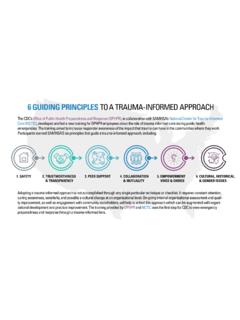
6 GUIDING PRINCIPLES TO A TRAUMA-INFORMED APPROACH
www.cdc.gov6 GUIDING PRINCIPLES TO A TRAUMA-INFORMED APPROACH ... as well as engagement with community stakeholders, will help to imbed this approach which can be augmented with organi- ... zational development and practice improvement. The training provided by OPHPR and NCTIC was the first step for CDC to view emergency preparedness and response through ...
RECOVERY RECOVERY: 10 GUIDING PRINCIPLES OF …
www.dshs.wa.govGUIDING PRINCIPLES OF RECOVERY BACKGROUND Recovery has been identified as a primary goal for behavioral health care. In August 2010, leaders in the behavioral health field, consisting of people in recovery from mental health and substance use problems and SAMHSA, met to explore the development of a common, unified working definition of recovery.
SAMHSA's Concept of Trauma and Guidance for a Trauma ...
store.samhsa.gov• What are the key principles of a trauma-informed approach? • What is the suggested guidance for . implementing a trauma-informed . approach? • How do we understand trauma in the context of community? SAMHSA’s approach to this task has been an attempt to integrate knowledge developed through research

9 Principles, Skills and Models of Group Work Practice
ignou.ac.inprinciples of working with people in groups to help them grow and change have emerged from the practice of social group work. The objectives of social group work can be fulfilled only within the frame work of principles. Therefore, it seems necessary to deal with basic principles, which are guiding force for group work practice.

Assessment for Learning:10 principles - HKEAA
www.hkeaa.edu.hkeducation community through the commissioned Black and Wiliam work, Inside the Black Box, and the follow-up, Assessment for Learning: beyond the black box. In continuing its endeavour to improve practice in assessment it has developed the Principles of assessment for learning. The ARG members who produced these principles are