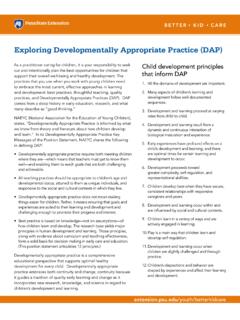
Exploring Developmentally Appropriate Practice (DAP)
4. Development and learning result from a dynamic and continuous interaction of biological maturation and experience. 5. Early experiences have profound effects on a child’s development and learning, and there development to occur. 6. Development proceeds toward greater complexity, self-regulation, and representational abilities. 7.
Download Exploring Developmentally Appropriate Practice (DAP)

Information
Domain:
Source:
Link to this page:
Documents from same domain
Helping your children learn self-control
bkc-od-media.vmhost.psu.eduHelping your children learn self-control ... As the child grows the problems can grow as well and the ... The work of helping your child build self-control ...
Art – an opportunity to develop children’s skills
bkc-od-media.vmhost.psu.eduArt – an opportunity to develop children’s skills As young children explore paint by putting it all over their hands, or create collages with torn
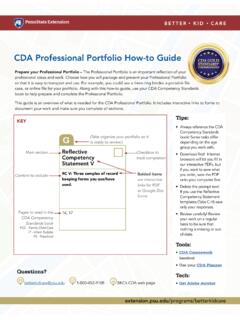
CDA Professional Portfolio How-to Guide
bkc-od-media.vmhost.psu.eduCDA Professional Portfolio How-to Guide Prepare your Professional Portfolio – The Professional Portfolio is an important reflection of your professional ideas and work. Choose how you will package and present your Professional Portfolio
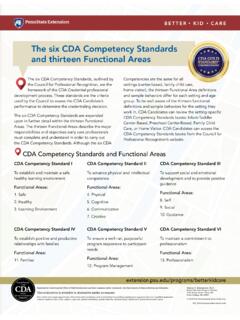
The six CDA Competency Standards P R OF E SI NAL and ...
bkc-od-media.vmhost.psu.eduAreas. The thirteen Functional Areas describe the major responsibilities and objectives early care professionals must complete and understand in order to carry out the CDA Competency Standards. Although the six CDA Competencies are the same for all settings (center-based, family child care, home visitor), the thirteen Functional Area definitions
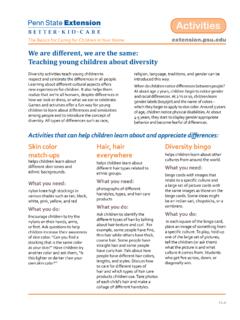
We are different, we are the same: Teaching young children ...
bkc-od-media.vmhost.psu.eduWe are different, we are the same: Teaching young children about diversity Diversity activities teach young children to respect and celebrate the differences in all people. Learning about different cultural aspects offers new experiences for children. It also helps them realize that we’re all humans, despite differences in

Developmental Milestones for School Age Children
bkc-od-media.vmhost.psu.edu• Wants to please friends • Likes pretend play with other children • Shows concern for others • Is aware of gender • Makes up games with simple rules • Has an understanding of right and wrong • Shows more independence • Uses a fork, spoon, and sometimes knife to eat • Skips and runs on tiptoe • Uses toilet on her own
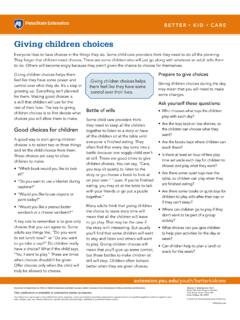
Giving children choices - Pennsylvania State University
bkc-od-media.vmhost.psu.edu• “Would you like to use crayons or paint today?” • “Would you like a peanut butter sandwich or a cheese sandwich?” A key rule to remember is to give only choices that you can agree to. Some adults say things like, “Do you want to eat lunch now?” or “Do you want to go take a nap?” Do children really have a choice?

CDA INFANT/TODDLER SAMPLE CURRICULUM
bkc-od-media.vmhost.psu.eduThe CDA Infant/Toddler Sample Curriculum provides a suggested list of specific lessons to take in ... activities and opportunities that encourage curiosity, explortation, and problem-solving appropriate to the developmental levels and learning styles of children.
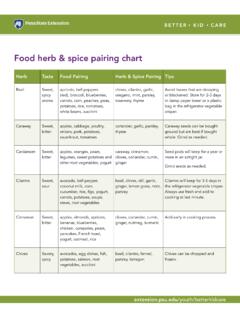
Food herb & spice pairing chart
bkc-od-media.vmhost.psu.edumost herbs and spices Choose unblemished, firm heads without signs of mold or sprouting. Ginger Sour apples, chicken, fish, passion fruit, pears, pineapple, mango basil, cilantro, coconut, garlic, lime, lemon grass, mint, scallions, turmeric Fresh ginger should be hard, plump and heavy. They keep well in the vegetable crisper of the
Phonological awareness activities for preschoolers
bkc-od-media.vmhost.psu.edu“The Itsy, Bitsy, Spider” and read rhyming books like Moose on the Loose or Fox in Socks. Emphasize the rhyming words. 2. Gather small props or pictures that represent rhyming objects (car- star, chair-bear, cat-hat, house-mouse, bell-shell). Hold up an object or picture. Pass around a rhyming box with three items or pictures in
Related documents
Communication Chapter 1 - cu
www.pathways.cu.edu.eg1.5.1 Functions of Communication Models 1. To clarify the scope of human interaction showing it to be a circular, complex, continuous dynamic, or a coding process. 2. To point out where to book and under what conditions to analyze different responses. 3. To show the variables in human communication. 4. Used as a frame work in researches. 1.5.2 ...

CHAPTER 4: Economic Profile and Development - Quezon …
quezoncity.gov.phworking less than the regular 8-hours per day and still looking for additional work) of 7.2% or (Table ED-1) 2. The economically inactive population or those not in the labor force. The economically inactive or those not in the labor force on the other hand, makes up students, housewives, retirees, the sick, PWDs , etc.
Principles of Community Engagement (Second Edition) …
www.atsdr.cdc.govFigure 1.1. Community Engagement Continuum Increasing Level of Community Involvement, Impact, Trust, and Communication Flow Some Community Involvement Communication flows from one to the other, to inform Provides community with information. Entities coexist. Outcomes: Optimally, establishes communica-tion channels and chan-nels for outreach ...

Infantry (CMF 11) Career Progression Plan Chapter 1. Duties
www.benning.army.mil(2) TC 7–22.7 contains suggested reading for SGTs. Many units as well as the SMA have suggested reading lists for Soldiers seeking self -development. (3) NCO boards such as “NCO of the Quarter,” “Soldier of the Year,” and organizations such as the SGT Audie Murphy and SGT Morales Clubs broaden the knowledge base, instill discipline,

Chapter 12: Network Management - Michigan State University
www.egr.msu.eduFigure 12.1: Typical Network Management Architecture [1] simple but less sophisticated SNMP; however, it has not been widely adopted. For this reason, we will focus on SNMP in this chapter. 1.1 OSI Network Management Model The OSI network management comprises four major models [2]: Organization Model de nes the manager, agent, and managed object.

EP 310-1-6 Graphic Standards Manual - United States Army
www.publications.usace.army.milThis Change 1 to EP 310-1-6, September 1994 changes the point of contact for the U.S. Army Corps of Engineers Sign Standards to the district, division sign program manager or the National Sign Program Manager located at the Sign MCX in the St. Paul District.
CHAPTER Defining Culture 1 and Identities
www.sagepub.comCHAPTER. 1. FOCUS QUESTIONS • In general, how does culture provide . ... Centuries of geographical separation were concurrent with the development of diverse . ... 8 PART 1 CULTURE AS CONTEXT FOR COMMUNICATION As Collier and Thomas suggest each …

N.J.A.C. 6A:16, Programs to Support Student Development
www.state.nj.usThroughout the chapter, “district board of education” refers to the governing authority for all of the agencies identified in this section, unless otherwise indicated. “District board of education” at N.J.A.C. 6A:16-7.7 shall not refer to APSSDs, which shall be governed by N.J.A.C. 6A:16-7.8.