FARMING SYSTEMS APPROACH Introduction
started developing the various farming systems models in accordance with the agro-eco systems zones. Since 1978, both scientists, extensionists, anthropologists, social workers, administrators have been publishing many articles on FSRE in different journals. Simmonds in 1984 clarifies the Farming System Approach as follows: It is an academic
Download FARMING SYSTEMS APPROACH Introduction

Information
Domain:
Source:
Link to this page:
Documents from same domain
STRATEGIC PLANNING FOR AGRICULTURAL …
www.manage.gov.inSTRATEGIC PLANNING FOR AGRICULTURAL DEVELOPMENT Dr. M.A.Kaereem Introduction During the last decade a number of management tools have been developed which are helpful
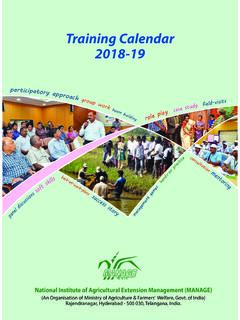
Training Calendar 2018-19 - manage.gov.in
www.manage.gov.in1. Training Calendar 2018-19. pa. rtici p a t o r y a p p r o a c h g r o u p w o r k s t e a m b u i l d i n g r o l e p l a y c a e s t u d y f i e l d - v i s i t s. National Institute of …

1. Introduction to Project Management
www.manage.gov.inIntroduction to Project Management Introduction Realization of these objectives requires systematic planning and careful implementation. To this effect, application of knowledge, skill, tools and techniques in the project environment, ... watershed project. At the beginning detailed sectoral planning and coordination among various
Geographical Information Systems (GIS)
www.manage.gov.inMethods A successful GIS operates according to a well-designed plan and business rules, which are the models and operating practices unique to each organization. Functions of GIS General-purpose GIS software performs six major tasks such as input, manipulation, management, query and analysis, Visualization. ...
STRATEGIC PLANNING FOR AGRICULTURAL …
www.manage.gov.inThe ultimate objective of both research and extension system is to increase agricultural production. Formulating extension and research agenda based on producers’ requirement results in technology that will be more acceptable to users. This also helps in allocation of
Farmer’s Handbook on Basic Agriculture
www.manage.gov.inAgriculture contributes around 17% to GDP and continues to be among the most important and success-ful sectors in India. Around 58% of the Indian population depend on agriculture for their livelihood. Apart from delivering the local industries with top quality raw materials for processing, agriculture provides almost 10% of total export earnings.
Basics of Project Management 1.1 Introduction
www.manage.gov.inIndian Railways changing the meter gauge railway track to broad gauge An FMCG company introducing its products into a new virgin market A company hiring fresh graduates ... extent with innovations taking place at a very rapid rate. Projects are needed for the upgradation of products. Globalization impact: ...

Effective Communication - Reading Material
www.manage.gov.inCommunication importance, process and elements Communication is one of the most basic functions of management, the manager can make a good decision, think out well conceived plans, establish a ... behaviour of employees within organizations. Agricultural communication is defined as a planned transfer of farm technologies

Farmer Producer Companies – Issues and Challenges
www.manage.gov.inowned producer organizations, or FPCs, is to enhance production, productivity and profitability of agriculturists, especially small farmers in the country. This issue of the Extension Digest focuses on the following aspects: 1. Rationale for Farmer Producer Organizations/Companies 2. Concept and Genesis of FPOs/FPCs 3.
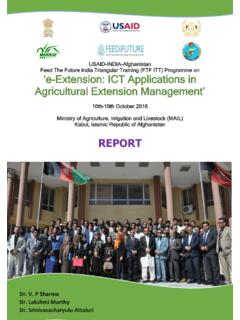
‘e-Extension: ICT Applications in Agricultural Extension ...
www.manage.gov.inImplementation of the Policy calls for comprehensive interventions including the strengthening of the Research-Extension-Education continuum from the laboratory to the field. ... basis and can build application that bank up on these infrastructures for capacity ... Modernized agricultural research-extension-education approaches.
Related documents

STATE OF AGRICULTURE IN MADHYA PRADESH
jnkvv.orgIndia, comprising 11 Agro – Climatic zones with diverse soil and climatic condition, which helps to support to cultivation of a wide range of crops with diversified cropping pattern. Madhya Pradesh stands in the top most position for producing pulses, oilseeds, garlic and coriander with highest cattle population in India.
Principles of Agronomy & Agricultural Meteorology
agrimoon.comAgro -climatic zones of India 90-93 18. Agro meteorology 94-103 19. Weather and climate, micro -climate 104-110 20. Weather elements and their influence on different crops 111-141 21. Monsoon 142-152 22. Clouds 153-175 23. Weather aberrations 176 …

Sugarcane in India Books
iisr.icar.gov.inalso due to similar agro-climatic zone condition. Thus, need was felt to compile the advanced technologies developed by various AICRP(S) centres for effective transmission at national level. Thus, present technical bulletin on Sugarcane in India: Package of Practices for Different Agro-climatic Zones has been developed

New Varieties of Vegetable Crops - SeedNet India Portal
seednet.gov.inGrowth of vegetable sector in India. A total of 526 vegetable varieties in 28 vegetable crops have been recommended for cultivation in various agro climatic zones of the country. This includes 309 O.P. varieties, 163 hybrids and 54 O.P./ hybrids resistant to …

BIHAR’S AGRICULTURE DEVELOPMENT: OPPORTUNITIES & …
www.niti.gov.intemperature and terrain, three main agro-climatic zones in Bihar have been identified. These are: Zone – I (North West Alluvial Plain), Zone – II (North East Alluvial Plain), and Zone-III (South Bihar Alluvial Plain), each with its own potential and prospects. All these zones have Chaur,