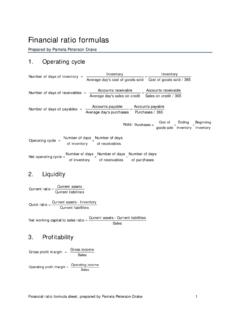
Financial Ratio Formulas
Price-earnings ratio = Earnings per share 7. Return ratios Operating income Basic earning power ratio = Operating return on assets = Total assets Net income Return on assets = Total assets Net income Return on equity = Shareholders' equity Financial ratio formula sheet, prepared by Pamela Peterson-Drake 3
Download Financial Ratio Formulas

Information
Domain:
Source:
Link to this page:
Documents from same domain
Financial Ratio Analysis - educ.jmu.edu
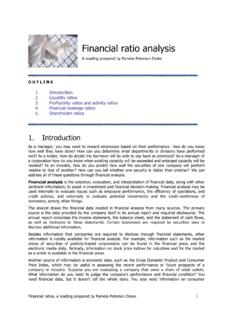
educ.jmu.eduFinancial ratio analysis A reading prepared by Pamela Peterson Drake O U T L I N E 1. Introduction 2. Liquidity ratios 3. Profitability ratios and activity ratios
Advantage and disadvantages of the different …
educ.jmu.eduProfitability Index Advantages Disadvantages 1. Tells whether an investment increases the firm's value 2. Considers all cash flows of the project
Solutions to Time Value of Money Practice Problems
educ.jmu.eduSolutions to Time value of money practice problems Prepared by Pamela Peterson Drake 1. What is the balance in an account at the end of 10 years if …
Financial ratio analysis - educ.jmu.edu
educ.jmu.eduBesides financial statement data, market data, and economic data, in financial analysis you also need
Solving simultaneous equations using matrix …
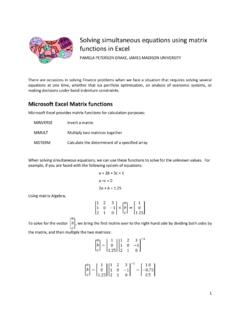
educ.jmu.edu3 Step 3: Multiply matrices You multiply matrices using the MMULTI function, selecting the cells that you want the results (in this example, cells B12, B13 and B14:
Residual income - educ.jmu.edu
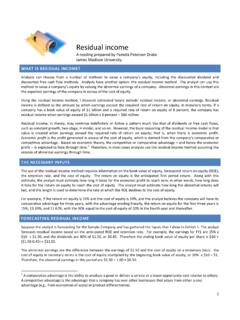
educ.jmu.edu1 Residual income A reading prepared by Pamela Peterson Drake James Madison University WHAT IS RESIDUAL INCOME? Analysts can choose from a number of methods to value a company’s equity, including the discounted dividend and
Corporate Strategy - educ.jmu.edu
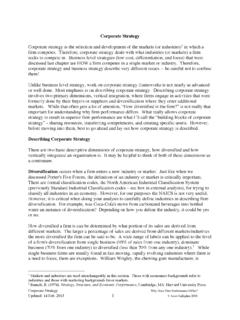
educ.jmu.eduCorporate strategy is the selection and development of the markets (or industries)1 in which a firm competes. Therefore, corporate strategy deals with what industries (or markets) a firm seeks to compete in. Business level strategies (low cost, differentiation, and focus) that were
quiver - educ.jmu.edu
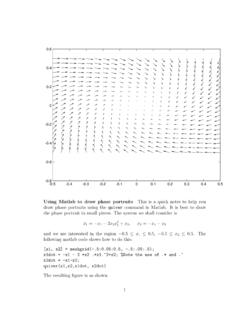
educ.jmu.eduUsing Matlab to draw phase portraits This is a quick notes to help you draw phase portraits using the quiver command in Matlab. It is best to draw the phase portrait in …
What is free cash flow and how do I calculate it?
educ.jmu.eduA key cash flow in both analysis and valuation is the cash flow for/from operating activities. This cash flow is calculated by adjusting net income for non-cash expenses and income, as well as for changes in working capital accounts. This
Business Unit Strategies - educ.jmu.edu
educ.jmu.eduBusiness Level Strategies Why Does Firm Performance Differ? Updated: 17 Sept 2008 2 ©Scott Gallagher 2004 very well. As a result, it usually loses out to successful differentiators and low cost firms.
Related documents
Estimating Beta - New York University
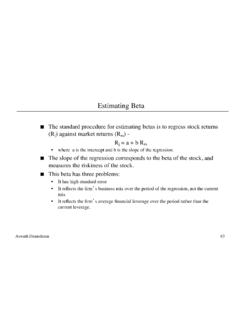
people.stern.nyu.eduequity ratio across the publicly traded firms in the sample. Unlevered beta for business = Average beta across publicly traded firms/ (1 + (1- t) (Average D/E ratio across firms)) If you can, adjust this beta for differences between your firm and the comparable firms on operating leverage and product characteristics.

Financial Ratios eBook - Corporate Finance Institute
corporatefinanceinstitute.comThe equity ratio is a leverage ratio that calculates the proportion of total shareholders’ equity versus total assets. The ratio determines the residual claim of shareholders on a business. It determines what portion of the business could be claimed by shareholder in a liquidation event.
Measuring Private Equity Performance
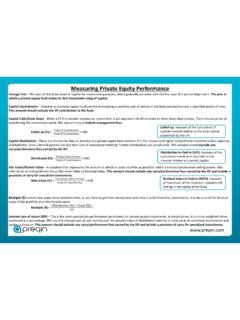
docs.preqin.comExplaining the Remaining Value to Paid-In (RVPI %) Ratio: Remaining Value to Paid-In (RVPI %): measure of how much of the investors’ capital is still tied up in the equity of the fund. Note: Portfolio valuations should be carried out in accordance with IFRS; GAAP; FAS 157 and/or International Private Equity and Venture Capital (IPEVC) guidelines.
Financial Ratio Formula Sheet - Fuqua School of Business
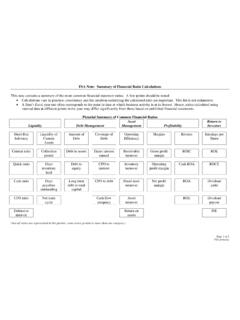
faculty.fuqua.duke.eduRatio of market price to earnings per share Benchmark: PG, HA Market to book ratio = Market value of equity Book value of equity Ratio of the market’s valuation of the enterprise to the book value of the enterprise on its financial statements. Benchmark: PG, HA Dividend Payout = Cash dividends paid on common equity Net income
The case for private equity at Vanguard
institutional.vanguard.comowned by private equity buyout funds only.2 Regulatory changes, easier access to private capital, and the shift in business operating models, from intensive tangible capital requirements to intangible capital, have all been identified as structural reasons contributing to the growing ratio of private to public companies. 1 Sources: Preqin, FactSet.
Ratio Studies - IAAO
www.iaao.orgExternal ratio studies conducted by oversight agencies (Part 2) focus more upon testing the assessor’s past per-formance in a few broad property categories. 2. Overview For local jurisdictions, ratio study is used as a generic [IAAO 2.3 Uses of …

KEY RATIO ANALYSIS: CALCULATING AND INTERPRETING …
www.icba.orgDebt Ratio = Debt/Net Worth (Equity) Adjustment: Subordinated Debt Task: Calculate the debt to worth ratio for Snider Corporation. Comment on the company’s leverage position. 14. 15 Creditor: To the creditor, leverage is important as this ratio highlights the reality of

Measuring Private Equity Fund Performance
www.insead.eduA private equity fund’s multiple of money invested (MoM) is represented by its total value to paid-in ratio (TVPI).3 The TVPI consists of a fund’s residual value to paid-in ratio (RVPI) and its distributed to paid-in ratio (DPI). That is, TVPI = RVPI + DPI.