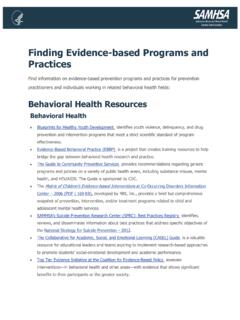
Finding Evidence-based Programs and Practices
Jul 19, 2019 · • Blueprints for Healthy Youth Development identifies youth violence, delinquency, and drug prevention and intervention programs that meet a strict scientific standard of program effectiveness. • Evidence-Based Behavioral Practice (EBBP) is a project that creates training resources to help
Download Finding Evidence-based Programs and Practices

Information
Domain:
Source:
Link to this page:
Documents from same domain
State Mental Health Authorities Directory
www.samhsa.govIowa Department of Human Services, Division of Mental Health and Disability Services . 1305 E. Walnut Des Moines, IA 50319 Phone:
SAMHSA Disaster Technical Assistance Center …
www.samhsa.govDisaster Behavioral Health Interventions Inventory ... Cognitive Behavioral Therapy for Acute Stress Disorder ... (CBI) ...
National Mental Health Services Survey (N-MHSS): …
www.samhsa.govPublication No. (SMA) 17-5049. ... 2016 ... National Mental Health Services Survey (N-MHSS), 2016. MHSS. Data . treatment facilities.
Key Substance Use and Mental Health Indicators in …
www.samhsa.govHowever, this publication may not be reproduced or distributed for a fee without the specific, ... adolescents aged 12 to 17 was lower in 2016 than in most
Results from the 2013 National Survey on Drug Use …
www.samhsa.govResults from the 2013 National Survey on Drug Use and Health: Summary of National Findings U.S. DEPARTMENT OF HEALTH AND HUMAN SERVICES Substance Abuse and Mental Health Services Administration
FREQUENTLY ASKED QUESTIONS - SAMHSA
www.samhsa.govFrequently Asked Questions Applying the Substance Abuse Confidentiality Regulations to Health Information Exchange (HIE)1 Prepared by the Legal Action Center for the
Single State Agency (SSA) Directory - samhsa.gov
www.samhsa.govNEBRASKA . Sheri Dawson, R.N. Division of Behavioral Health . Nebraska Department of Health and Human Services . P.O. Box 95026 . Nebraska State Office Building
Single State Agency (SSA) Directory - SAMHSA
www.samhsa.govDirectory of Single State Agencies (SSA) for Substance Abuse Services Center for Substance Abuse Treatment Division of State and Community Assistance
National Prevention Week 2018 - samhsa.gov
www.samhsa.govNational Prevention Week 2018 WHAT IS NATIONAL PREVENTION WEEK? ... the prevention of substance use and promotion of mental health. The observance brings individuals, organizations, coalitions, states, and communities together through local events to raise awareness about the ... importance of preventing substance use and mental disorders. WHEN ...
Successful Strategies for Recruiting, Training, and ...
www.samhsa.govSuccessful Strategies for Recruiting, Training, and Utilizing Volunteers is a guidance handbook designed for community groups and faith-based organizations seeking to maximize the skills of their volunteers, expand their services to the community, and enhance their effectiveness.
Related documents
Prevention and Intervention Programs for Juvenile …
files.eric.ed.govdelinquency.3 Only during the past fifteen years have re-searchers begun clearly identifying both the risk factors that produce delinquency and the interventions that consistently reduce the likelihood that it will occur. Some of the identified risk factors for delinquency are genetic or biological and cannot easily be changed.
Preventing Problem Behaviors: Primary, Secondary, and ...
files.eric.ed.govPrevention Interventions for Young Children Tary J. Tobin and George Sugai Abstract The purpose of this report is to compare changes in social skills, problem behaviors, and academi c competence ... the identification of adolescents at risk delinquency (Loeber, Dishion, & Patterson, 1984).
Master List of Evidence-Based and Innovative Interventions ...
health.ri.govdelinquency, academic underachievement, and substance use; short -term goals include -child interactions, building positive relationships and attachment, improved parental functioning, less harsh and more nurturing parenting, and increased parental social support and problem solving.14 “Results indicated that intervention teachers used
Tips for Teachers
www.justice.govSep 19, 2011 · assessment and interventions that teachers cannot provide. If that is the case, teachers should refer children to other professionals within or outside the school system. Psychologists, social workers, or school counselors can help children and their families by looking at ways to keep current problems from getting worse.
Delinquency Prevention & Intervention
www.ncsl.orgresulting in delinquency proceedings. During this time, the strongest risk factor for delinquency is influence from a delinquent peer group. Risk/Needs Assessments Research shows the most effective interventions are those that target the right kids. Research by the Peabody Research Institute (2010) shows, in
Child Delinquency: Early Intervention and Prevention
www.ojp.govnature of child delinquency, its develop-mental course, key risk and protective factors, and effective interventions. Child delinquency is an enduring and troubling phenomenon that requires more research and the efforts of a broader community to be fully under-stood and addressed. The work summa-rized in this Bulletin helps to advance
Treatment, Services, and Intervention Programs for Child ...
www.ojp.govchild delinquency from escalating into chronic criminality, the most successful interventions to date have been isolat-ed and unintegrated with other ongoing interventions. In fact, only a few well-organized, integrated programs designed to reduce child delinquency exist in North America today. The Study Group on Very Young Offend-
WHAT DOESN’T WORK IN PREVENTING AND REDUCING …
www.sagepub.cominterventions have staying power despite their ineffectiveness. D.A.R.E. is not effective (Durlak, 1997; Rosenbaum & Hanson, 1998); it is perhaps the most widely acclaimed “successful” intervention of all ineffective delinquency prevention programs. Launched in 1983 by the Los Angeles Police Department and the Los Angeles Unified School