Finite Difference Method for Solving Differential Equations
08.07.1 . Chapter 08.07 Finite Difference Method for Ordinary Differential Equations . After reading this chapter, you should be able to . 1. Understand what the finite difference method is and how to use it to solve problems.
Download Finite Difference Method for Solving Differential Equations

Information
Domain:
Source:
Link to this page:
Documents from same domain

Chapter 01.03 Sources of Error - MATH FOR COLLEGE
mathforcollege.com01.03.1 Chapter 01.03 Sources of Error After reading this chapter, you should be able to: 1. know that there are two inherent sources of error in numerical methods – round-

Runge-Kutta 4th Order Method for Ordinary …
mathforcollege.com08.04.1 Chapter 08.04 Runge-Kutta 4th Order Method for Ordinary Differential Equations . After reading this chapter, you should be able to . 1. develop Runge-Kutta 4th order method for solving ordinary differential equations,

Simpson 3/8 Rule for Integration - MATH FOR …
mathforcollege.comIn a similar fashion, Simpson rule for integration can be derived by 3/8 approximating the given function

Chapter 04.08 Gauss-Seidel Method
mathforcollege.comusing the Gauss-Seidel method. Assume an initial guess of the solution as = 5 2 1
Chapter 05.03 Newton’s Divided Difference Interpolation
mathforcollege.comNewton’s Divided Difference Interpolation 05.03.3 Figure 2 Linear interpolation. Example 1 The upward velocity of a rocket is given as a function of time in Table 1 (Figure 3).

False-Position Method of Solving a Nonlinear Equation
mathforcollege.com03.06.1 . Chapter 03.06 False-Position Method of Solving a Nonlinear Equation . After reading this chapter, you should be able to . 1. follow the algorithm of the false-position method of solving a nonlinear equation,
Bisection Method of Solving Nonlinear Equations: General ...
mathforcollege.comOne of the first numerical methods developed to find the root of a nonlinear equation . f (x) =0 was the bisection method (also called binary-search method). The method is based on the following theorem. Theorem. An equation. f (x) =0, where f (x) is a real continuous function, has at least one root between . x and . x. u. if f (x ) f (x. u ...
Runge-Kutta 4th Order Method for Ordinary Differential ...
mathforcollege.comOct 13, 2010 · 08.04.1 Chapter 08.04 Runge-Kutta 4th Order Method for Ordinary Differential Equations . After reading this chapter, you should be able to . 1. develop Runge-Kutta 4th order method for solving ordinary differential equations, 2. find the effect size of step size has on the solution, 3. know the formulas for other versions of the Runge-Kutta 4th order method
Chapter 10.02 Parabolic Partial Differential Equations
mathforcollege.comParabolic Partial Differential Equations . After reading this chapter, you should be able to: 1. Use numerical methods to solve parabolic partial differential eqplicit, uations by ex implicit, and Crank-Nicolson methods. The general second order linear PDE with two independent variables and one dependent variable is given by . 0. 2 2 2 2 2 ...

Chapter 03.04 Newton-Raphson Method of Solving a …
mathforcollege.com03.04.1 Chapter 03.04 Newton-Raphson Method of Solving a Nonlinear Equation After reading this chapter, you should be able to: 1. derive the Newton-Raphson method formula, 2. develop the algorithm of the Newton-Raphson method, 3. use the Newton-Raphson method to solve a nonlinear equation, and 4. discuss the drawbacks of the Newton-Raphson method. ...
Related documents

Endogenous Ranking and Equilibrium Lorenz Curve-Jan 2013
faculty.wcas.northwestern.eduEndogenous Ranking and Equilibrium Lorenz Curve Across (ex-ante) Identical Countries By Kiminori Matsuyama1 January 2013 Abstract: This paper proposes a symmetry-breaking model of trade with a (large but) finite number of (ex-ante) identical countries and a continuum of tradeable
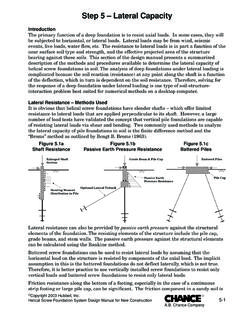
Step 5 – Lateral Capacity - Foundation Underpinning & Repair
vickars.com©Copyright 2003 Hubbell, Inc. Helical Screw Foundation System Design Manual for New Construction ® A.B. Chance Company 5-1 Step 5 – Lateral Capacity
USE OF BROMS’S METHOD AND FINITE DIFFERENCE …
www.arhivzatehnickenauke.comVlaški S. Use of broms's method ..... Archives for Technical Sciences 2014, 11(1), 65-72 0 Technical Institute Bijeljina, Archives for Technical Sciences.

DESIGN AND FABRICATION OF HIGH EFFICIENCY SQUIRREL …
www.arpnjournals.comvol. 10, no. 4, march 2015 issn 1819-6608
Comparison between Structured and Unstructured Grid ...
www.isaet.orgComparison between Structured and Unstructured Grid Generation on Two Dimensional Flows Based on Finite Volume Method (FVM) Abobaker Mohammed …

Finite Element Method Introduction, 1D heat conduction
www.wind.civil.aau.dkFinite Element Method Introduction, 1D heat conduction 4 Form and expectations To give the participants an understanding of the basic elements of the finite element method as a tool for finding approximate solutions of linear boundary value problems.

Review of the finite-element method - CREWES
www.crewes.orgReview of the finite-element method CREWES Research Report — Volume 15 (2003) 1 A review of the finite-element method in seismic wave modelling
Related search queries
Endogenous Ranking and Equilibrium Lorenz Curve, Finite, Step 5 – Lateral Capacity, METHOD AND FINITE DIFFERENCE, Comparison between Structured and Unstructured, Comparison between Structured and Unstructured Grid Generation, Finite Element Method Introduction, 1D heat conduction, Review of the finite-element method