Finite Difference Method for Solving Differential Equations
The finite difference method is used to solve ordinary differential equations that have conditions imposed on the boundary rather than at the initial point. These problems are called boundary-value problems. In this chapter, we solve second-order ordinary differential equations of the form . f x y y a x b dx d y = ( , , '), ≤ ≤ 2 2, (1)
Download Finite Difference Method for Solving Differential Equations

Information
Domain:
Source:
Link to this page:
Documents from same domain

Chapter 01.03 Sources of Error - MATH FOR COLLEGE
mathforcollege.com01.03.1 Chapter 01.03 Sources of Error After reading this chapter, you should be able to: 1. know that there are two inherent sources of error in numerical methods – round-

Runge-Kutta 4th Order Method for Ordinary …
mathforcollege.com08.04.1 Chapter 08.04 Runge-Kutta 4th Order Method for Ordinary Differential Equations . After reading this chapter, you should be able to . 1. develop Runge-Kutta 4th order method for solving ordinary differential equations,

Simpson 3/8 Rule for Integration - MATH FOR …
mathforcollege.comIn a similar fashion, Simpson rule for integration can be derived by 3/8 approximating the given function
Finite Difference Method for Solving Differential …
mathforcollege.com08.07.1 . Chapter 08.07 Finite Difference Method for Ordinary Differential Equations . After reading this chapter, you should be able to . 1. Understand what the finite difference method is and how to use it to solve problems.

Chapter 04.08 Gauss-Seidel Method
mathforcollege.comusing the Gauss-Seidel method. Assume an initial guess of the solution as = 5 2 1
Chapter 05.03 Newton’s Divided Difference Interpolation
mathforcollege.comNewton’s Divided Difference Interpolation 05.03.3 Figure 2 Linear interpolation. Example 1 The upward velocity of a rocket is given as a function of time in Table 1 (Figure 3).

False-Position Method of Solving a Nonlinear Equation
mathforcollege.com03.06.1 . Chapter 03.06 False-Position Method of Solving a Nonlinear Equation . After reading this chapter, you should be able to . 1. follow the algorithm of the false-position method of solving a nonlinear equation,
Bisection Method of Solving Nonlinear Equations: General ...
mathforcollege.comOne of the first numerical methods developed to find the root of a nonlinear equation . f (x) =0 was the bisection method (also called binary-search method). The method is based on the following theorem. Theorem. An equation. f (x) =0, where f (x) is a real continuous function, has at least one root between . x and . x. u. if f (x ) f (x. u ...
Runge-Kutta 4th Order Method for Ordinary Differential ...
mathforcollege.comOct 13, 2010 · 08.04.1 Chapter 08.04 Runge-Kutta 4th Order Method for Ordinary Differential Equations . After reading this chapter, you should be able to . 1. develop Runge-Kutta 4th order method for solving ordinary differential equations, 2. find the effect size of step size has on the solution, 3. know the formulas for other versions of the Runge-Kutta 4th order method
Chapter 10.02 Parabolic Partial Differential Equations
mathforcollege.comParabolic Partial Differential Equations . After reading this chapter, you should be able to: 1. Use numerical methods to solve parabolic partial differential eqplicit, uations by ex implicit, and Crank-Nicolson methods. The general second order linear PDE with two independent variables and one dependent variable is given by . 0. 2 2 2 2 2 ...
Related documents
First Order Partial Differential Equations, Part - 1: Single …
math.iisc.ernet.inSymbols for various domains used In this lecture we denote by Da domain in R2 where a solution is de ned, by D 1 a domain in R2 where the coe cients of a linear equation are de ned and by D 2 is a domain in(x;y;u)-space i.e., R3 nally by D 3 a domain in R5 where the function F of ve independent variables is de ned.
Second Order Linear Differential Equations - University of …
www.math.utah.eduSecond Order Linear Differential Equations 12.1. Homogeneous Equations A differential equation is a relation involvingvariables x y y y . A solution is a function f x such that the substitution y f x y f x y f x gives an identity. The differential equation is said to be linear if it is linear in the variables y y y .
DIFFERENTIAL EQUATIONS - University of Kentucky
www.ms.uky.eduHigher Order Differential Equations Basic Concepts for nth Order Linear Equations – We’ll start the chapter off with a quick look at some of the basic ideas behind solving higher order linear differential equations. Linear Homogeneous Differential Equations – …

Chapter 7 First-order Differential Equations
www.sjsu.eduFirst order differential equations are the equations that involve highest order derivatives of order one. They are often called “ the 1st order differential equations Examples of first order differential equations: Function σ(x)= the stress in a uni-axial stretched metal rod with tapered cross section (Fig. a),
Second Order Linear Nonhomogeneous Differential …
www.personal.psu.eduSecond Order Linear Nonhomogeneous Differential Equations; Method of Undetermined Coefficients We will now turn our attention to nonhomogeneous second order linear equations, equations with the standard form y″ + p(t) y′ + q(t) y = g(t), g(t) ≠ 0. (*) Each such nonhomogeneous equation has a corresponding homogeneous equation: y″ + p(t ...
Second Order Linear Differential Equations
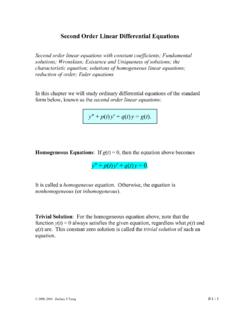
www.personal.psu.educharacteristic equation; solutions of homogeneous linear equations; reduction of order; Euler equations In this chapter we will study ordinary differential equations of the standard form below, known as the second order linear equations: y″ + p(t) y′ + q(t) y = g(t). Homogeneous Equations: If g(t) = 0, then the equation above becomes y ...

FIRST-ORDER ORDINARY DIFFERENTIAL EQUATIONS
www-thphys.physics.ox.ac.uk♦ 1st-order ODEs correspond to families of curves in x, y plane ⇒ geometric interpretation of solutions ♦ Equations of higher order may be reduceable to first-order problems in special cases — e.g. when y or x variables are missing from 2nd order equations

Fractional Derivatives, Fractional Integrals, and Fractional …
cdn.intechopen.comIntegrals, and Fractional Differential Equations in Matlab Ivo Petrá Technical University of Ko ice Slovak Republic 1.Introduction The term fractional calculus is more than 300 years old. It is a generalization of the ordinar y differentiation and integration to non-integer (arbitrary) order. The subject is as old as the