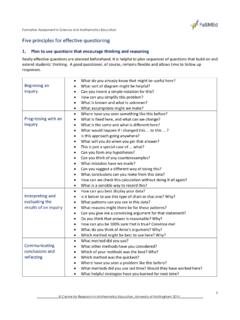
Five principles for effective questioning - PDST
Five principles for effective questioning 1. Plan to use questions that encourage thinking and reasoning Really effective questions are planned beforehand. It is helpful to plan sequences of questions that build on and extend students [ thinking. A good questioner, of course, remains flexible and allows time to follow up responses. Beginning an ...
Download Five principles for effective questioning - PDST

Information
Domain:
Source:
Link to this page:
Documents from same domain

Active Learning & Teaching Methodologies Full …
pdst.ie2 Introduction The promotion of the use of a broad range of teaching methodologies and participant centred learning is a key underlying principle in Leaving Certificate Applied.
Using Graphic Organisers in SS S LEVEL Teaching and ERVICE ...
pdst.ieUsing Graphic Organisers in Teaching and Learning SSECOND LEVEL UPPORT SERVICE SEIRBHÍS TACAÍOCHTA DARA LEIBHÉAL The SLSS is funded by the Department of Education ...

English and Communications - PDST
pdst.ieenglish and communications • communications and the working world • oral communication and listening skills 3. obtain basic information from peers (1) in a personal context

Guided Reading: An Introduction - PDST
pdst.ie•Re-reading is crucial in the guided reading lesson. •Re-reading can be done in school as a familiar reading lesson or it can be sent home to be read as homework. Guided Reading in action Roll it there …. Text Selection •The book chosen must be at the children's

2016 - PDST
pdst.iesubstantial way through parent meetings. This would be particularly useful at the beginning of the school year before the Programme is implemented. Such meetings could have inputs from educators with responsibility for personal safety or sexuality education, as well as experts on drugs, or local providers of services such as guards, Health Service

03 Walk Tall First Class - PDST
pdst.ie01 I Belong in My Home page 108 02 I Belong with My Class page 112 03 Taking Care of our Classroom Environment page 120 04 I Belong in My Community page 125 05 When I’m Older I Would Like To Belong page 128 UNIT SIX: Media page 132 01 Facts or Fiction page 133 02 We are Modern Explorers page 136
Differentiation in action!
pdst.iefloor plans to facilitate groupwork Teach group work skills approachessuch as listening, turn-taking, welcoming all contributions, etc. explicitly Define areas of the classroom for independent and group work. If space allows, each child should havea“home base” deskthat they return to for whole-class teaching.

Introduction to Information & Communications Technology
pdst.ieThe theory of this unit should be taught very much at the level described. Safe work practices and care of equipment should be central to all the practical sessions, with emphasise on proper booting and closing down of the computer. Unit 2: Keyboarding While it is not intended that students should be able to touch-type

FOURTH CLASS - PDST
pdst.ieThe original Walk Tall classroom materials were devised in the mid-1990s on foot of a Ministerial Task Force Report (1996) which recommended that substance misuse preventative strategies should be put in place as early as possible in the classroom, and before children begin to experiment with drugs. At that time, the

2016 - PDST
pdst.ieupdate was timely, both in terms of tailoring the classroom materials to a more diverse pupil population, updating some of the content (for example, stories), and making a more explicit link between Walk Tall and the content objectives of the 1999 Social Personal and Health Education (SPHE) curriculum in order to assist classroom planning.
Related documents
From Sage on the Stage to Guide on the Side
faculty.washington.eduthrough the process of trying to make sense of new information in terms of ... and it always leads to deeper understand ing. However, students do not spontane ... Guided Reciprocal Peer Questioning is an interactive learning procedure that can be used by students in any area of the curriculum to help them actively ...
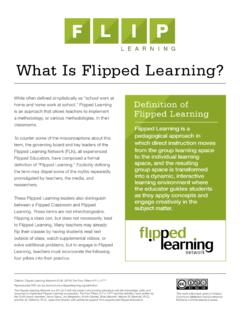
What Is Flipped Learning?
www.flippedlearning.orgLearning, teachers must incorporate the following four pillars into their practice. Flipped Learning is a pedagogical approach in which direct instruction moves from the group learning space to the individual learning space, and the resulting ... through differentiation and feedback.
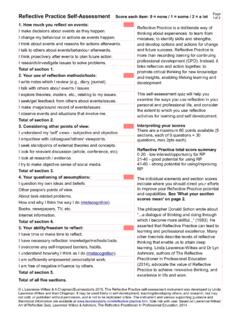
Reflective Practice Self-Assessment Page Score each item ...
www.businessballs.coma deeper understanding to examine and inform your work. You tend to step outside your comfort zone to ask for feedback, be self-critical, examine assumptions, question theory and challenge the status quo. Development of these reflective learning skills make you a more successful all round learner. Notes: Your score 3. Considering other points ...
Learning in the Workplace - Effective Practitioner
www.effectivepractitioner.nes.scot.nhs.uk• Questioning your own practice and questioning your colleagues so you can learn and develop together. • Questioning the role of others in the wider multidisciplinary team so you can develop a deeper knowledge and understanding of their role. • Accessing information to allow you to make more informed decisions on improving your practice.
A Constructivist Approach to Online Teaching and Learning
files.eric.ed.govMar 06, 2009 · of making meaning. New technologies allow for construction of knowledge through what is actually deeper reflection by the learner. Through groups and other learning interactio ns with their online peers, students acquire deeper understanding because of the “opportunities for exposure to multiple perspectives and interpretations” (p. 1).
Deeper Learning through Questioning - ed
lincs.ed.govTEAL Center Fact Sheet No. 12: Deeper Learning through Questioning 2013 . Deeper Learning through Questioning. Asking good questions is central to learning and sometimes can be more important than getting the answers, particularly when the questions en-courage students to think critically. ”Skill in the art . of questioning lies at the basis ...
Project Based Learning in the Secondary English Classroom
ilearn.marist.eduProject Based Learning (PBL) is an evidence based strategy for actively engaging students in the learning ... result students are inspired to obtain deeper knowledge of the subjects they are studying because the ... questioning, analyzing, and so forth through direct instruction and modeling. Teachers often become co-learners in the process,
Information Sheet 1 of 6 Effective Questioning
www.westlothian.gov.ukEffective questioning is a key tool in Assessment for Learning strategies and should ... the top, therefore questions can be planned to develop deeper learning: Page 2 ... Encouraging students to work through their decision making process, even if it brings frustration and makes ...