Five principles for effective questioning - PDST
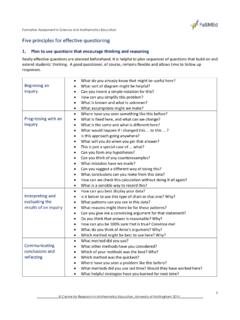
Formative Assessment in Science and Mathematics Education 1 _____© Centre for Research in Mathematics Education, University of Nottingham 2014_____ Five principles for effective questioning 1. Plan to use questions that encourage thinking and reasoning Really effective questions are planned beforehand.
Download Five principles for effective questioning - PDST

Information
Domain:
Source:
Link to this page:
Documents from same domain

Active Learning & Teaching Methodologies Full …
pdst.ie2 Introduction The promotion of the use of a broad range of teaching methodologies and participant centred learning is a key underlying principle in Leaving Certificate Applied.
Using Graphic Organisers in SS S LEVEL Teaching and ERVICE ...
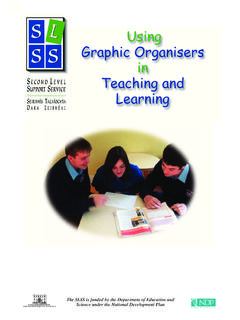
pdst.ieUsing Graphic Organisers in Teaching and Learning SSECOND LEVEL UPPORT SERVICE SEIRBHÍS TACAÍOCHTA DARA LEIBHÉAL The SLSS is funded by the Department of Education ...

English and Communications - PDST
pdst.ieenglish and communications • communications and the working world • oral communication and listening skills 3. obtain basic information from peers (1) in a personal context

Guided Reading: An Introduction - PDST
pdst.ie•Re-reading is crucial in the guided reading lesson. •Re-reading can be done in school as a familiar reading lesson or it can be sent home to be read as homework. Guided Reading in action Roll it there …. Text Selection •The book chosen must be at the children's

2016 - PDST
pdst.iesubstantial way through parent meetings. This would be particularly useful at the beginning of the school year before the Programme is implemented. Such meetings could have inputs from educators with responsibility for personal safety or sexuality education, as well as experts on drugs, or local providers of services such as guards, Health Service

03 Walk Tall First Class - PDST
pdst.ie01 I Belong in My Home page 108 02 I Belong with My Class page 112 03 Taking Care of our Classroom Environment page 120 04 I Belong in My Community page 125 05 When I’m Older I Would Like To Belong page 128 UNIT SIX: Media page 132 01 Facts or Fiction page 133 02 We are Modern Explorers page 136

Differentiation in action!
pdst.iefloor plans to facilitate groupwork Teach group work skills approachessuch as listening, turn-taking, welcoming all contributions, etc. explicitly Define areas of the classroom for independent and group work. If space allows, each child should havea“home base” deskthat they return to for whole-class teaching.

Introduction to Information & Communications Technology
pdst.ieThe theory of this unit should be taught very much at the level described. Safe work practices and care of equipment should be central to all the practical sessions, with emphasise on proper booting and closing down of the computer. Unit 2: Keyboarding While it is not intended that students should be able to touch-type

FOURTH CLASS - PDST
pdst.ieThe original Walk Tall classroom materials were devised in the mid-1990s on foot of a Ministerial Task Force Report (1996) which recommended that substance misuse preventative strategies should be put in place as early as possible in the classroom, and before children begin to experiment with drugs. At that time, the

2016 - PDST
pdst.ieupdate was timely, both in terms of tailoring the classroom materials to a more diverse pupil population, updating some of the content (for example, stories), and making a more explicit link between Walk Tall and the content objectives of the 1999 Social Personal and Health Education (SPHE) curriculum in order to assist classroom planning.
Related documents
Learning: Theory and Research
gsi.berkeley.eduFor instance, asking students to explain new material in their own words can assist them in assimilating it by forcing them to re-express the new ideas in their existing vocabulary. Likewise, providing students with sets of questions to structure their reading makes it easier for them to relate it to previous material by highlighting certain
Teaching The Science Process Skills - Longwood University
www.longwood.eduof doing science and scientific attitudes. The processes of doing science are the science process skills that scientists use in the process of doing science. Since science is about asking questions and finding answers to questions, these are actually the same skills that we all use in our daily lives as we try to figure out everyday questions.

Identifying Similarities and Differences: Summarizing and ...
www.middleweb.comquestions and hypotheses about what may or may not work. 9. Cues, Questions, and Advanced Organizers: helps students use what they already know to enhance what they are about to learn. These are usually most effective when used before a specific lesson. a. Pause briefly after asking a question to give students time to answer with more depth. b.

Sample Handbook for New Art and Science of Teaching A - …
files.ascd.orgThe New Art and Science of Teaching (Marzano, 2017) represents the current knowledge of effective teaching and draws from the past and is rooted in the present while turning an eye toward the future. The New Art and Science of Teaching The model of effective instruction has been updated in several ways. I have added two categories ([1]

Communication Skills 2 Overcoming Barriers to Effective ...
cdn.ps.emap.comasking sensitive questions where others may hear patients’ replies. Consider alter-native ways of gathering pertinent infor-mation, such as asking the patient to com-plete a written form – but remember that some patients struggle with reading and writing or may need the form to be pro-vided in a different language or have

Benchmarks Sciences - Education Scotland
education.gov.scot- Responds to questions about their investigation. Scientific analytical thinking skills - Demonstrates natural curiosity and shows development of basic skills of analysis in simple and familiar contexts, for example, through asking questions, experimenting and making predictions.
Strategies for Teaching Science Content Reading - ed
files.eric.ed.govheads. That is where they learn science. Science is not learned merely by observing, reading, doing, memorizing, or reciting. Science is learned by thinking. It is learned by processing information and constructing models and theories that can be tested. When my students perform a lab, they are asking questions, making predictions,

Transfer of Learning and Teaching: A Review of ... - ed
files.eric.ed.goveffective ways to optimize knowledge acquisition and transfer. The results of the comparison ... inquiry learning methods in science and technology research and the presence of empirical ... adaptation of skills, and asking questions such as what the problems are, what principles need
The Art of Asking Essential Questions - critical thinking
www.criticalthinking.orgask essential questions.Practice in asking essential questions eventual-ly leads to the habit of asking essential questions. But we can never practice asking essential questions if we have no conception of them. This mini-guide is a starting place for understanding concepts that, when applied, lead to essential questions. Sincerely, Richard Paul

The Effectiveness of Teachers' Use of ... - Science education
www.ejmste.comfew studies have focused on how effective this method is in promoting cognitive involvement. Hofstein et al. (2005) and Dkeidek, Mamlok-Naaman, and Hofstein (2012) published a study on question asking as a tool for developing high-order thinking skills in the chemistry laboratory.