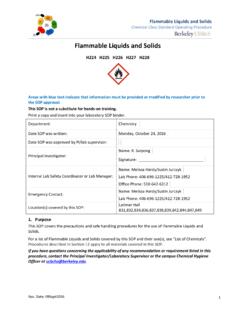
Flammable Liquids and Solids
• Verify your experimental set-up and procedure prior to use. • Know the location of the nearest eyewash, safety shower and fire extinguisher before beginning work. • Upon leaving the work area, remove any personal protective equipment worn and wash hands.
Download Flammable Liquids and Solids

Information
Domain:
Source:
Link to this page:
Documents from same domain
Dyeing Reagents for TLC - University of California, …
www.cchem.berkeley.eduDyeing Reagents for Thin-Layer and Paper Chromatography Contents • Introduction • Index of compounds and compound classes and appropriate detection reagents • Reagents in alphabetical order
A Modified Soave Equation of State for Phase Equilibrium ...
www.cchem.berkeley.eduThe Soave modification of the Redlich-Kwong equation state is shown to work well for the estimation of the vapor-liquid equilibrium behavior of a wide variety of technically important hydrocarbon mixtures.
Water Reactive Materials and Strong Reducing Agents
www.cchem.berkeley.eduThis SOP covers the precautions and safe handling procedures for the use of Water Reactive Chemicals, which include the following chemicals and their uses: Note: A * next to chemical indicates that it is also an Acutely Toxic Chemical.
D-orbital splitting diagrams
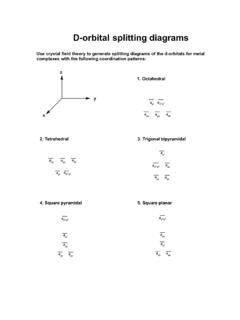
www.cchem.berkeley.eduSquare pyramidal d z2x2-y d xy d yzxz 5. Square planar d z2x2-y d xy d yzxz d z2 d x2-yxy d yz d xz d z2 d x2-y2 d xy d yz d xz d z2 d x2-y d xy d yz d xz z x y. Title: Microsoft Word - Document1 Created Date: 5/17/2017 11:24:42 PM ...
Don’t Gamble With Physical Properties For Simulations
www.cchem.berkeley.eduVapor enthalpy usually is calculated via an ideal gas assumption or an equation of state. The equation-of-state methods calculate a depar-ture from ideality called the vapor enthalpy departure. For components such as acetic acid, the Hayden-O’Connell model is best, and will calcu-late a larger-than-normal vapor enthalpy departure.

Visualizing the McCabe-Thiele Diagram
www.cchem.berkeley.eduThe McCabe-Thiele diagram is constructed by “stepping off stages.” The starting point is (x D, x D), which is the vapor composition ascending from tray 1. The liquid composition descending from tray 1 is the mole fraction in equilibrium with a vapor with composition x D

Appendix 3: Recipes For TLC Stains
www.cchem.berkeley.eduCerium Sulfate: Prepare a 10% (w/v) solution of cerium (IV) sulfate in 15% sulfuric acid. Ferric Chloride: Prepare a 1% (w/v) solution of 1% ferric (III) chloride in 50% aqueous methanol. Ehrlich’s Reagent: Dissolve 1.0 g of p-dimethylaminobenzalde-hyde in 75 mL of MeOH and add 50 mL of conc. HCl.

MASS TRANSFER COEFFICIENTS BETWEEN GAS AND LIQUID …
www.cchem.berkeley.edurings, Berl saddles, Spheres and rods made of ceramic, glass, and polyvinylchloride, and also coated with paraffine film. This paper presents the correlations on the masstrans-fer coefficients for gas absorption and desorption based on Eq. (l) of aw and confirms the applicability of those to the vaporization of water and the gas absorption into

Complex Numbers : Solutions
www.cchem.berkeley.educomplex conjugate z∗ = a − 0i = a, which is also equal to z. So a real number is its own complex conjugate. [Suggestion : show this using Euler’s z = r eiθ representation of complex numbers.] Exercise 8. Take a point in the complex plane. In the Cartesian picture, how does the act of taking the complex conjugate move the point? What about in
Delta Functions - University of California, Berkeley
www.cchem.berkeley.eduExercise 2.1. Using the definition of a Dirac Delta function given in equation (9), prove that the Dirac Delta function has to be normalized. i.e. prove: Z ∞ −∞ δ(x)dx = 1 Another way that you can think of the Dirac Delta function is as the deriva-tive of the step (Heaviside) function, H(x). This function looks like: x 0 x H(x) y 1