
Foundation Phase Framework
The Foundation Phase is the statutory curriculum for all three to seven year olds in Wales, having been introduced in September 2010. It encourages children to be creative and imaginative, and makes learning more enjoyable and more effective. The Welsh Government’s approach to education and lifelong learning is set out in the broader
Download Foundation Phase Framework

Information
Domain:
Source:
Link to this page:
Documents from same domain
Curriculum for Wales guidance
hwb.gov.walesDesigning your curriculum – general guidance on developing a curriculum across all areas of learning and experience (Area/Areas). Introduction to each area of learning and experience. Statements of what matters – the ‘big ideas’ and key principles in each Area.

Education for Sustainable Development and Global …
hwb.gov.walesof education should be the process of learning to think through the application of real problems.” - John Dewey “Education for Sustainable Development and Global Citizenship is an intrinsic part of the existing school curriculum. It is not an additional requirement.” - Jane Hutt, Minister for Education and Lifelong Learning, WAG, 2008
A new curriculum in Wales
hwb.gov.walesSchools and teachers will now start changing and getting ready to teach the new curriculum. Children and young people will learn through the new curriculum from September 2022. All primary school children and children in year 7 in 2022 will follow the new curriculum.

Foundation Phase Outdoor Learning Handbook
hwb.gov.walesFoundation Phase Outdoor Learning Handbook The Forest School approach to children’s development and learning complements the Foundation Phase pedagogy. A number of settings/schools have developed their own Forest School areas, while others visit designated areas in the community. The sessions are led by a qualified forest school

Professional standards for further education teachers and ...
hwb.gov.walesPractitioners in further education (FE) and work-based learning (WBL) are part of a highly diverse workforce which plays a vital role in promoting the social and economic well-being of those living and working in Wales. This document has been developed with the practitioners for whom it has been designed.
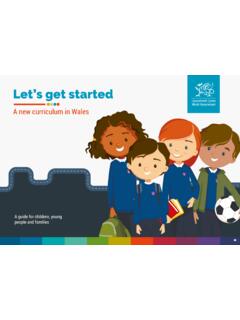
A New Curriculum in Wales: A Guide for Children Young ...
hwb.gov.walesA guide for children, young people and families. Let’s get started The world is changing. There are lots of new challenges that will need new technology and new ideas. The Welsh Government wants you to have the knowledge, skills and experiences you’ll need to succeed.

Numeracy Framework - Hwb
hwb.gov.walesactivities. I can make connections so that mathematical concepts can be transferred during play and classroom activities. ... Numeracy Framework . ae’r ddogfen yma hefyd ar gael yn ymraeg. This document is also available in Welsh. Crown copyright 22 4 Digital ISN 1 3 2 1 Strand Element Progression step 1 Progression step 2 Progression step 3 ...

Literacy Framework - Hwb
hwb.gov.walessyllables, and onset and rime to learn to read. I am beginning to discriminate phonemes aurally in different positions, e.g. initial sounds, medial vowels, final sounds in spoken words. I can blend phonemes together automatically and silently. I am beginning to develop my knowledge of grapheme (written letters)–phoneme (speech sounds)

Curriculum for Wales guidance
hwb.gov.walesprogression. The Curriculum for Wales guidance has been informed by international evidence of what it means to make progress in learning. The statements of what matters are the basis of learners’ progression. It is through exploration of the key ideas and principles contained in these statements that they will develop their learning.

Science in the National Curriculum - Hwb
hwb.gov.walesout in eight level descriptions of increasing difficulty, with an additional description above Level 8 to help teachers in differentiating Exceptional Performance. At Key Stage 4, external qualifications are the main means of assessing attainment in the national curriculum. The Welsh Assembly Government
Related documents
Teaching and Learning Online - UMass Amherst
www.umass.eduOnline learning is most effective when delivered by teachers experienced in their ... experience geographic and time barriers in gaining access to higher education. ... Online teaching can expand existing curriculum to students on a regional, national, and international level.
Effect of Availability of Teaching and Learning Resources ...
files.eric.ed.govInstructional methods, examination systems and rigid curriculum are some of the barriers to implementation of inclusive education in pre-school centres in Kenya. Implementing successful inclusive education often requires adequate support human resource, teaching and learning resources. Teachers frequently feel there is lack of
Operational Guidelines on School Health Programme under ...
www.nhm.gov.inhealth barriers experienced by them can be greatly reduced. I, therefore encourage all ... different levels of implementation will find these guidelines as a resource to for effective implementation of the strategy as envisaged. Dr.Ajay Khera M.D. (Public Health) ... as part of the curriculum, promoting hygiene and healthy practices within the ...
NHS England » SBAR implementation and training guide
www.england.nhs.ukThe good news is that a structured implementation does not have to be a lengthy and onerous part of the process. This section offers you an overview of one of the most well-used and effective improvement methodologies in the NHS and wider industry - the Model for Improvement. The Model for Improvement (see page 14) is a simple four–stage
Be it enacted by the People of the State of Illinois ...
www.ilga.govbarriers to employment, including low educational attainment, prior involvement with the criminal legal system, and language barriers; and applicants who are graduates of or currently enrolled in the foster care system, regardless of the applicant's area of residence. The Department and Regional Administrators shall protect
Strategic Planning
www.education.vic.gov.auachievements; and identify effective strategies and areas for improvement during the next planning period. The community can do this by contributing to discussion about: • how well the school is meeting the community’s expectations • where the school could improve its performance • what the school’s priorities should be going forward.

A Framework for Safe and Successful Schools
www.naesp.orgprogram or piece of equipment but rather by effective comprehensive and collaborative efforts requiring the dedication and commitment of all school staff and relevant community members. Schools require consistent and effective approaches to prevent violence and promote learning, sufficient time to implement these approaches, and ongoing evaluation.

Barriers to effective curriculum implementation
files.eric.ed.govunderstanding the barriers to complete implementation of new curricula and how teachers view available systems for curriculum support. The conceptual framework for the proposed study is the CBAM (AIR, 2016).
Model and Process for Nutrition and Dietetic Practice
www.bda.uk.combarriers and facilitators to progress. As you can see on the image above, the arrow here leads back to either assessment or evaluation - new issues or a lack of progress will lead to reassessment and possibly a new NDD, strategy and/or implementation. Step 6: Evaluation – establish whether the outcome has been met, and the NDD resolved.