
G. P. Nikishkov
most popular method of its finite element formulation is the Galerkin method. If the physical problem can be formulated as minimization of a functional then variational formulation of the finite element equations is usually used. 1.3.1 Galerkin method
Download G. P. Nikishkov

Information
Domain:
Source:
Link to this page:
Documents from same domain
Chapter 14-DESIGN CONSIDERATIONS FOR …
homepages.cae.wisc.eduDESIGN CONSIDERATIONS FOR WELDING A part from resistance spot welding (RSW), three processes are most commonly used for welding metal stampings and fabrications: gas metal arc welding (GMAW) or MIG; gas tungsten arc welding (GTAW) or
Introduction to SystemC Tutorial - CAE Users
homepages.cae.wisc.eduIntroduction to SystemC Tutorial SystemC is essentially a C++ library used for modeling concurrent systems in ... C++ implements Object-Orientation on the C language.

Finite Element Analysis Why FEA? - CAE Users
homepages.cae.wisc.edu1 Finite Element Analysis • Numerical method of solving engineering problems. • May be applied in: – structural – heat transfer –fluid flow

Principles of Dimensioning - CAE Users
homepages.cae.wisc.eduDIMENSIONING ROUND HOLES Rules: 19. Holes are specified by a local note and placed in the view where the hole appears as a true circle. The leader line should extend radially from the circle, touching its

xxx xxx App 879605 - CAE Users
homepages.cae.wisc.eduAppendix C 8 Appendix C In the United States, the governing body responsible for the standards established for tech-nical and engineering drawing is the American National Standards Institute (ANSI).
Fastener Handout - University of Wisconsin–Madison
homepages.cae.wisc.eduFastener Handout Introduction: Engineering Design ... in one revolution is referred to as pitch or lead. ... Class fit is a specification of how tightly mating ...
S-Domain Analysis - CAE Users
homepages.cae.wisc.edus-Domain Circuit Analysis Time domain (t domain) Complex frequency domain (s domain) Linear Circuit Differential equation Classical techniques Response
Product Design Specifications - University of Wisconsin ...
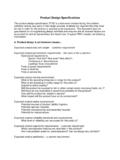
homepages.cae.wisc.eduProduct Design Specifications The product design specification (PDS) is a document created during the problem definition activity very early in the design process. It details the requirements that must be met in order for the product or process to be successful. The document lays the

Failure Modes and Effects Analysis (FMEA) - CAE Users
homepages.cae.wisc.eduFailure effect is defined as “the effect of a failure mode on the product/process function as perceived by the customer.” 6) Identify the causes for each failure mode.

Common Mechanical Engineering Terms
homepages.cae.wisc.eduCommon Mechanical Engineering Terms Ball and Detent (n) A simple mechanical arrangement used to hold a moving part in a temporarily fixed position relative to another part. The ball slides within a bored cylinder, against the
Related documents
Chapter 4a – Development of Beam Equations - Memphis
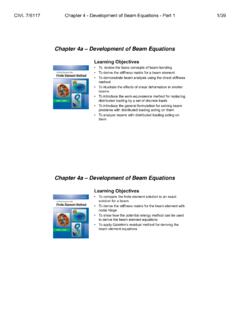
www.ce.memphis.edu• To compare the finite element solution to an exact solution for a beam • To derive the stiffness matrix for the beam element with nodal hinge • To show how the potential energy method can be used to derive the beam element equations • To apply Galerkin’sresidual method for deriving the beam element equations
FINITE ELEMENT ANALYSIS OF STRESSES IN BEAM …
upcommons.upc.eduFinite element analysis of stresses in beam structures 7 3 FINITE ELEMENT METHOD In order to solve the elastic problem, the finite element method will be used with modelling and discretization of the object under study. One- and two-dimensional elements are needed, so the basics of both are going to be described [16].

CHAP 4 FINITE ELEMENT ANALYSIS OF BEAMS AND FRAMES
mae.ufl.edu1 CHAP 4 FINITE ELEMENT ANALYSIS OF BEAMS AND FRAMES 2 INTRODUCTION • We learned Direct Stiffness Method in Chapter 2 – Limited to simple elements such as 1D bars • we will learn Energy Methodto build beam finite element – Structure is in equilibrium when the potential energy is minimum
Finite Volume Method: A Crash introduction - Wolf Dynamics
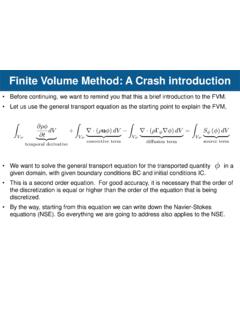
www.wolfdynamics.comFinite Volume Method: A Crash introduction Profile assumptions using Taylor expansions around point P (in space) and point t (in time) • Hereafter we are going to assume that the discretization practice is at least second order accurate in space and time. • As consequence of the previous requirement, all dependent variables are assumed