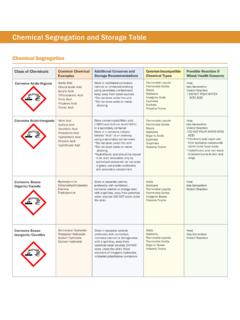
General Chemical Storage Compatibility Chart
Flammable Liquids . Ethanol, Ethyl Acetate, Methanol, Acetone, Benzene, Xylene, Toluene Diethyl Ether Tetrahydrofuran Acetonitrile Glacial Acetic Acid Acetone liquids with flashpoints < 100 F Flammable storage cabinet or refrigerator rated for flammable/ hazardous storage/explosion proof *Peroxide-forming chemicals Oxidizers Acids Bases Reactives
Download General Chemical Storage Compatibility Chart

Information
Domain:
Source:
Link to this page:
Documents from same domain
HVAC Duct Cleaning - National Institutes of Health
ors.od.nih.govDivision of Occupational Health and Safety . The dirty filter/vent above indicate a cleaning is needed and should be performed by a professional . DOHS Fact Sheet on . HVAC Duct Cleaning . National Institutes of Health • Office of Research Services (ORS) • Division of Occupational Health and Safety (DOHS) • Technical Assistance Branch (TAB)
Contractor Health and Safety Requirements
ors.od.nih.gova. Contractor Safety Program Assessment: The NIH is committed to providing a safe environment for its employees, guests, and patients. Safety, as demonstrated during previous contracts, may be used in the past performance evaluation of a Contractor. Contractors are required to enroll in the Contractor Safety Assessment Program (CSAP).
Guidance for the Selection of Laboratory Coats
ors.od.nih.govThis reference document provides a general overview for selection of laboratory coats. It does not alter or determine compliance responsibilities in OSHA standards or NIH’s Manual Chapter 1340. Because interpretations and policy may change over time, you should your consult with your Institute's Safety and Health Specialist.
Protocol for Use and Maintenance of Oxygen Monitoring …
ors.od.nih.govdisplacement of oxygen. At a minimum, the following factors should be used in determining if a device should be installed: manufacturer (e.g., magnet) guidance, volume of gas used, location of gas, and air changes/hour in the room/area. The 2008 NIH DRM notes that both ‘carbon dioxide manifold rooms…
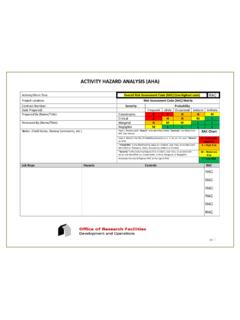
ACTIVITY HAZARD ANALYSIS (AHA)
ors.od.nih.govACTIVITY HAZARD ANALYSIS (AHA) Activity/Work Task: Overall Risk Assessment Code (RAC) (Use highest code) Project Location: Risk Assessment Code (RAC) Matrix . ... " is the likelihood to cause an incident, near miss, or accident and identified as: Frequent, Likely, Occasional, Seldom or Unlikely . H = High Risk "
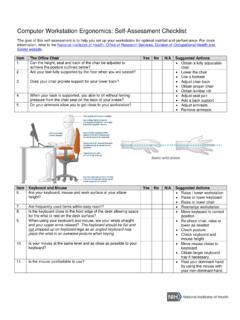
Computer Workstation Ergonomics: Self-Assessment Checklist
ors.od.nih.govSelf Assessment Computer Workstation Ergonomics: Self-Assessment Checklist . The goal of this self-assessment is to help you set up your workstation for optimal comfort and performance. For more information, refer to the . National Institutes of Health, Office of Research Services, Division of Occupational Health and Safety website.
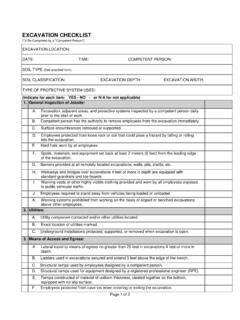
EXCAVATION CHK LST
ors.od.nih.govinto the excavation. rolling E. Hard hats worn by all employees. F. Spoils, materials, and equipment set back at least of the excavation. 2 meters (6 feet) from the leading edge G. Barriers provided at all remotely located excavations, wells, pits, shafts, etc. H. Walkways and bridges over excavations 4 feet or more in depth are equipped
Applicant Instructions for Completing Form HHS-745, “HHS ...
ors.od.nih.govApplicant Instructions for Completing Form HHS-745, “HHS ID Badge Request” Section A collects identifying information about Applicants needed to issue an HHS ID Badge. In some Federal agencies, Sponsors or other authorized offi cials will complete this section for Applicants. If …
NIH Chemical Hygiene Plan
ors.od.nih.govBSC Biological Safety Cabinets CFH Chemical Fume Hood CFR Code of Federal Regulations CHO Chemical Hygiene Officer ... eyes, or mucus membranes. Physical hazards include, but are not limited to, chemicals which are explosive, flammable, or corrosive. (Definition listed in . Appendix F “Glossary of Terms.”) III.

Safety and Health Program Audit Tool
ors.od.nih.govImplemented Evidence of Implementation . A mechanism is established to exchange information about hazards present in the workplace and measures in place to prevent or control them. for all contractors to use to report injuries, hazards, and concerns. Host employers include any safety - related specifications and qualifications requirements for
Related documents

BUILDING CODE REQUIREMENTS FOR STORAGE
www.ispeboston.orgJun 12, 2019 · Chapter 66 Flammable and Combustible Liquids 66.1.1 The storage, handling, and use of flammable and combustible liquids, including waste liquids…shall comply with this chapter; NFPA 30, Flammable and Combustible Liquids Code; Sections 60.1 through 60.4 of this Code; and NFPA 35 Standards for the Manufacture of Organic Coatings, as applicable.

Guide - Storage of flammable liquids
www.safeworkaustralia.gov.auStorage of flammable liquids Page 7 Figure 1: The fire triangle Take stock of your flammable liquids The first step in managing risks associated with flammable liquids is to identify which types are stored at the workplace, and in what volumes. A …
Chemical Segregation and Storage Guide
i-lab.harvard.edu2.1 Flammable liquids Flammable liquids are liquids that will ignite easily and burn rapidly. More precisely, they are liquids with flash points that do not exceed 100 F (37.8 C). Less flammable liquids with flash points at 100 F or higher are categorized as combustible liquids. For storage purposes, flammable and combustible liquids are
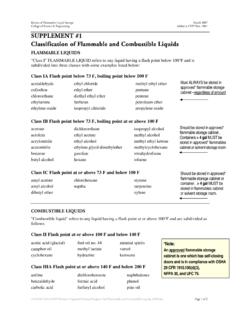
Classification of Flammable and Combustible Liquids
www.sfsu.eduCOMBUSTIBLE LIQUIDS "Combustible liquid" refers to any liquid having a flash point at or above 100°F and are subdivided as follows: Class II Flash point at or above 100 F and below 140 F *Note: An . approved flammable storage cabinet is one which has self-closing doors and is in compliance with OSHA 29 CFR 1910.106(d)(3), NFPA 30, and UFC 79.
Chapter 5: CHEMICAL STORAGE - Lehman
www.lehman.eduThe flammable storage limit for laboratories in Davis is 15 gallons; in Science Hall, 25-30 gallons (approximately). Inventories of flammable liquids in quantities that exceed day-to-day laboratory use should be stored in FDNY-permitted flammable storage rooms to minimize the potential harm to persons and property in case of fire.

Storage of flammable liquids in containers HSG51
www.hse.gov.ukStorage of flammable liquids in containers Page 4 of 60 Health and Safety Executive Introduction 1 This guidance is for those responsible for the safe storage of flammable liquids in containers at the workplace. It provides information on the fire and explosion hazards associated with flammable liquids and will help you to control the risks. It