
General Pathology Notes - BU
530.304 – General Pathology Lecture Notes INTRODUCTION TO PATHOLOGY • Introduction to Pathology General pathology is the study of the mechanisms of disease (with emphasis on aetiology and pathogenesis), while systematic pathology is the study of diseases as they occur within particular organ systems – it involves aetiology, pathogenesis, epidemiology, macro- and
Download General Pathology Notes - BU

Information
Domain:
Source:
Link to this page:
Documents from same domain

MECHANICAL PROPERTIES OF ENGINEERING MATERIALS
www.bu.edu.egMaterials scientists learn about these mechanical properties by testing materials. Results from the tests depend on the size and shape of material to be tested (specimen), how it is held, and the way of performing the test.

1. AACE Practice No. - Bu
www.bu.edu.egThe World Bank and the International Finance Corporation (IFC), “Doing Business 2010 Egypt, Arab Republic” , The International Bank for Reconstruction and Development / The World Bank, 2009.

Benha University 3 Faculty of Engineering at Shoubra High ...
www.bu.edu.egFaculty of Engineering at Shoubra High Voltage Engineering (1) Electrical Engineering Department 2014, E. M. S. Page 3 Of 10 resulting in the formation of an electron avalanche. Breakdown will occur, when the avalanche exceeds a certain critical size.

Introduction to Three-phase Circuits
www.bu.edu.eg• Three phase is the most economical polyphase system. AC Generation • Three things must be present in order to produce electrical current: a) Magnetic field b) Conductor c) Relative motion • Conductor cuts lines of magnetic flux, a voltage is induced in the conductor
7 Measurement of High Voltages and Currents
www.bu.edu.egresistors located in an airtight transformer oil filled P.V.C. tube, for 100 kV operation had very good temperature stability. The limitations in the series resistance design are: (O power dissipation and source loading, (ii) temperature effects and long time stability, (Ui) voltage dependence of resistive elements, and
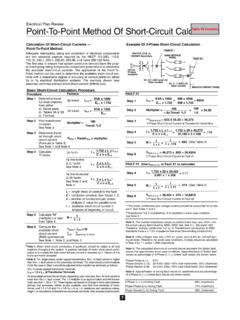
Electrical Plan Review Point-To-Point Method Of Short ...
www.bu.edu.eg440 59 98 148 197 295 394 656 984 1312 1968 2624 460 56 94 141 188 282 377 628 941 1255 1883 2510 480 54 90 135 180 271 361 601 902 1203 1804 2406 600 43 72 108 144 217 289 481 722 962 1443 1925 Electrical Plan Review Point-To-Point Method Of Short-Circuit Calculation Ampacity Busway Plug-In Feeder High Impedance Copper Aluminum Copper Aluminum ...
Chapter 2 Field crop classification
www.bu.edu.egThis family includes about three fourths of the cultivated forage crops and all the cereals. They have the following characters: - They are winter annuals or perennials. - They are almost herbaceous plants. - Stems are usually hollow, cylindrical and made up of nodes and internodes. - Leaves are alternative with parallel veins.
MECHANICAL PROPERTIES OF ENGINEERING MATERIALS
www.bu.edu.egthe mechanical properties of a material. The test is performed using a loading apparatus such as the Tinius Olsen machine. The capacity of this machine is 10,000 pounds (tension and compression). The specimen of a given material (i.e. steel, aluminum, cast iron) takes a cylindrical shape that is 2.0 in. long and 0.5 in.

Chapter 5 BJT Biasing Circuits
www.bu.edu.eg1. Determine the Q-point and construct dc load line for this transistor. Figure 5.26 For problem 1. [7] 2. Assume DC = 100 and I E I C. (a) Find V E, V C (b) Determine Q-point of this transistor (c) Construct DC load line and plot Q-point (d) Calculate IC if R B is changed from 10 k to be 1 k Figure 5.27 For problem 2.

Lecture #4 BJT AC Analysis
www.bu.edu.eg• The dc analysis of npn and pnp configurations is quite different in the sense that the currents will have opposite directions and the voltages opposite polarities. • However, for an ac analysis where the signal will progress between positive and negative values, the ac equivalent circuit will be the same. npn versus pnp J-601-4 l-a
Related documents

Introduction to Virology I: Viral Structure and Function
www.columbia.eduIII. Classification Viral classification has been confusing and oft-changing over the years. In the past, viruses were often classified by host, target organ or vector and these are still used vernacularly (e.g., the hepatitis viruses). Modern classification is based …

VIRUSES - Introduction, structure and classification
www.virologyresearch.unsw.edu.auclassification of Viruses Main criteria used for classification of Viruses • The type of nucleic acid • Number of strands of nucleic acid and their physical construction; ss or ds, linear, circular, circular with breaks, segmented. • Polarity of the viral genome – viral genome acts as mRNA are termed “positive-stranded".
SUBJECT: BOTANY Botany-I: Intermediate First Year
sche.ap.gov.inTaxonomy of angiosperms: Introduction. Types of Systems of classification (In brief). Semi- ... Viruses: Discovery, Classification of Viruses, structure of Viruses, Multiplication of Bacteriophages – The lytic cycle, The Lysogenic Cycle, Viral diseases in Plants, Viral diseases in Humans. UNIT-III:GENETICS:

INTERMEDIATE 1 YEAR ACCOUNTANCY SYLLABUS
tsbie.cgg.gov.in1.ATOMIC STRUCTURE: Discovery of Election, proton and Neutron, atomic number, isotopes and isobars. Thomson’s model and its limitations. Rutherford’s model and its limitations 1.6 Quantum mechanical model of an atom - shapes of atomic orbitals 2.CLASSIFICATION OF ELEMENTS A ND PERIODICITY OF PROPERTIES 2.1 Need to classify elements 2.2 Genesis

Biology
www.aku.edu5.4.3 explain how viruses survive inside a host cell; * 5.5 Classification of Viruses 5.5.1 classify viruses on the basis of their structure, type of nucleic acid and host; * 5.5.2 list diseases caused by viruses in animals and plants; 5.6 * Life Cycle of Viruses 5.6.1 compare lytic and lysogenic life cycle of a bacteriophage; *

European Medicines Agency
www.ema.europa.euINTRODUCTION 2 2. SOURCE MATERIALS 3 2.1 Classification 3 ... specific steps to inactivate or remove these and other blood-borne viruses. However, ... accordance with the “Contribution to Part II of the structure of the dossier for applications for marketing authorisation - control of starting materials for the production of blood derivatives

Biology of White Leg Shrimp, Penaeus vannamei: Review
www.idosi.orgsince the early 1990s. Viruses and bacteria mainly cause the diseases of the shrimp. Hence, most of the published reviews focused on the diseases and production aspects ofP. vannamei. However, the biology of this species is neglected during the last two decades. For better production and health management systems