Genes DNA Replication - NJCTL
www.njctl.org Biology Genes Genes DNA Replication Classwork 1. Explain why it is necessary to be able to replicate DNA in order to sustain life. 2. What is the appropriate scientific term used to describe ‘a series of bases that code for a protein?’ 3. If a strand of DNA …
Download Genes DNA Replication - NJCTL

Information
Domain:
Source:
Link to this page:
Documents from same domain
Thermodynamics - Center For Teaching & Learning
content.njctl.orgThermodynamics AP Physics B Name_____ Multiple Choice Questions 1. What is the name of the following statement: “When two systems are in thermal equilibrium
Multiple Choice Review- Photosynthesis and Cellular ...
content.njctl.orgMultiple Choice Review- Photosynthesis and Cellular Respiration 1. Oxidation is a. The addition of electrons to a molecule b. The addition of protons to a molecule c. The loss of electrons from a molecule d. The loss of protons from a molecule 2. What molecules are necessary for aerobic cellular respiration? a. Glucose and Oxygen b.

Atomic Structure and Electron Configurations Multiple ...
content.njctl.orgAtomic Structure and Electron Configurations Multiple Choice PSI Chemistry Name:_____ 1. Rutherford’s Nuclear Model of the atom A. is the currently accepted atomic model. B. explains the unique emission spectra of different elements. C. does not account for the stability of most atoms since accelerating electrons

Periodic Trends Multiple Choice Review PSI Chemistry Name
content.njctl.orgJul 13, 2012 · Electronegativity 23)The ability of an atom in a molecule to attract electrons is best quantified by the _____. A) paramagnetism B) diamagnetism C) electronegativity D) first ionization potential E) electron change-to-mass ratio 24)Electronegativity _____ from left to right within a period and _____ from top to bottom within a group.

PSI AP Physics 2 Electric Potential and Capacitors ...
content.njctl.orgA Dielectric can do which of the following in capacitors? Select two answers. A. Decrease capacitance B. The electric field between plates is reduced. C. Increase capacitance ... How long a capacitor is connected to a power source . Answers 1. C 2. D 3. D 4. A 5. B 6. C 7. C 8. A 9. A 10. A 11. B 12. D 13. B 14. A 15. B 16. D 17. D 18. C 19. A ...

PSI Physics - Kinematics Multiple Choice Questions
content.njctl.orgOct 13, 2013 · PSI Physics - Kinematics Multiple Choice Questions 1. An object moves at a constant speed of 6 m/s. This means that the object: A. Increases its speed by 6 m/s every second B. Decreases its speed by 6 m/s every second . Doesn’t move D. Has a positive acceleration E. Moves 6 meters every second 2. A toy car moves 8 m in 4 s at the constant ...

Fluids Practice Problems - NJCTL
content.njctl.orgMay 13, 2009 · Fluids Practice Problems PSI AP Physics B Name_____ Multiple Choice Questions 1. Two substances mercury with a density 13600 kg/m3 and alcohol with a density 0.8 kg/m3 are selected for an experiment. If the experiment requires equal masses of each liquid, what is the ratio of alcohol volume to the mercury volume?

PSI Physics Simple Harmonic Motion (SHM) Multiple-Choice ...
content.njctl.org14. An object with a mass M is suspended from an elastic spring with a spring constant k. The object oscillates with period T on the surface of Earth. If the oscillating system is moved to the surface of Moon, how it will change the period of oscillations? Acceleration due to gravity on moon= 1.6 m/s 2 A. The period is increased by factor √6 B.

Covalent Bonding & Molecular Compounds Multiple Choice ...
content.njctl.orgMar 01, 2013 · A) boron chloride B) boron trichloride C) monoboron chloride D) trichloro boron E) monoboron trichloride 22) The name of the binary compound CS 2 is _____. A) carbon sulfide B) monocarbon disulfide C) carbon disulfide D) carbon …

PSI AP Physics 1 Circular Motion - NJCTL
content.njctl.orgball just clears the ground. Air resistance is negligible. Express all answers in terms of M, L, and g. a. Determine the magnitude and direction of the net force on the ball when it is at the top. b. Determine the speed v o of the ball at the top. After a few circles, the string breaks when the ball is at the highest point.
Related documents

Continuous and discontinuous variation
biologymad.comContinuous variation is the combined effect of many genes (known as polygenic inheritance) and is often significantly affected by environmental influences. Milk yield in cows, for example, is determined not only by their genetic make-up but is also significantly affected by environmental factors
DNA: The Genetic Material
www.csun.eduDNA as the Genetic Material ¥DNA was first extracted from nuclei in 1870 ¥named ÔnucleinÕ after their source. ¥Chemical analysis Ð determined that DNA was a weak acid rich in phosphorous. ¥Its name provides a lot of information about DNA: Ðdeoxyribose nucleic acid: Ðit contains a sugar moiety (deoxyribose), Ðit is weakly acidic,
Principles and Processes in Biotechnology
ncertbooks.prashanthellina.comIn a chromosome there is a specific DNA sequence called the origin of replication, which is responsible for initiating replication. Therefore, for the multiplication of any alien piece of DNA in an organism it needs to be a part of a chromosome(s) which has a specific sequence known as ‘origin of replication’. Thus, an alien DNA is linked ...
Questions with Answers- Replication, Transcription ...
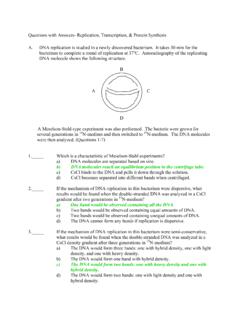
med.fau.eduC. The proteins needed for all stages of DNA replication in E. coli are studied. (Questions 14-25) 14._____ During initiation of replication a) DNA polymerases denature A-T rich sequences at the origin. b) replication begins when Dna A protein binds the origin and synthesizes primers.

DNA AND IT’ S STRUCTURE, FUNCTION, TYPES, MODES OF ...
www.eagri.orgDNA AND IT’ S STRUCTURE, FUNCTION, TYPES, MODES OF REPLICATION AND REPAIR . The discovery that DNA is the prime genetic molecule, carrying all the hereditary information within chromosomes, immediately had its attention focused on its structure. It was hoped that knowledge of the structure would reveal how DNA carries the genetic messages ...

Similarity between replication and transcription
www.qu.edu.iq-DNA regions that can be transcribed into RNA are called structural genes. 5 2-RNA Polymerase: • The enzyme responsible for the RNA synthesis is DNA-dependent RNA polymerase. – The prokaryotic RNA polymerase is a multiple-subunit protein of ~480kD. – Eukaryotic systems have three kinds of RNA polymerases, each of which is a multiple-

Unit 6 PPT #2
ca01001129.schoolwires.netSegments of DNA (GENES) are the instructions that control the production of proteins. Genetic messages can be decoded by copying part of the nucleotide sequence from DNA into RNA. ... DNA Replication DNA-DNA A – T C – G G – C T - A Transcription DNA-mRNA A – U

Chapter 11 Lecture Notes: The Structure of DNA
facultystaff.richmond.eduE. Steps in DNA replication 1. Binding of DnaA to oriC and initial unwinding of the helix 2. RepA helicase “melts” the DNA at the replication fork 3. Priming DNA synthesis – Primase synthesizes RNA primers. (From: AN INTRODUCTION TO GENETIC ANALYSIS 6/E BY Griffiths, Miller, Suzuki, Leontin, Gelbart 1996 by W. H. Freeman and Company.

DNA, RNA, replication, translation, and transcription ...
sites.engineering.ucsb.eduOct 27, 2010 · DNA, RNA, replication, translation, and transcription Overview Recall the central dogma of biology: DNA (genetic information in genes) RNA (copies of genes) proteins (functional molecules) DNA structure One monomer unit = deoxyribonucleic acid • composed of a base, a sugar (deoxyribose), and a phosphate

DNA replication
www.csun.eduThe mechanism of DNA replication (prokaryotic) ¥DNA polymerase ... ¥Transcription of histone genes is initiated near the end of G1 phase, and translation of histone proteins occurs throughout S phase. ¥Assembly of newly replicated DNA into nucleosomes is shown in Figure 11.16. 29