
Grades K–12 - NASA
of altitude, velocity and acceleration (i.e., height, distance and speed). The Adventures in Rocket Science Activity Matrix on page v organizes the activities by suggested grade level bands as well as target concepts. Examine the matrix for a grade level band (e.g., grades 1–3). Select a target word located in that grade level band (e.g ...
Download Grades K–12 - NASA

Information
Domain:
Source:
Link to this page:
Documents from same domain
Q: What do you do on the International Space …
www.nasa.govQ: What do you do on the International Space Station (ISS)? A: Astronauts and cosmonauts on the space station stay busy.There’s lots of work to operate the many science experiments on board.
NEPA RECORD OF ENVIRONMENTAL …
www.nasa.govDec 13, 2012 · JSC Form 1119 (Revised January 25, 2011)(MS Word October 2010) NEPA RECORD OF ENVIRONMENTAL CONSIDERATION (REC) Complete this form if you answered “yes” or “unknown” on any JF 1138 entries and if
Use of XSLT to transform the output of multiple …
www.nasa.govNASA IV&V International Workshop 2014 1 Use of XSLT to transform the output of multiple Static Code Analysis tools into a consistent analysis spreadsheet format
International Space Station Activity Book
www.nasa.govNational Aeronautics and Space Administration . Grades K-5 . This activity book belongs to: International Space Station Activity Book >>> For more information, check out the web sites on page 30!
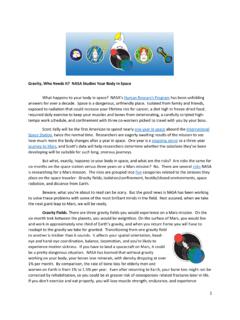
Gravity, Who Needs It
www.nasa.govGravity, Who Needs It? ... six months on the space station versus three years on a Mars mission? No. ... human, being more isolated ...
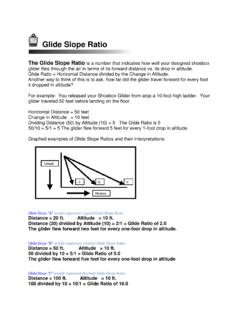
Glide Slope Ratio
www.nasa.govGlide Slope Ratio The Glide Slope Ratio is a number that indicates how well your designed shoebox glider flies through the air in terms of its forward distance vs. its drop in altitude. Glide Ratio = Horizontal Distance divided by the Change in Altitude.
Modeling, SiMulation, inforMation technology & …
www.nasa.govTA11-1 exeCuTive Summary Figure 1 is an initial draft strategic roadmap for the Modeling, Simulation, Information Technol-ogy and Processing Technology Area.
NASA Technology Roadmaps
www.nasa.gov2015 NASA Technology Roadmaps TA 11: Modeling, Simulation, Information Technology, and Processing TA 11- 2 July 2015 Foreword NASA is leading the way with a balanced program of space exploration, aeronautics, and science research.

A Journey to Inspire, Innovate, and Discover
www.nasa.govReport of the President’s Commission on 2 Implementation of United States Space Exploration Policy Transmittal Letter June 4, 2004 The Honorable George W. Bush
National Aeronautics and Space Administration Headquarters
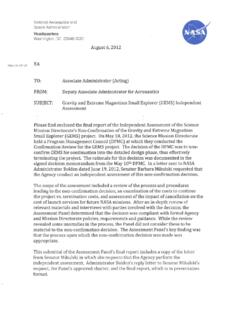
www.nasa.govGEMS is a Category 3 project (less than $250M) in Phase B, and was requesting transition from Formulation to Implementation (Phase C) where the official Agency baseline is established and external commitments are made
Related documents

Velocity Profile in Open Channel Flow
abe-research.illinois.eduThe average velocity is given by v = ∫ 0 d vdy d = 2.5v∗ d ∫ 0 d ln 33y κdy v =2.5V∗ln 12.14d κ v = 2.5ln 12.14d κ g R 1 2i 1 2 This theoretical equation can be compared with empirical equations that have been developed to express the mean velocity in an open channel: Chezy Equation v =CR 1 2 i 1 2 ⇒C =2.5ln 12.14d κ g
Linear Impulse and Momentum; Collisions - MIT …
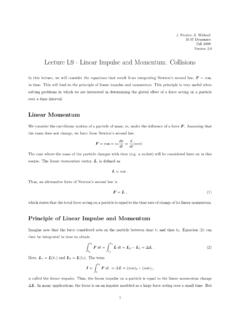
ocw.mit.eduA baseball is traveling with a horizontal velocity of 85 mph just before impact with the bat. Just after the impact, the velocity oof the 5 81 oz. ball is 130 mph, at an angle of 35 above the horizontal. We want to determine the horizontal and vertical components of the average force exerted by the bat on the baseball during the 0.02 s impact.
Exercise Set 2.5: Average Rate of Change - UH
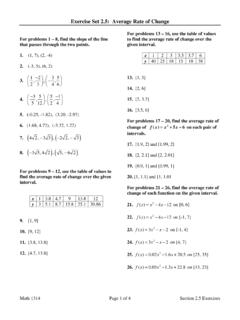
online.math.uh.eduA. Find the average velocity in the first two seconds after the object is thrown. B. Find the average velocity from t =2 to t =4. 30. Suppose an object is thrown upward with initial velocity of 48 feet per second from a height of 120 feet. The height of the object t seconds after it is thrown is given by h t t t( ) 16 48 120=− + +2
Instantaneous Rate of Change — Lecture 8. The Derivative.
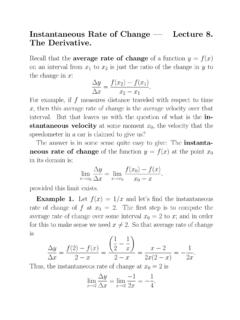
pages.uoregon.eduRecall that the average rate of change of a function y = f(x) on an interval from x 1 to x 2 is just the ratio of the change in y to the change in x: ∆y ∆x = f(x 2)−f(x 1) x 2 −x 1. For example, if f measures distance traveled with respect to time x, then this average rate of change is the average velocity over that interval.
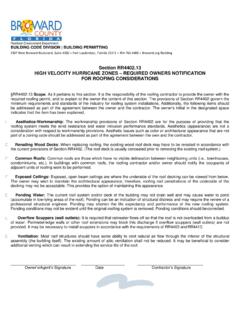
Section RR4402.13 HIGH VELOCITY HURRICANE ZONES …
www.broward.orgHIGH VELOCITY HURRICANE ZONES – REQUIRED OWNERS NOTIFICATION FOR ROOFING CONSIDERATIONS §RR4402.13 Scope. As it pertains to this section. It is the responsibility of the roofing contractor to provide the owner with the required roofing permit, and to explain to the owner the content of this section. The provisions of Section RR4402 govern the
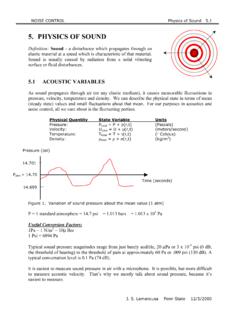
5. PHYSICS OF SOUND - Pennsylvania State University
www.mne.psu.eduThe acoustic particle velocity is: r p t u ∂ ∂ =− ∂ ∂ ρ 1 Considering only the outgoing wave, the velocity is: = + t c p r t dt r u r t 0 2 1 ( ,) ( , ) ρ ρ For large values of r (large in terms of a wavelength), the first term becomes negligible and the impedance converges to ρc. The curvature of the wave front becomes negligible ...
General Physics (PHY 170) - University of Hawaiʻi
www.phys.hawaii.eduThe average acceleration vector: is defined as the rate at which the velocity changes. It is in the direction of the change in velocity Δv. The instantaneous acceleration is the limit of the average acceleration as Δt approaches zero.