GUIDE TO MEASURING INFORMATION AND …
The UNESCO Institute for Statistics (UIS) is the statistical office of the United Nations Educational, Scientific and Cultural Organization (UNESCO) and is the UN depository for internationally comparable statistics in the fields of education, science and technology, culture and communication. GUIDE TO MEASURING INFORMATION AND
Download GUIDE TO MEASURING INFORMATION AND …

Information
Domain:
Source:
Link to this page:
Documents from same domain
One in Five Children, Adolescents and Youth is Out of School
uis.unesco.orgchildren and youth has declined by little more than 1 million per year since 2012. Some 63 million, or 24% of the total, are children of primary school age (about 6 to 11 years old); 61 million, or 23% of the total, are adolescents of lower secondary
Provisional Agenda - UNESCO UIS
uis.unesco.orgProvisional Agenda Day 1 – Sunday, 4 December 2016 Bilateral meetings The meetings will be held with the representatives of each country to review the outcomes of UIS education surveys. Specifically, the objectives of bilateral meetings are to: ... Advanced charts in Excel

Communications and Stakeholder Engagement Guide
uis.unesco.org2 Communications and Stakeholder Engagement Guide . Introduction . The Global Alliance to Monitor Learning (GAML) is an institutional platform to coordinate efforts
Principles of Good Practice in Learning Assessment
uis.unesco.orgThe ACER Centre for Global Education Monitoring Principles of Good Practice in Learning Assessment 3 At the national level, this involves the development of national strategies for large-scale
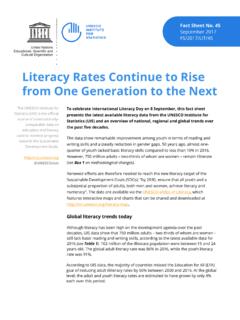
Literacy Rates Continue to Rise from One Generation to the ...
uis.unesco.orgFact Sheet No. 45 September 2017 FS/2017/LIT/45 Literacy Rates Continue to Rise from One Generation to the Next To celebrate International Literacy Day on 8 September, this fact sheet
Information and Communication Technology ICT in Education ...
uis.unesco.orgof ICT in education and how it is integrated across national education systems must be a priority for all countries. 1. Why do we measure ICT in education? The UNESCO Institute for Statistics (UIS) is mandated to administer international data collections on the availability, use and impact of ICT in education. Through the establishment of
INFORMATION AND COMMUNICATION TECHNOLOGY …
uis.unesco.org1. Why do we measure ICT in education? The UNESCO Institute for Statistics (UIS), which is the United Nation’s repository for statistics on education, science and technology, and culture and communication, is mandated to administer international data collections on the availability, use and impact of ICT in education.
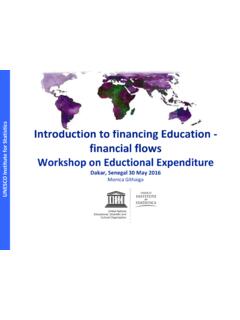
Introduction to financing Education - s financial flows
uis.unesco.orgs Typical Sources of Education Financing – multiple actors • Government/Public – often the largest contributor to the education sector and/or most sectors of the economy; • Income generated by schools; • External (grants or loans channelled …
and Incheon Declaration Framework for Action
uis.unesco.orgsustainable development agenda. 10. We commit to promoting quality lifelong learning opportunities for all, in all settings and at all levels of education. This includes equitable and increased access to quality technical and vocational education and training and higher education and research, with due attention to quality assurance.
Children Out of School - UNESCO
uis.unesco.orgout of school are counted, but they are also needed to provide a more detailed picture of these children. The global count is important for monitoring progress. Yet at the same time, it is essential to view the child and household as units of analysis in order to reassess or
Related documents
A Guide to Risk Management of Cultural Heritage
www.iccrom.orgThis guide, supported with examples and illustrations, provides a scientific model and methodology for risk examination and assessment. It enables cultural heritage professionals and institutions to devise intervention plans based on thorough assessment, which can ultimately facilitate decision-making processes.

Early Years Communication Practice Guide
www.vcaa.vic.edu.aufoundation for subsequent communication skill development. This guide draws on evidence detailed in Assessment of Children as Effective Communicators in Early Childhood Education and Care: Literature Review, (Verdon et al. 2018). The guide is designed to help educators better understand the trajectory of communication skill
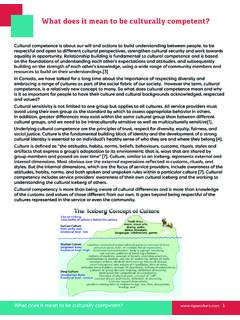
What does it mean to be culturally competent?
rapworkers.com• developing skills for communication and interaction across cultures.[6] Cultural proficiency “requires more than becoming culturally aware or practicing tolerance”. Rather, it is the ability to “identify and challenge one’s own cultural assumptions, values and beliefs, and to
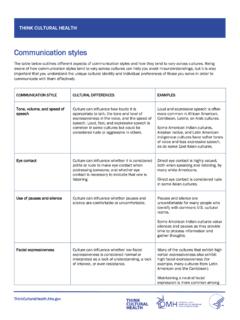
Communication Styles - thinkculturalhealth.hhs.gov
thinkculturalhealth.hhs.govCOMMUNICATION STYLE CULTURAL DIFFERENCES EXAMPLES Orientation to self or others Some cultures are much more oriented to the self, while others are more oriented to others. This shows in communication styles through the use of mostly “I” statements versus use of primarily third person and plural pronouns. The dominant cultural norm in the
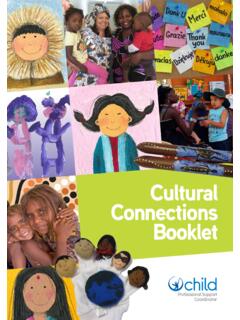
Cultural Connections Booklet - Child Australia
www.childaustralia.org.auCultural competence encompasses: • Being aware of one’s own world view • Developing positive attitudes towards cultural differences • Gaining knowledge of different cultural practices and world views • Developing skills for communication and interaction across cultures. The EYLF Educators Guide (2010, 25-26) describes cultural ...