GUIDELINES FOR DEVELOPING LEARNING MATERIALS
Advanced Technical and Vocational Training (1987)). Curriculum document refers to a document that reflects essential guiding information on a particular curriculum or learning programme. It usually covers issues such as the main purpose of the curriculum, implementation, assessment and monitoring strategies to be used, and the necessary resources.
Download GUIDELINES FOR DEVELOPING LEARNING MATERIALS

Information
Domain:
Source:
Link to this page:
Documents from same domain
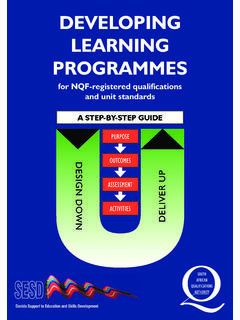
DEVELOPING LEARNING PROGRAMMES - saide.org.za
www.saide.org.zaDeveloping Learning Programmes for NQF-registered Qualifications and Unit Standards i DEVELOPING LEARNING PROGRAMMES for NQF-registered qualifications
Haramaya University School of Agricultural …
www.saide.org.zaHaramaya University School of Agricultural Economics and Agribusiness Module on Agricultural Marketing and Price Analysis By: Jema Haji (PhD) November 2014
˜e Right to dut ommunit Education - saide.org.za
www.saide.org.zaERP BooklEts in this sERiEs 1 HIV/AIDS: The Rights of Learners and Educators 2 Sexual Violence: The Rights of Learners and Educators 3 The Education Rights of Refugees, Asylum Seekers and Migrants
CRITERIA AND GUIDELINES FOR THE EVALUATION …
www.saide.org.zacriteria and guidelines for the evaluation of foreign qualifications the south african qualifications authority
Criteria and Guidelines for Short Courses and Skills ...
www.saide.org.zaGUIDELINE DOCUMENT Criteria and Guidelines for Short Courses and Skills Programmes Providers of short learning programmes have a critical role to play in the resource-efficient

Learner support: a South African Programme Perspective
www.saide.org.zageneral, are underprepared. In light of the above, it becomes clear why learner support should be seen as an integral part of any well functioning distance education or ‘flexible’ learning programme. Learner support has been perceived as one way of creating optimum conditions for success and enhancing the quality of educational provision.

Using learning resources – some examples - Saide
www.saide.org.zaevaluating 9. summarising and integrating 10. decision making Developing and and action planning maintaining the relationship 1. Practising empathy 2. attending and active listening 3. reflecting back and paraphrasing 4. self-disclosure 11. questioning 12. focusing 13. using silence and paraphrasing 14. Giving constructive feedback 15 ...
Related documents

How To Form an Effective Advisory Committee
www.avc.eduregarding program curriculum. Identifies the relevant and current specific skills, knowledge and attitudes that should be included in the program. Assists in distributing announcements of vocational openings. (Class openings or new faculty positions, etc.) Helps develop and implement dissemination of program information to the community.
A brief history of educational assessment in the Philippines
files.eric.ed.govvocational education in the Philippines. He observed various types of schools and schoolwork. He interviewed school officials and businessmen. He recommended in the survey to improve various phases of the vocational educational such as 7th grade shopwork, provincial trade schools, practical arts training in the regular high
Technical Vocational and Education Training (TVET) 1
en.unesco.orgTechnical Vocational and Education Training (TVET) iii Executive Summary Technical and Vocational Education and Training (TVET) is an important part of the education system with the aim of developing skilled workers for a country. For developing countries, including the

Curriculum: Concepts, Nature and Purposes
khayma.comAllan Glatthorn (2000) describes seven types of curriculum operating in the schools. 1) Recommended curriculum- proposed by scholars and professional organizations. 2) Written curriculum- appears in school, district, division or country documents. 3) Taught curriculum- what teachers implement or deliver in the classrooms and schools
Quality in School Education - Quality Council of India
qcin.org16 Table: 4.1 Designing Curriculum and Syllabus of Different Boards 49 17 Table: 4.2 Class- wise and school-wise pedagogy of CBSE, CISCE, IB and Delhi Govt. Schools 52-53 18 Table: 5.1 Class- Wise Distributions of Subjects, Tests and Examination (CBSE) 63 19 Table: 5.2 Classes X and XII: Examination and Marks Division (CBSE) 63
Class X - CBSE
cbseacademic.nic.inCBSE has introduced Information Technology (IT) as Vocational course at secondary level in class IX (Level-1) and class X (level-2). In the present day of globalized competition, Information Technology plays a significant role. Information Technology (IT) has created a revolution in every field and enabled students towards progressive learning.

Developing a Curriculum for the Transition Program of ...
files.eric.ed.govb Division City Schools of Pasig City, Pasig City Philippines c,d, Bureau of Curriculum Development, Department of Education, Pasig City, Philippines Abstract This paper focuses on creating a curriculum development model and curriculum framework for the Transition Program designed for special learners with intellectual and physical disabilities.
Employability Skills - NCERT
ncert.nic.inResearch and Training, 2019 215.00 Printed on 80 GSM paper with NCERT watermark Published at the Publication Division by the Secretary, National Council of Educational Research and Training, Sri Aurobindo Marg, New Delhi 110 016 and printed at Raas Technoprint, A-93, Sector-65, Noida-201 301 (U.P.) ISBN 978-93-5292-126-3 Publication Team

Philippines Curriculum development
daneshnamehicsa.irDevelopment of the basic education level curriculum is the responsibility of the Central Office Bureau of Elemen-tary and Secondary Education, Curriculum Development Divisions. This bureau defines the learning competencies for the different subject areas; conceptualizes the structure of the curriculum; formulates national curricular policies.