
Hardness - MRWA
Water should have a total hardness of less than 75 to 85 mg/l as CaCO 3 and a magnesium hardness of less than 40 mg/l as CaCO 3 to minimize scaling at elevated temperatures. Many systems allow hardness in finished water to approach 110 to 150 mg/L to reduce chemical
Download Hardness - MRWA

Information
Domain:
Source:
Link to this page:
Documents from same domain

Lime-Soda Ash Softening - MRWA.com
www.mrwa.comLime Softening 1 Lime Softening . Chemical precipitation is one of the more common methods used to soften water. Chemicals normally used are lime (calcium …
Filtration - MRWA.com
www.mrwa.comFiltration 1 Filtration . Filtration plays an important role in the natural treatment of groundwater as it percolates through the soil. It is also a …
Filtration - MRWA
www.mrwa.comFiltration 1 Filtration . Filtration plays an important role in the natural treatment of groundwater as it percolates through the soil. It is also a …
Membrane Filtration - MRWA
www.mrwa.comMembrane Filtration 1 Membrane Filtration . A membrane is a thin layer of semi-permeable material that separates substances when a driving force is applied across the membrane.
Corrosion - MRWA
www.mrwa.comCorrosion 1 Corrosion . Corrosion causes gradual decay and deterioration of pipes, both internally and externally. It can reduce the life of a pipe …
Lime-Soda Ash Softening - MRWA.com
www.mrwa.comLime Softening 1 Lime Softening . Chemical precipitation is one of the more common methods used to soften water. Chemicals normally used …

Iron and Manganese Removal - MRWA
www.mrwa.comIron and Manganese 1 Iron and Manganese . Iron and manganese control is the most common type of municipal water treatment in Minnesota. Iron and manganese occur naturally in groundwater.

Class D Study Guide - MRWA.com
www.mrwa.comClass D Study Guide . This study guide is designed for operators taking the Class D water operator . certification exam and is a condensed version of the Minnesota Water Works Operations Manual. This tool, along with your operating experience and
Iron and Manganese Removal - MRWA.com
www.mrwa.comRemoval by Iron and Manganese Filtration Removing iron and manganese from drinking water instead of sequestration it is recommended if the water contains over 0.3 ppm of iron or 0.05 ppm of manganese.

Financing Your Community Projects - mrwa.com
www.mrwa.comFinancing Your Clean Water and Drinking Water Municipal Infrastructure Projects With State Loan and Grant Funds Find out about the financing process when using the Clean Water and Drinking Water Revolving Funds, WIF, and Legacy Funds. Becky Sabie, Minnesota Public Facilities Authority
Related documents
Interpreting Drinking Water Test Results
adams.extension.wisc.eduthe tendency for water to corrode plumbing, or for lime deposits to form in pipes. HARDNESS. Helps determine the need for water softening; also influences corrosivity. pH. Indicates water's acidity and helps determine if water will corrode plumbing. After running the initial set of tests, well users should continue to test for bacteria once a year.
Interpreting Drinking Water Quality Results
www.uwsp.eduWater that is naturally low in total hardness (referred to as soft water) may be corrosive. Note the water softening industry measures gallon. 1 grain per gallon = 17.1 mg/L CaCO 3. Acceptable Results: Total hardness is a test for overall water quality; there are no health concerns related to total hardness. Values near 150 mg/L are generally ...
Determination of water hardness from common water …
dept.cord.eduWater hardness is determined by measuring the total concentration of magnesium and calcium in a water source. Water hardness impacts ecological, economic, and human health concerns. Ecologically, water hardness impacts fish cultures as well as many other species that rely on a steady calcium carbonate concentration.1 Hard water in the municipal
Hardness in Drinking-water - World Health Organization
www.who.intHARDNESS IN DRINKING-WATER 2 Estimated daily intakes of magnesium from water of about 2.3 mg and 52.1 mg in soft-water and hard-water areas, respectively, have been reported, based on adults drinking 2 litres of water per day (Neri et al., 1985). 2.2 Food Food is the principal dietary source of intake of both calcium and magnesium. Dairy

Determination of Water Hardness using Complexometric …
mccord.cm.utexas.eduTotal water hardness is usually expressed as the milligrams of CaCO3 equivalent to the total amount of calcium and magnesium present in one liter of water (mg/liter, i.e., ppm). Water hardness may range from zero to hundreds of ppm, depending on the source. The classification of degree of water hardness
HARDNESS (2340)/EDTA Titrimetric Method 2-37 2340 …
beta-static.fishersci.comhardness.”When the hardness numerically is equal to or less than the sum of carbonate and bicarbonate alkalinity, all hard-ness is carbonate hardness and noncarbonate hardness is absent. The hardness may range from zero to hundreds of milligrams per liter, depending on the source and treatment to which the water has been subjected. 2.
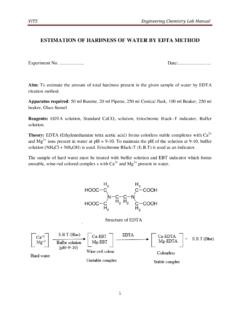
ESTIMATION OF HARDNESS OF WATER BY EDTA METHOD
uobabylon.edu.iq2. Determination of Total hardness Repeat the above titration method for sample hard water instead of standard hard water. Let the burette reading of EDTA be V 3 ml. 3. Determination of Permanent hardness Take 100 ml of sample hard water in 250 ml beaker. Boil it to remove temporary hardness to about half of this volume and cool to room ...

CHEMICAL PRECIPITATION: WATER SOFTENING
www.egr.msu.eduThe acceptable water hardness range is between 60-120 mg/L as CaCO 3. A water softening experiment was conducted in replicate to observe the changes in parameters such as total hardness, calcium hardness, magnesium hardness, alkalinity and pH with varying dosages of lime. A lime dosage range of 30-180% of the stoichiometric amount
EDTA Titrations 2: Analysis of Calcium in a Supplement ...
www.uclmail.netThe total hardness can be calculated from the titration values. The units of hardness are based on the fictional assumption that the hardness ions are all calcium: Water Hardness = mg / L or ppm of CaCO 3 Definition of the ppm Unit for a Dilute Aqueous Solution For very dilute solutions in water, since the mass of 1.0 L of the solution is very ...