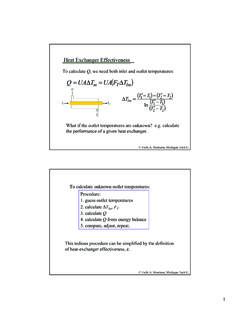
Heat Exchanger Effectiveness
The heat capacity of the oil is 1.89 kJ/kg K, and the average heat capacity of water over the temperature range of interest is 4.192 kJ/kg K. The overall heat-transfer coefficient of the exchanger is 300 W/m2 K, and the area for heat transfer is 15.4 m2. What is the total amount of heat transferred? ©Faith A. Morrison, Michigan Tech U.
Download Heat Exchanger Effectiveness

Information
Domain:
Source:
Link to this page:
Documents from same domain
CM3215 Fundamentals of Chemical Engineering …
pages.mtu.eduControl Valve Lecture, CM3215 Morrison 2/17/2016 1 CM3215 Fundamentals of Chemical Engineering Laboratory Professor Faith Morrison Department of Chemical Engineering

Basic Concepts of Human Genetics - pages.mtu.edu
pages.mtu.edu1 Basic Concepts of Human Genetics • The genetic information of an individual is contained in 23 pairs of chromosomes. Every human cell contains the 23 pair of chromosomes. • One pair is called sex chromosomes Male: XY Female: XX • Other 22 pairs of homologous chromosomes are called autosomes. • The autosome …

Pumping System Curves - Michigan Technological …
pages.mtu.eduPumping System Head CM3215 FAM 3Mar2014 1 CM3215 Fundamentals of Chemical Engineering Laboratory Professor Faith Morrison Department of Chemical Engineering
Chapter 4 - Student
pages.mtu.eduIn Chapter 4, the following problem modules explain the heat transfer processes involved in fuel cell vehicles and in the processes for producing fuel for fuel cells. 4.1-1 Heat Loss through a Stainless Steel Bipolar Plate
Heat Exchanger Effectiveness
pages.mtu.eduHeat Exchanger Effectiveness ... Double-pipe or 1-1 Shell-and-Tube Heat Exchangers ©Faith A. Morrison, Michigan Tech U. 8 Final Exam CM 310 November 16, 1998 ... The heat capacity of the oil is 1.89 kJ/kg K, and the average heat capacity of water over the temperature range of interest is 4.192 kJ/kg K. The overall heat-transfer coefficient of ...

Introduction to Electromagnetic Theory
pages.mtu.edu1/19/18 1 Lecture topics • Laws of magnetism and electricity • Meaning of Maxwell’s equations • Solution of Maxwell’s equations Introduction to Electromagnetic Theory

Note: This document represents a draft of text that is ...
pages.mtu.edubalance equations we choose the boundaries and then note the quantities of mass, energy, or momentum that cross the boundaries (Figure 2). A closed system is a system that does not have any mass crossing its boundaries.

Compressibility Factor from Redlick-Kwong Equations
pages.mtu.eduCompressibility Factor from Redlick-Kwong Equations (Dr. Tom Co 9/2/08) Working Equations: (based on Cutlip and Shacham, 2008, pp. 101-103) Let be pressure in …

STEAM TABLES - Michigan Technological University
pages.mtu.eduSaturated Steam: TEMPERATURE Table STEAM TABLES ( from M. D. Koretsky, "Engineering and Chemical Thermodynamics", John Wiley & Sons, 2004)

ROBOT OPERATIONS - Michigan Technological University
pages.mtu.eduR-J3, R-J3iB and R-30iA Controller This training focuses on the FANUC Robotics R-J3, R-J3iB and R-30iA controller. The R-J3 series uses advanced technology packaged in a
Related documents

HEAT AND MASS TRANSFER Solved Problems By Mr. P. …
www.melamaruthuvakudi.weebly.comCalculate the rate of heat loss through the vertical walls of a boiler furnace of size 4 m by 3 m by 3 m high. The walls are constructed from an inner fire brick wall 25 cm thick of thermal conductivity 0.4 W/mK, a layer of ceramic blanket insulation of

CHAPTER 4 DESIGN FUNDAMENTALS OF SHELL-AND-TUBE …
cheguide.com4.2.1.4 Tube-Side Heat Transfer Coefficient The heat transfer coefficient for the tube-side is expressed as follows: (k 4.7) i t t t d h =Nu where is the Nusselt number for the tube-side fluid which is found by using Eqs. (4.4) and (4.6), k is the thermal conductivity of the tube-side fluid, and is the tube inside diameter. Nut t di
Heat transfer in Flow Through Conduits - Clarkson University
web2.clarkson.eduflux of heat at the wall is uniform, Nu →4.36, but in this case we already know the heat flux and a heat transfer coefficient is not needed. Remember that the purpose of using a heat transfer coefficient is to calculate the heat flux between the wall and the fluid. In the case of uniform

Heat Stress: Hydration - Centers for Disease Control and ...
www.cdc.gov1/4 gallon (32 oz) = approx. 1 L. Hydrate . After. Work • Most people need several hours to drink enough fluids to replace what they have lost through sweat. The sooner you get started, the less strain you place on your body from dehydration. • Hydrating after work is even more important if you work in the heat on a regular basis.

Cooling/Heat Pump Convertible Air Handlers - Trane
www.trane.comPUB. NO. 22-1774-01-0905 (EN) Cooling/Heat Pump Convertible Air Handlers 2/4TEC3F18-60A1000A 1½ – 5 Ton

Installer’s Guide Heat Pumps - Trane
www.trane.com18-BC95D1-4-EN 9 STEP 2 - Remove the pressure tap cap and valve cores from both service valves. STEP 3 - Purge the refrigerant lines and indoor coil with dry nitrogen. STEP 4 - Wrap a wet rag around the valve body to avoid heat damage and continue the dry nitro-gen purge. Braze the refrigerant lines to the service valves.