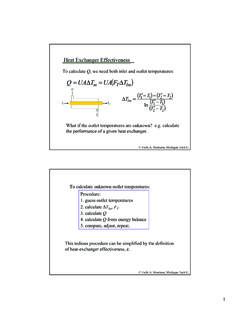
Heat Exchanger Effectiveness
Q A=∞ = mC phot T −T this temperature difference only depends on inlet temperatures hot side: T hi T ho=T ci T co distance along the exchanger ©Faith A. Morrison, Michigan Tech U. =∞ ≡ Q A Q Heat Exchanger Effectiveness, ε ε ( ) hi ci ⇒Q=εmC phot T −T hot fluid = minimum fluid if ε is known, we can calculate Q without ...
Download Heat Exchanger Effectiveness

Information
Domain:
Source:
Link to this page:
Documents from same domain
CM3215 Fundamentals of Chemical Engineering …
pages.mtu.eduControl Valve Lecture, CM3215 Morrison 2/17/2016 1 CM3215 Fundamentals of Chemical Engineering Laboratory Professor Faith Morrison Department of Chemical Engineering

Basic Concepts of Human Genetics - pages.mtu.edu
pages.mtu.edu1 Basic Concepts of Human Genetics • The genetic information of an individual is contained in 23 pairs of chromosomes. Every human cell contains the 23 pair of chromosomes. • One pair is called sex chromosomes Male: XY Female: XX • Other 22 pairs of homologous chromosomes are called autosomes. • The autosome …

Pumping System Curves - Michigan Technological …
pages.mtu.eduPumping System Head CM3215 FAM 3Mar2014 1 CM3215 Fundamentals of Chemical Engineering Laboratory Professor Faith Morrison Department of Chemical Engineering
Chapter 4 - Student
pages.mtu.eduIn Chapter 4, the following problem modules explain the heat transfer processes involved in fuel cell vehicles and in the processes for producing fuel for fuel cells. 4.1-1 Heat Loss through a Stainless Steel Bipolar Plate
Heat Exchanger Effectiveness
pages.mtu.eduHeat Exchanger Effectiveness ... Double-pipe or 1-1 Shell-and-Tube Heat Exchangers ©Faith A. Morrison, Michigan Tech U. 8 Final Exam CM 310 November 16, 1998 ... The heat capacity of the oil is 1.89 kJ/kg K, and the average heat capacity of water over the temperature range of interest is 4.192 kJ/kg K. The overall heat-transfer coefficient of ...

Introduction to Electromagnetic Theory
pages.mtu.edu1/19/18 1 Lecture topics • Laws of magnetism and electricity • Meaning of Maxwell’s equations • Solution of Maxwell’s equations Introduction to Electromagnetic Theory

Note: This document represents a draft of text that is ...
pages.mtu.edubalance equations we choose the boundaries and then note the quantities of mass, energy, or momentum that cross the boundaries (Figure 2). A closed system is a system that does not have any mass crossing its boundaries.

Compressibility Factor from Redlick-Kwong Equations
pages.mtu.eduCompressibility Factor from Redlick-Kwong Equations (Dr. Tom Co 9/2/08) Working Equations: (based on Cutlip and Shacham, 2008, pp. 101-103) Let be pressure in …

STEAM TABLES - Michigan Technological University
pages.mtu.eduSaturated Steam: TEMPERATURE Table STEAM TABLES ( from M. D. Koretsky, "Engineering and Chemical Thermodynamics", John Wiley & Sons, 2004)

ROBOT OPERATIONS - Michigan Technological University
pages.mtu.eduR-J3, R-J3iB and R-30iA Controller This training focuses on the FANUC Robotics R-J3, R-J3iB and R-30iA controller. The R-J3 series uses advanced technology packaged in a
Related documents

HEAT CONDUCTION EQUATION H - Wright State University
cecs.wright.eduHEAT CONDUCTION EQUATION H eat transfer has direction as well as magnitude. The rate of heat conduc-tion in a specified direction is proportional to the temperature gradient, which is the rate of change in temperature with distance in that direction. ... Q …

Chapter 19. Heat Engines and Refrigerators
physics.gsu.eduHeat QH = Q34 is transferred into the gas. 4. The gas expands adiabatically, with Q = 0, until the temperature decreases back to TC. Work is done in all four processes of the Carnot cycle, but heat is transferred only during the two isothermal processes.

Chapter 2: Internal Energy (U), Work (w), Heat (q ...
scienide2.uwaterloo.cacannot say that a system contains that amount of energy or heat Heat: associated with a process going from State 1 o State 2 ' U q w system q is heat; w is the work Heat is exchanged between system and environment q 0: system loses energy q! 0: system gains energy qq system environment note: TT system environment z for heat to flow Isolated system
Q. What is heat wave? - IMD
internal.imd.gov.inQ. What is heat wave? Qualitatively, heat wave is a condition of air temperature which becomes fatal to human body when exposed. Quantitatively, it is defined based on the temperature thresholds over a region in terms of actual temperature or its departure from normal. In certain

Heat Exchanger Modeling, Sizing, and Design
pages.mtu.eduLectures 19 Applied Heat Transfer CM3110 12/3/2019 3 T , outer bulk temperature T, inner bulk temperature L BUT: The temperature difference between the fluid and the wall varies along the length of the heat exchanger. T1 T2 T1 T2 x The Simplest Heat Exchanger: Double‐Pipe Heat exchanger ‐counter current cold less cold less hot hot ...
Conduction in the Cylindrical Geometry - Clarkson University
web2.clarkson.eduQ = constant independent of radial location. The heat flow rate . Q qA= r, where . A. is the area of the cylindrical surface normal to the . r. − direction, and . q. r. is the heat flux in the radial direction. The area of the cylindrical surface is . A rL =2π , where . L. is the length of the pipe. From Fourier’s law, r. dT q k dr =− ...