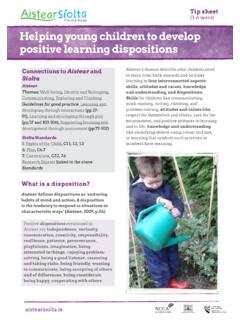
Helping young children to develop positive learning ...
Helping young children to develop positive learning dispositions Tip sheet (3-6 years) Aistear’s themes describe what children need to learn from birth onwards and outlines learning in four interconnected aspects: skills, attitudes and values, knowledge and …
Download Helping young children to develop positive learning ...

Information
Domain:
Source:
Link to this page:
Documents from same domain
Mathematics in Early Childhood and Primary Education (3-8 ...
ncca.ieThe literature offers a range of perspectives, and advice, as to the issues for educators in integrating these elements into their practices. In doing so, the vision of ‘mathematics for all’ is supported. ... Mathematics in Early Childhood and Primary Education (3–8 years) 18.

Literacy in Early Childhood and Primary Education (3-8 years)
ncca.ieFinally, theoretical perspectives emphasising the key role in literacy learning of children’s motivation, engagement and sense of self efficacy are reviewed. Disposition and a sense of being able emerge as crucial components in young children’s literacy development.

Curriculum reform: An education change perspective
ncca.ieThe National Quality Framework for Early Childhood Education and Care (NQF) National Foundation Skills Strategy for Adults Advancing Quality in Higher Education The Australian Workforce and Productivity Agency My University website National Partnership Agreement on Skills Reform 2013 National Partnership Agreement on Universal Access to Early
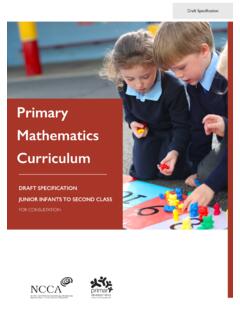
Primary Mathematics Curriculum - NCCA
ncca.ieMeasures 4 - Measuring 46 Measures 5 – Time 48 Measures 6 – Money 50 ... that is, communicating, reasoning, argumentation, justifying, generalising, representing, problem-solving, and connecting, ... Children’s progress towards Learning Outcomes will be influenced by their varying circumstances, experiences and abilities. ...

A Framework for the Junior Cycle - NCCA
ncca.ieof assessment approaches, both formative and summative, that generate evidence of this learning by students. The approach to reporting will facilitate provision of assessment information based on the following elements: Ongoing formative assessments, including routine teacher-designed tasks and tests

Junior Cycle Wellbeing Guidelines
ncca.ie3.7 Assessment practices and student wellbeing 31 3.8 School policies 32 ... 4.5 Providing a Wellbeing programme for students engaging with ... 5 OECD (2017), PISA 2015 Results (Volume III): Students’ Well-Being, OECD Publishing, Paris. 6 Weare, K. (2000).
Transition: Moving from Preschool to Primary
ncca.iesome of the enjoyable activities they will be able to do in the yard when they start school. • a bus tour and simply ‘drive-by’ the local schools. This is a good idea if the children are moving on to a number of schools. • a virtual visit - use skype/facetime sessions with the school/s. The children in the infant class might show
Key Elements of Good Practice to Support the ... - NCCA
ncca.ieprovide resources to support early childhood educators in enhancing the learning and development of children from birth to three years old. The NSAI was established to support the co-ordinated roll out of Síolta (Centre for Early Childhood Development and Education [CECDE], 2006) and Aistear (National Council for Curriculum and Assessment, 2009).
G uidelines f or g od p r a c t i c e - NCCA
ncca.ieAistear: the Early Childhood Curriculum Framework Introduction Aistear is the curriculum framework for children from birth to six years in Ireland. It describes learning and development through the four interconnected themes of Well-being, Identity and Belonging, Communicating, and Exploring and Thinking
Transition from Preschool to Primary School
ncca.ieThe Early Start Programme is a pre-primary project established by the Department of Education and Skills in 1994 in 40 primary schools in designated areas of urban disadvantage in Ireland. The one-year intervention scheme in the year before they start primary school aims to meet the needs of children (aged between 3 years 2 months and 4
Related documents
A Handbook on Learning Disabilities - Child Develop
childdevelop.caIntegra is an accredited Children’s Mental Health Centre leading in the treatment of vulnerable children and youth with learning disabilities (LDs). Our agency’s mission is to improve social, emotional and behavioral outcomes through a range of specialized, therapeutic, family-centered services, community education and research.
Family, Peer and School Influence on Children's Social ...
files.eric.ed.gov1969). Ainsworth, Blehar, Waters & Wall (1978) discovered that children that are tightly connected to their mothers as babies have a tendency to develop stronger self-respect and better self-confidence, to be independent, better in school, have successful social relationships and experience less depression and anxiety. Schaffer and Emerson (1964)

California Preschool Curriculum Framework
www.cde.ca.govdevelopment of preschool children. Principles and strategies for teaching children who are English learners are included. Three themes are interwoven through-out this volume: early childhood educa-tors need to be intentional in supporting learning in all domains, young children learn through play, and young children’s
Children Are Not Coloblind: How Young Children Learn Race
inclusions.orgchildren develop what psychologists call “in-group bias,” or favoritism towards the groups in which they are members (Patterson & Bigler, 2006). However, as children become more aware of societal norms that favor certain groups over others, they will often show a bias toward the socially privileged group. In their study
Observing and assessing children’s learning and development
study.sagepub.comObserving and assessing children’s learning can also enhance our own knowledge and understanding of how children develop and learn. Detailed, careful, attentive observation, followed by well-informed assessment, can show us how children make meaning in their world, how they use and develop their language to enable then to communicate with
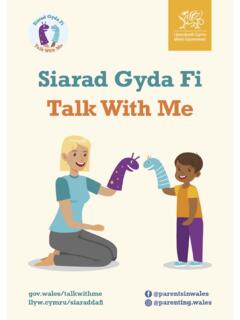
Talk With Me: Speech, Language and Communication (SLC ...
gov.walesThe majority of children develop language with few difficulties, but some children present with speech, language and communication needs (SLCN). These needs can vary and include the following definitions: • ‘Late Talkers’: children aged 18 months to 35 months who develop expressive language at a slower rate than their
Reasonable Efforts to Preserve or Reunify Families and ...
www.childwelfare.govchildren and families also may be offered. These services are designed to do the following: Increase family strength and stability Increase parent confidence and competence Afford children safe, stable, and supportive family environments Enhance child development In many States, the statutes also require

Effective approaches to connect children with nature
www.doc.govt.nzand can help children and young people develop a sense of empowerment and personal responsibility.17 Research has found that ‘internal locus of control’ is the core variable for improving the intention to act for responsible environmental behaviour.39 Therefore, it is important to stimulate the internal locus of control by: