
Hindi Language Manual
The present day nomenclature/term of Hindi language includes 49 mother tongues, creating a statistical majority. Different mother tongues are combined to make a linguistic majority. It is the mother tongue of 22% of the population; it has 20.22% of …
Download Hindi Language Manual

Information
Domain:
Source:
Link to this page:
Documents from same domain

PUNJABI: CULTURE & LANGUAGE MANUAL
languagemanuals.weebly.comPage 4 of 34 The following table shows the states and union territories of India with the greatest populations of Punjabi speakers (According to 2001 census of India).

A Clinician’s Guide to Vietnamese Language and Culture
languagemanuals.weebly.comFood Rice is the main portion of the meal which is mostly consumed in three meals per day. Usually several dishes are made and placed on a tray for

Amharic Language Manual
languagemanuals.weebly.comAmharic includes glottalized series of consonant phonemes, which is characteristic ... or affect is shown to strangers, but physical affection is common between friends. Fellman (1976) describes the Amhara as very talkative and loquacious. ... health, or social problems in times of crisis. Families are large with households including

Turkish Manual: Language and Culture
languagemanuals.weebly.comstand for two sounds: a plain velar or lateral [k l] and a front velar or palatal [c ]. In words of Turkish origin, the front velar variant occurs with front vowels and the plain velar occurs with back vowels. In words of Arabic origin, however, /c / …
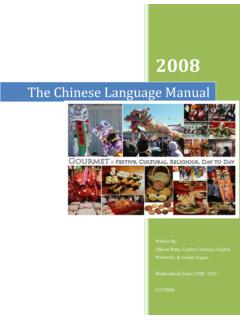
The Chinese Language Manual
languagemanuals.weebly.comChinese in general rely on body movements, facial expression, eye messages, and other nonverbal signals. Chinese are less direct or forward when communicating with others. Issues arise when interpreting nonverbal expressions, which can be difficult. Smiling in the Chinese, culture unlike American, normally signifies shyness or embarrassment.

Telugu - Language Manuals for Culturally, Linguistically ...
languagemanuals.weebly.comAndhra Pradesh, the main state Telugu is spoken in, is located in southeast India. To the north of Andhra Pradesh are the states of Madhya Pradesh, Chattisgarh, and Orissa. To the east lies the Bay of Bengal. To the south are the states of Tamil Nadu and Karnataka. To the west is Mahrashtra. The capital of Andhra Pradesh is the city of Hyderabad.

1 Portuguese Manual: Language and Culture
languagemanuals.weebly.comand combined to develop a people with unique physical characteristics. Most Portuguese have typical Mediterranean features like brown eyes, dark hair, and a height of less than 6 feet. About 97% of the Portuguese population identify themselves as Roman Catholic, but other religions enjoy freedom of worship.
Amharic Language Manual
languagemanuals.weebly.comthe Ethiopian government, court system, and on all official documents. The language spoken at the secondary and university education level is English. Amharic is the language spoken by the wealthier upper and middle classes in Ethiopia. The rural areas throughout the country speak the many other languages and dialects previously mentioned.
Related documents
POWER LANGUAGE INDEX - Kai L. Chan
www.kailchan.caThe language that counts that most number of native speakers is Mandarin Chinese, the official language of China (and Taiwan), at close to 1 billion. Spanish is the second most common mother tongue at close to half a billion. English places third with over 400 million native speakers – but it counts over

Mother-Tongue Interference in the Acquisition of English ...
files.eric.ed.govMother-tongue refers to one's native language or parent language. ("mother tongue," 2015). Mother-tongue interference refers to the influence of the native language of the learner on her/his acquisition of the target language. What we mean by the target language is the language the learner is aiming to learn (L2). ("Contrastive analysis," 2015).

The Importance of Play in the Development of Language Skills
www.theministryofparenting.comThe Importance of Play in the Development of Language Skills Jackie M. Oddo, M.S., OTR/L & Leigh Castleberry (Former Speech-Language Pathology Intern) Play has been called “the work of children” because it is through play that children learn how to interact

Krashen’s Five Proposals on Language Learning: Are They ...
files.eric.ed.govstudents have two different ways of developing skills in a second language: learning and acquisition. Learning is a conscious process that focuses the students’ attention on the form of the language (structure). Acquisition, unlike learning, is a process similar to that by which we acquired our mother tongue, and which represents the

Determining Language Proficiency - Cameron School of …
csb.uncw.eduSpeak: the ability to produce speech in the language and be understood by its speakers. Native Language / Native Speaker – The language that is your primary language. This is usually learned during childhood and is considered your “mother-tongue”. A native speaker is more than fluent—he correctly and easily uses his first language, in a ...