
How-To Note: Developing a Project ... - USAID Learning Lab
beliefs about how change is expected to take place and expand thinking beyond conventional interventions, as well as promote shared buy-in around the ultimate approach. For this reason, it’s important to include diverse stakeholders in the project design team so that current paradigms can be challenged and new approaches can be considered.
Download How-To Note: Developing a Project ... - USAID Learning Lab

Information
Domain:
Source:
Link to this page:
Documents from same domain

What We Know about “What Works” in Youth Civic …
usaidlearninglab.orgvoice more generally, this project focused specifically on interventions to support youth organizations, youth leadership, and civic education for youth. Although it …

Exercise 6-1.1: Identifying Threats to Validity (Answers)
usaidlearninglab.orgExercise 6-1.1: Identifying Threats to Validity (Answers) ... 2. Using . Reference 6: Threats to Internal and External Validity. diagnose potential threats to internal validity in each of the evaluation scenarios. 3. Discuss these threats with your group. 4. What could be done differently to mitigate or avoid these threats?
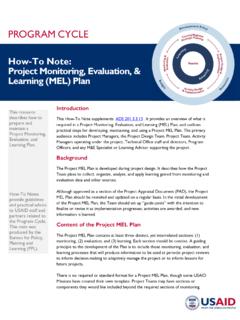
Program Cycle: How-To Note: Project Monitoring, …
usaidlearninglab.orgThis resource describes how to prepare and maintain a Project Monitoring, Evaluation, and Learning Plan. How-To Notes provide guidelines and practical advice

THE EVALUATION DESIGN MATRIX: TEMPLATES
usaidlearninglab.orguniverse. Be sure to address how these limitations will affect the evaluation. What are the expected results of the work? Describe what the evaluation team can likely say. Draw on preliminary results for illustrative purposes, if helpful. Ensure that the proposed answer addresses the evaluation question in column one.
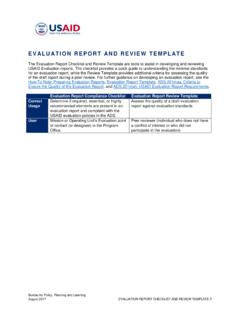
EVALUATION REPORT AND REVIEW TEMPLATE
usaidlearninglab.org2.4. List of the evaluation questions? 2.5. If an impact evaluation, are the evaluation questions about measuring the change in specific outcome(s) attributable to a specific USAID intervention? 2.6. Description of the evaluation method(s) for data collection and analysis,

Project Management Glossary Terms - USAID Learning Lab
usaidlearninglab.orgProject Management Glossary of Terms www.pm4dev.com Evaluation A periodic, systematic assessment of a project’s relevance, efficiency, effectiveness and impact on a defined population. Evaluation draws from data collected during monitoring, as well as data from additional surveys or studies to assess project achievements against set objectives.

Performance Management Plan Toolkit - USAID Learning Lab
usaidlearninglab.orgReviewing and analyzing performance data to monitor progress toward achieving results in the R/CDCS and Project LogFrames Planning and budgeting for evaluations Managing, analyzing, communicating and reporting performance data, and Using …
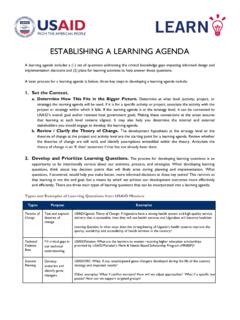
Establishing a Learning Agenda - USAID Learning Lab
usaidlearninglab.orgreflection exercises, peer assists, etc. Determine what mix of learning activities could best help you answer learning questions. In determining priority learning activities, consider when learning is needed (and at what frequency) to inform key decisions. Additionally, ensure that learning activities align with available resources.

Model Measurement Workbook - USAID Learning Lab
usaidlearninglab.orgBoth Monitoring and Evaluation Monitoring is the periodic and systematic collection of data regarding the implementation and results of a specific intervention. Developmental evaluation informs and supports a change agent who is implementing innovative approaches in complex dynamic situations. The process applies evaluative thinking to project,

SELECTING PERFORMANCE INDICATORS - USAID Learning …
usaidlearninglab.orgPerformance indicators are the basis for observing progress and measuring actual results compared to expected results. Performance indicators help answer the extent to which a Mission or Washington Operating Unit (OU) is progressing toward its objective(s), but alone cannot tell a Mission
Related documents
RESEARCH PARADIGMS: METHODOLOGIES AND …
www.stclements.eduRESEARCH PARADIGMS: METHODOLOGIES AND COMPATIBLE METHODS Abderrazak Dammak* (“All But Dissertation” (ABD) Doctoral Candidate in TESOL) Abstract Conducting educational research studies is a daunting and challenging experience for novice ... cause of any change in the performance or behavior of subjects. This change in the performance

Mixed-Methods Research: A Discussion on its Types ...
files.eric.ed.govparadigm, “the researcher’s role is one of advocate, a change agent, who argues for and leads the way towards a more equitable, fair and sustainable society” (Taylor & Medina, 2011, p. 6). To sum up, the two main paradigms, which are
International Norm Dynamics and Political Change
home.gwu.educhange other features of the political landscape. Like other theoretical frameworks in international relations (IR), much of the macrotheoretical equipment of constructiv- ism is better at explaining stability than change. Claims that actors conform to "log- ics of appropriateness"3 say little about how standards of appropriateness might change.

An Introduction to Cognitive Dissonance Theory and an ...
www.apa.orgticular cognition will change to reduce dissonance is determined by the resis-tance to change of the cognition. Cognitions that are less resistant to change ... We now review briefly the common paradigms used in dissonance research. Important research generated by the theory has been concerned with what

BUILDING A CULTURE OF LEARNING AT SCALE LEARNING …
www.orangecompass.com.aureflected in different educational paradigms. Without going in to too much detail, what can be ascertained from these approaches are some common threads. These include that individuals can pursue and construct knowledge through a range of means, ranging from tenacity and intuition through to rationalism and science (Lawrence et al., 2007).

Frederic Laloux - Reinventing Organizations
www.reinventingorganizations.comNever before in human history have we had people operating from so many different paradigms all living alongside each other. The same is true for organizations: in the same city, if we care to look, we can find Red, Amber, Orange, and Green Organizations working side by side.