HYDROGEN - NCERT
periodic table (Unit 3). 9.2 DIHYDROGEN, H 2 9.2.1 Occurrence Dihydrogen is the most abundant element in the universe (70% of the total mass of the universe) and is the principal element in the Property Hydrogen Deuterium Tritium Relative abundance (%) 99.985 0.0156 10–15 Relative atomic mass (g mol–1) 1.008 2.014 3.016
Download HYDROGEN - NCERT

Information
Domain:
Source:
Link to this page:
Documents from same domain
11 UnitUnitUnit
www.ncert.nic.in317 Alcohols, Phenols and Ethers Allylic and benzylic alcohols may be primary, secondary or tertiary. (ii) Compounds containing C OHsp2 − bond: These alcohols contain —OH group bonded to a carbon-carbon double bond i.e., to a
Model Question Paper Mathematics Class XII
www.ncert.nic.inModel Question Paper Mathematics Class XII Time Allowed : 3 hours Max: Marks: 100 General Instructions (i) The question paper consists of three parts A, B and C.
Information Brochure and Application Form
www.ncert.nic.inPriority Areas : Fellowship will be given for research pertaining to the following priority areas: Rashtriya Madhyamik Shiksha Abhiyan (RMSA) : This scheme was launched in March, 2009 with the objective to enhance access to secondary education and to improve its quality.

13108 - National Council Of Educational Research …
www.ncert.nic.inForeword What is ‘Education’? What is its primary purpose, and what is not? Which approaches support it, and at which levels of cognition? So many basic questions that many of our ‘trained
Information and Communication Technology
www.ncert.nic.inInformation and Communication Technology for the School System Curricula for ICT in Education Version #1.01 Developed by Central Institute of Educational Technology
fok; lwph - National Council Of Educational …
www.ncert.nic.in2-5 Kku ,oa le> 28 2-5-1 cqfu;knh {kerk,¡ 29 2-5-2 O;ogkj esa Kku 30 2-5-3 le> ds :i 31 2-6 Kku dks fQj ls jpuk 33 2-7 cPpksa dk Kku vkSj LFkkuh; Kku 34
NCERT
www.ncert.nic.inNCERT A Pioneer in Educational Publishing An Enduring Contribution to Improve the Quality of School Education through 1. Attractive Books …
Syllabus for Bachelor of Education (B. Ed.) …
www.ncert.nic.inSyllabus for Bachelor of Education (B. Ed.) Programme DEPARTMENT OF TEACHER EDUCATION National Council of Educational Research and Training Sri Aurobindo Marg, New Delhi – 110 016
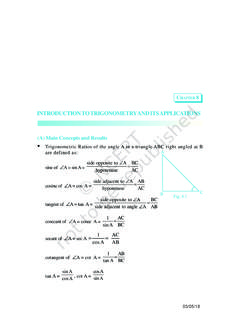
INTRODUCTION TO TRIGONOMETRY AND ITS …
www.ncert.nic.inINTRODUCTION TO TRIGONOMETRY AND ITS APPLICATIONS 89 • The ‘line of sight’ is the line from the eye of an observer to the point in the object viewed by the observer. ...
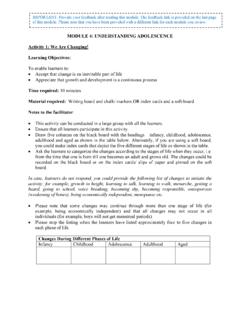
MODULE 4: UNDERSTANDING ADOLESCENCE …
www.ncert.nic.in4 Please remember to provide feedback at the end of this module 2. Do you think that Robin can be a good football player and that the coach should give him
Related documents

Activity 2.4: Causes and Effects of Climate Change
www.chicagobotanic.org• Student work and/or journals from unit 1 and unit 2 activities • LCD or overhead projector with slide of ... ranges, oceans, and lakes. Dynamic processes such as cloud formation, ocean currents, ... 3. Ask students to quietly read the directions and begin filling out …
Industry Agenda The New Plastics ... - World Economic Forum
www3.weforum.orgFeb 13, 2015 · 21 2.3 Now Is an Opportune Moment to Act 22 2.4 Where to Start 23 3 The New Plastics Economy Demands a New Approach 28 For further information 28 List of Figures 28 Endnotes 31 Acknowledgements The circular economy is gaining growing attention as a potential way for our society to increase prosperity, while reducing demands on finite
5th Grade Life Science: Ecosystems Unit
ie.unc.eduSep 05, 2019 · the characteristics of several common ecosystems, including estuaries and salt marshes, oceans, lakes and ponds, forests, and grasslands. 5.L.2.2 Classify. the organisms within an ecosystem according to the function they serve: producers, consumers, or decomposers (biotic factors). 5.L.2.3 Infer

OCR A Level Geography H481/03 Geographical debates - SAM
www.ocr.org.ukTopic 3.3 – Exploring Oceans . 3 (a) Identify three limitations with the data evidence in . Fig. 3. [3] (b) Explain the global distribution of warm and cold ocean surface currents. [6] Topic 3.4 – Future of Food . 4 (a) Identify three limitations with the data evidence in . Fig. 4. [3] (b) Explain the physical conditions necessary for ...

Map of Surficial Deposits and Materials in the ... - USGS
pubs.usgs.govThe map unit includes erosional remnants of the surface till and exhumed older till, erosional remnants of outwash sand and gravel (units gs, gg), catastrophic flood deposits (units ah, ak), and flood-scoured bedrock. The thickness of the till generally is 0.5–5 m. Mapped in North Dakota. Also see map unit ak
EARTH SCIENCE
sciencekaufman.weebly.comTo the Student Earth Science:The Physical Setting,Second Edition, which follows the New York State Core Curriculum, which is based on National Standards, is an introduction to …

UNIT 1 Landforms and landscapes - Teacher Superstore
www.teachersuperstore.com.auSource 1.3 Ripples in sand preserved in rock at Kings Canyon, Northern Territory, Australia The processes that produce landforms are both large and small in scale. At a large scale, the Earth’s surface is influenced by forces that affect the distribution and nature of continents and oceans. The solid continents and sub-oceanic

Lesson I: Why the Oceans are Important! - USF
www.marine.usf.eduLesson I: Why the Oceans are Important! In this lesson, we will introduce you to the first of our three fall units: Year of the Ocean 98. In this unit shows, we will discuss why the ocean is important, the ocean biosphere, marine pollution, the methods used to study the ocean, and the instruments used for research. The first lesson