
Hyperbolic functions - mathcentre.ac.uk
Identities for hyperbolic functions 8 6. Other related functions 9 1 c mathcentre January 9, 2006. 1. Introduction In this video we shall define the three hyperbolic functions f(x) = sinhx, f(x) = coshx and f(x) = tanhx. We shall look at the graphs of …
Download Hyperbolic functions - mathcentre.ac.uk

Information
Domain:
Source:
Link to this page:
Documents from same domain
sigma - mathcentre.ac.uk
www.mathcentre.ac.ukSigma notation Sigma notation is a method used to write out a long sum in a concise way. In this unit we look at ways of using sigma …
Ratios
www.mathcentre.ac.uk1. Introduction A ratio is a way of comparing two or more similar quantities. Ratios can be used to compare costs, weights, sizes and other quantities.
The geometry of a circle - mathcentre.ac.uk
www.mathcentre.ac.ukThe geometry of a circle mc-TY-circles-2009-1 In this unit we find the equation of a circle, when we are told its centre and its radius. There are

evaluation of mathematics support centres - …
www.mathcentre.ac.uk3 Section 1: Executive Summary Mathematics Support Centres (MSCs) have been established at universities in the UK and in a number of other countries
Partial fractions - mathcentre.ac.uk
www.mathcentre.ac.ukPartial fractions mc-TY-partialfractions-2009-1 An algebraic fraction such as 3x+5 2x2 − 5x− 3 can often be broken down into simpler parts called partial fractions.
Percentages
www.mathcentre.ac.ukKey Point Percentage means ‘out of 100’, which means ‘divide by 100’. To change a fraction to a percentage, divide the numerator by the denominator and multiply by
Polynomial functions - Mathematics resources
www.mathcentre.ac.uk3. Graphs of polynomial functions We have met some of the basic polynomials already. For example, f(x) = 2is a constant function and f(x) = 2x+1 is a linear function.
Solving inequalities - Mathematics resources
www.mathcentre.ac.ukSolving inequalities mc-TY-inequalities-2009-1 Inequalities are mathematical expressions involving the symbols >, <, ≥ and ≤. To ‘solve’ an
mathcentrecommunityproject - Mathematics …
www.mathcentre.ac.ukmathcentrecommunityproject encouraging academics to share maths support resources AllmccpresourcesarereleasedunderaCreativeCommonslicence community …
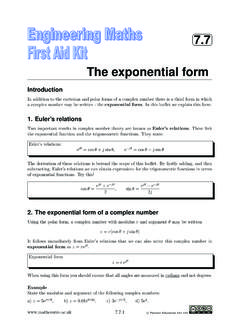
7.7 The exponential form - Mathematics resources
www.mathcentre.ac.uk7.7 The exponential form Introduction In addition to the cartesian and polar forms of a complex number there is a third form in which a complex number may be written - the exponential form.
Related documents
Mathematical Formula Handbook
homepage.ntu.edu.twEquation of a plane A point r (x, y, z)is on a plane if either (a) r bd= jdj, where d is the normal from the origin to the plane, or (b) x X + y Y + z Z = 1 where X,Y, Z are the intercepts on the axes. Vector product A B = n jAjjBjsin , where is the angle between the vectors and n is a unit vector normal to the plane containing A and B in the direction for which A, B, n form a right-handed set ...

3.6 The hyperbolic identities - mathcentre.ac.uk
www.mathcentre.ac.uk3.6 The hyperbolic identities Introduction The hyperbolic functions satisfy a number of identities. These allow expressions involving the hyperbolic functions to be written in different, yet equivalent forms. Several commonly used identities are given on this leaflet. 1. Hyperbolic identities coshx = e x+e−x 2, sinhx = ex −e− 2 tanhx ...
This page intentionally left blank - Sharif
ee.sharif.edu3.4 de Moivre’s theorem95 trigonometric identities; finding the nth roots of unity; solving polynomial equations 3.5 Complex logarithms and complex powers99 3.6 Applications to differentiation and integration101 3.7 Hyperbolic functions102 Definitions; hyperbolic–trigonometric analogies; identities of hyperbolic
The two-dimensional heat equation - Trinity University
ramanujan.math.trinity.eduThe hyperbolic trigonometric functions The hyperbolic cosine and sine functions are coshy = ey + e y 2; sinhy = ey e y 2: They satisfy the following identities: cosh2 y sinh2 y = 1; d dy coshy = sinhy; d dy sinhy = coshy: One can show that the general solution to the ODE Y00 2Y = 0 can (also) be written as Y = Acosh( y) + B sinh( y): Daileda ...

Complex Algebra - Miami
www.physics.miami.edu3|Complex Algebra 2 z 1 = x 1 +iy 1 z 2 = x 2 +iy 2 y 1 +y 2 z 1 +z 2 x 1 +x 2 The graphical interpretation of complex numbers is the Car-tesian geometry of the plane. The xand yin z= x+iyindicate a point in the plane, and the operations of addition and multiplication

Mathematica for Rogawski's Calculus 2nd Editiion
csm.rowan.edu6.3.3 The Method of Cylindrical Shells Chapter 7 Techniques of Integration 7.1 Numerical Integration 7.1.1 Trapezoidal Rule ... 7.4.1 Hyperbolic Functions 7.4.2 Identities Involving Hyperbolic Functions 7.4.3 Derivatives of Hyperbolic Functions 7.4.4 Inverse Hyperbolic Functions Chapter 8 Further Applications of Integration 8.1 Arc Length and ...

3.6 The hyperbolic identities - mathcentre.ac.uk
mathcentre.ac.uk3.6 The hyperbolic identities Introduction The hyperbolic functions satisfy a number of identities. These allow expressions involving the hyperbolic functions to be written in different, yet equivalent forms. Several commonly used identities are given on this leaflet. 1. Hyperbolic identities coshx = e x+e−x 2, sinhx = ex −e− 2 tanhx ...

Lecture Notes in Group Theory - University of Bath
people.bath.ac.uk3, the group of all permutations of 1;2;3. This is because the 6 elements in G A permute the corner points of the triangle and all the 6 = 3! permutations of S 3 occur: rand r2 correspond to (1 2 3) and (1 3 2) and the three re ections s 1;s 2 and s 3 correspond to the (2 3), (1 3) and (1 2). The following questions now arise naturally:

A: TABLE OF BASIC DERIVATIVES - University of Calgary in ...
people.ucalgary.caA: TABLE OF BASIC DERIVATIVES Let u = u(x) be a differentiable function of the independent variable x, that is u(x) exists. (A) The Power Rule : Examples : d dx {un} = nu n−1. u ddx {(x3 + 4x + 1)3/4} = 34 (x3 + 4x + 1)−1/4.(3x2 + 4)d dx {u} = 12 u.u d dx { 2 − 4x2 + 7x5} = 1 2 2 − 4x2 + 7x5 (−8x + 35x4) d dx {c} = 0 , c is a constant ddx {6} = 0 , since ≅ 3.14 is a constant.