Introduction to Matrix Algebra
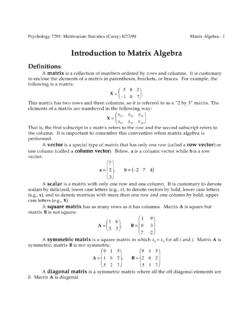
scalars by italicized, lower case letters (e.g., x), to denote vectors by bold, lower case letters (e.g., x), and to denote matrices with more than one row and one column by bold, upper case letters (e.g., X). A square matrix has as many rows as it has columns. Matrix A is square but matrix B is not square: A = 1 6 3 2 , B = 1 9 0 3 7 −2
Download Introduction to Matrix Algebra

Information
Domain:
Source:
Link to this page:
Documents from same domain

Quantitative Genetics and Quantitative Traits
ibgwww.colorado.eduQuantitative Genetics and Quantitative Traits Introduction In the chapter on Mendel and Morgan, we saw how the transmission of genes from one generation to another follows precise mathematical formula. The traits discussed in that chapter, however, were discrete traits—peas are either yellow or green, someone either has a disorder or does …
MULTIPLE REGRESSION AND PATH ANALYSIS
ibgwww.colorado.eduMULTIPLE REGRESSION AND PATH ANALYSIS Introduction Path analysis and multiple regression go hand in hand (almost). Also, it is easier to learn about multivariate regression using path analysis than using algebra. We will start with an intuitive approach and later develop the algebraic notation.

Multivariate Analysis of Variance (MANOVA): I. Theory
ibgwww.colorado.eduMultivariate Analysis of Variance (MANOVA): I. Theory Introduction The purpose of a t test is to assess the likelihood that the means for two groups are sampled from the same sampling distribution of means. The purpose of an ANOVA is to test whether the means for two or more groups are taken from the same sampling distribution.
Related documents
Introduction to Tensor Calculus for General Relativity
web.mit.eduScalars and vectors are invariant under coordinate transformations; vector components are not. The whole point of writing the laws of physics (e.g., F~= m~a) using scalars and vectors is that these laws do not depend on the coordinate system imposed by the physicist.
Vectors and Vector Spaces
www.math.tamu.eduVectors and Vector Spaces 1.1 Vector Spaces Underlying every vector space (to be defined shortly) is a scalar field F. ... If we allow all the scalars to be zero we can always arrange for (T) to hold, making the concept vacuous. Proposition 1.2.1. If …
Vectors - Clemson University
people.cs.clemson.eduspace, supporting the operations of scaling, by elements known as scalars, and also supporting addition between vectors. When using vectors to describe physical quantities, like velocity, acceleration, and force, we can move away from this abstract definition, and stick with a more concrete notion. We can view them as arrows in space, of a ...
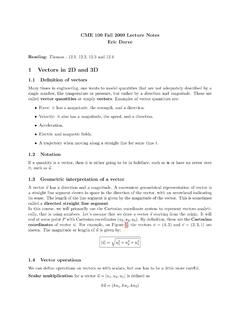
1 Vectors in 2D and 3D - Stanford University
mc.stanford.eduThe e ect of multiplying a vector ~uwith scalars 2.5, 1 and 0.3 is given in Figure 2 in di erent colors. Note that the di erent vectors all lie on top of each other as scalar multiplication of a vector cannot change the direction of the vector, except for reversing it. But scalar multiplication does change the magnitude of ~u! x y ~u (0,0) u~ 2 ...
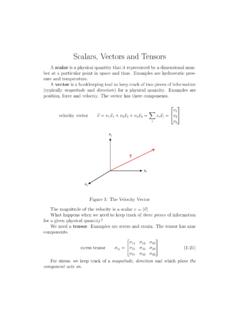
Scalars, Vectors and Tensors
zeus.plmsc.psu.eduScalars, Vectors and Tensors A scalar is a physical quantity that it represented by a dimensional num-ber at a particular point in space and time. Examples are hydrostatic pres-sure and temperature. A vector is a bookkeeping tool to keep track of two pieces of information (typically magnitude and direction) for a physical quantity. Examples are
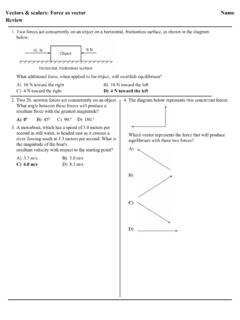
Vectors & scalars: Force as vector Name Review
www.johnbowne.orgNov 04, 2018 · Vectors & scalars: Force as vector Name Review A) 16 N toward the right B) 16 N toward the left C) 4 N toward the right D) 4 N toward the left 1.Two forces act concurrently on an object on a horizontal, frictionless surface, as shown in the diagram below. What additional force, when applied to the object, will establish equilibrium?

8.1 Span of aSet ofVectors - Oregon Institute of Technology
math.oit.edurather small) sets of vectors, but a span itself always contains infinitely many vectors (unless the set S consists of only the zero vector). It is often of interest to know whether a particular vector is in the span of a certain set of vectors. The next examples show how we do this. ⋄ Example 8.1(c): Is v= 3 −2 −4 1
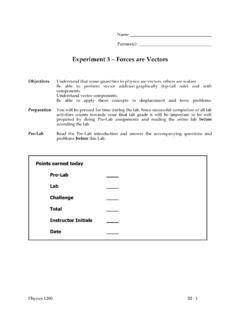
Experiment 3 – Forces are Vectors
www.asc.ohio-state.eduExperiment 3 – Forces are Vectors Objectives Understand that some quantities in physics are vectors, others are scalars. Be able to perform vector addition graphically (tip-tail rule) and with components. Understand vector components. Be able to apply these concepts to displacement and force problems.

4.5 Linear Dependence and Linear Independence
www.math.purdue.edu“main” 2007/2/16 page 267 4.5 Linear Dependence and Linear Independence 267 32. {v1,v2}, where v1,v2 are collinear vectors in R3. 33. Prove that if S and S spanare subsets of a vector space V such that S is a subset of S, then span(S) is a subset of span(S ). 34. Prove that
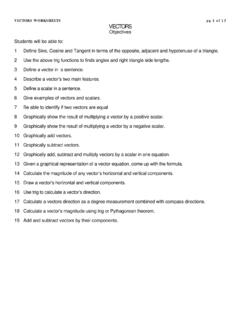
VECTORS WORKSHEETS pg 1 of 13 VECTORS
www.mrwaynesclass.com6 Give examples of vectors and scalars. 7 Be able to identify if two vectors are equal 8 Graphically show the result of multiplying a vector by a positive scalar. 9 Graphically show the result of multiplying a vector by a negative scalar. 10 Graphically add vectors. 11 Graphically subtract vectors.