
Introduction to Robotics
Proximity Sensors Example. Tilt Sensor Planar Bipedal Robot Tilt sensors: e.g., to balance a robot Tilt Sensors Example. Actuators/Muscles: I • Common robotic actuators utilize combinations of different electro-mechanical devices – Synchronous motor – Stepper motor – AC servo motor
Download Introduction to Robotics

Information
Domain:
Source:
Link to this page:
Documents from same domain
Basic Electronics - NYU Tandon School of Engineering
engineering.nyu.eduBasic Electronics. Semiconductor ... electrical field supplied by the battery. The electrons and holes combine causing the current to pass through the ...

Intro to Electricity - NYU Tandon School of …
engineering.nyu.edu•A resistor is a dissipative element. It converts electrical energy into heat energy. It is analogous to the viscous friction element of mechanical system.

Introduction to Engineering
engineering.nyu.eduIntroduction to Engineering. ... • Engineering: Latin root, ingeniere, to design or to devise ... • Chemical • Civil • Computer ...

Intro to Mechanical Engineering
engineering.nyu.edumanipulation of chemical-, kinetic, potential-, and nuclear- ... surgery, tissue engineering Codes and standards: Interchangeability, interoperability,

2020 IEEE TRANSACTIONS ON POWER DELIVERY, VOL. 27, …
engineering.nyu.edu2020 IEEE TRANSACTIONS ON POWER DELIVERY, VOL. 27, NO. 4, OCTOBER 2012 Analysis of Voltage Profile Problems Due to the Penetration of Distributed Generation in Low-Voltage
Intro to Sensors - NYU Tandon School of Engineering
engineering.nyu.eduSensors? • American National Standards Institute – A device which provides a usable output in response to a specified measurand • A sensor acquires a physical quantity and converts it into a signal
Intro to Mechatronics - engineering.nyu.edu
engineering.nyu.eduMechatronics Defined — III • “Synergistic use of precision engineering, control theory, computer science, and sensor and actuator technology to design improved products and processes.”

Introduction to Robotics
engineering.nyu.eduUniversal Robots (RUR) • Robot in Czech is a word for worker or servant Definition of robot: –Any machine made by by one our members: Robot Institute of America –A robot is a reprogrammable, multifunctional manipulator designed to move material, parts, tools or specialized devices through variable programmed motions for the performance of

FreqResponse Analysis Design
engineering.nyu.eduhappens. Mechatronics Frequency Response Analysis & Design K. Craig 8 System Frequency Response. Mechatronics Frequency Response Analysis & Design K. Craig 9 • When one has the frequency-response curves for any system and is given a specific sinusoidal input,

RLocus Analysis Design - New York University
engineering.nyu.eduRoot Locus Analysis and Design K. Craig 4 – The Root Locus Plot is a plot of the roots of the characteristic equation of the closed-loop system for all values of a system parameter, usually the gain; however, any other variable of the open - loop transfer function may be used. – By using this method, the designer can predict
Related documents
Capacitive Sensors
www.capsense.comJul 20, 2000 · Capacitive Sensors 1 Capacitive Sensors copyright 6-26-00 L. K. Baxter revised 7-20-00 1 Introduction Capacitive sensors can directly sense a variety of things—motion, chemical composition, electric field—and, indirectly, sense many other variables which can be converted into motion or dielec-

INSTRUMENTATION AND CONTROL TUTORIAL 2 – SENSORS …
www.freestudy.co.ukSensors may operate simple on/off switches to detect the following: Objects(Proximity switch) Empty or full (level switch) Hot or cold (thermostat) Pressure high or low (pressure switch) The block diagram of a sensor is shown below. Figure 2
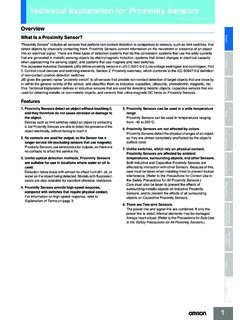
Technical Explanation for Proximity Sensors
www.ia.omron.com4. Proximity Sensors provide high-speed response, compared with switches that require physical contact. For information on high-speed response, refer to Explanation of Terms on page 3. 5. Proximity Sensors can be used in a wide temperature range. Proximity Sensors can be used in temperatures ranging from −40 to 200°C. 6.
Technical Explanation for Proximity Sensors
www.ia.omron.comProximity Sensors can be used in temperatures ranging from −40 to 200°C. 6. Proximity Sensors are not affected by colors. Proximity Sensors detect the physical changes of an object, so they are almost completely unaffected by the object's surface color. 7. Unlike switches, which rely on physical contact, Proximity Sensors are affected by ambient