
Introduction - UCONN
THE REMAINDER IN TAYLOR SERIES KEITH CONRAD 1. Introduction Let f(x) be in nitely di erentiable on an interval I around a number a. On the interval I,
Download Introduction - UCONN

Information
Domain:
Source:
Link to this page:
Documents from same domain
Introduction The Divisibility Relation
www.math.uconn.eduDIVISIBILITY AND GREATEST COMMON DIVISORS KEITH CONRAD 1. Introduction We will begin with a review of divisibility among integers, mostly to set some notation

Introduction - UCONN
www.math.uconn.eduTHE MINIMAL POLYNOMIAL AND SOME APPLICATIONS 3 (See the proof of Theorem 2.2.) The converse is false: if all the eigenvalues of an operator are in F this does not necessarily mean the operator is diagonalizable.

GALOIS THEORY AT WORK: CONCRETE EXAMPLES
www.math.uconn.edugalois theory at work: concrete examples 5 (4) A nontrivial nite p-group has a subgroup of index p. The rst property is a consequence of the intermediate value theorem.

The Trace and Norm for a Galois extension - UCONN
www.math.uconn.eduThe Trace and Norm for a Galois extension Let L=Kbe a nite Galois extension, with Galois group G= Gal(L=K). We can express characteristic polynomials, traces, and norms for the extension L=Kin terms of G. Theorem 1.1. When L=Kis a nite Galois extension with Galois group Gand 2L, ... From Galois theory,
Introduction -automorphism 2 Example 1.1. f - UCONN
www.math.uconn.edu(1.3) FˆLAut(L=F); HˆAut(L=LH): That is, F is contained in the set of elements xed by the automorphisms of Lwhich x Fand His contained in the set of automorphisms of Lwhich x the elements xed by H. (This is practically a tautology, but you may need to read through that two times to see it.)

THE CHINESE REMAINDER THEOREM - UCONN
www.math.uconn.eduThe Chinese remainder theorem says we can uniquely solve any pair of congruences that have relatively prime moduli. Theorem 1.1. Let m and n be relatively prime positive integers. For any integers a and b, the pair of congruences x a mod m; x b mod n

Introduction - math.uconn.edu
www.math.uconn.edu2 KEITH CONRAD 2. Isometries and dot products Using translations, we can reduce the study of isometries of Rnto the case of isometries xing 0. Theorem 2.1. Every isometry of Rncan be uniquely written as the composition t kwhere tis a translation and kis an isometry xing the origin.
Related documents

The Chinese Remainder Theorem - Loyola University Chicago
gauss.math.luc.eduThe Chinese Remainder Theorem We now know how to solve a single linear congruence. In this lecture we consider how to solve systems of simultaneous linear congruences.

The Chinese Remainder Theorem
homepages.math.uic.eduThe Chinese Remainder Theorem Chinese Remainder Theorem: If m 1, m 2, .., m k are pairwise relatively prime positive integers, and if a 1, a 2, .., a
Math 110 Problem Set 2 Solutions - Stanford University
math.stanford.eduMath 110 Problem Set 2 Solutions ... the Chinese Remainder Theorem guarantees that there is a unique answer to the question. 3.11 Let p be prime. Show that ap · a (mod p) for all a. Solution: Let us consider two cases: p divides a, and p does not divide a. If p divides a, then both sides are 0 modulo p.
The Chinese Remainder Theorem - ramanujan.math.trinity.edu
ramanujan.math.trinity.eduThe Chinese remainder theorem (CRT) asserts that there is a unique class a+ NZ so that xsolves the system (2) if and only if x2a+ NZ, i.e. x a(mod N). Thus the system (2) is equivalent to a single congruence modulo N. Although we only proved one implication, one can actually show that the …
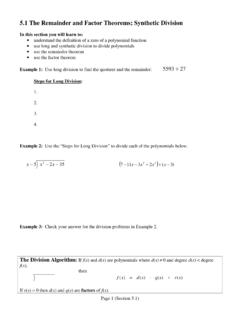
5.1 The Remainder and Factor Theorems.doc; Synthetic Division
users.math.msu.eduPage 2 (Section 5.1) Example 4: Perform the operation below. Write the remainder as a rational expression (remainder/divisor). 2 1 2 8 2 3 5 4 3 2 + − + + x x x x x Synthetic Division – Generally used for “short” division of polynomials when the divisor is in the form x – c. (Refer to page 506 in your textbook for more examples.)

The Chinese Remainder Theorem - UC Denver
www-math.ucdenver.eduby 3, and remainder 3 when divided by 7. We are looking for a number which satisfies the congruences, x ≡ 2 mod 3, x ≡ 3 mod 7, x ≡ 0 mod 2 and x ≡ 0 mod 5.

What GOAL 1 - ClassZone
www.classzone.comPage 1 of 2 6.5 The Remainder and Factor Theorems 353 In the activity you may have discovered that ƒ(2) gives you the remainder when ƒ(x)is divided by x º 2. This result is generalized in the remainder theorem. You may also have discovered in the activity that synthetic substitution gives the

C. FUTURE INTERESTS - Harvard Law School
www.law.harvard.educ. future interests The important characteristic of future interests is that the holder of such an interest is not entitled to the possession of the land, if at all, until some future time.
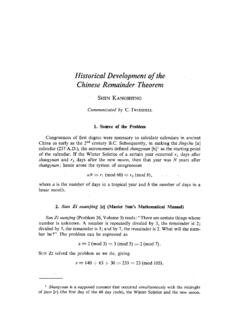
Historical development of the Chinese remainder theorem
www.math.harvard.eduThe Chinese Remainder Theorem 291 where a, b, c are natural numbers, was the same as the congruence ax ~- b (mod c). Therefore the system of congruences in Example 2 may be converted into 100x ~ 32 (mod 83) ~ 70 (rood 110) ~ 30 (mod 135), and that in …
THE CHINESE REMAINDER THEOREM - UCONN
www.math.uconn.eduThe Chinese remainder theorem says we can uniquely solve any pair of congruences that have relatively prime moduli. Theorem 1.1. Let m and n be relatively prime positive integers. For any integers a and b, the pair of congruences x a mod m; x b mod n