IP Addresses: Classful Addressing - JMU
©The McGraw-Hill Companies, Inc., 2000 © Adapted for use at JMU by 3 Mohamed Aboutabl, 2003 4.1 Introduction • An IP address is a 32-bit address that identifies a ...
Download IP Addresses: Classful Addressing - JMU

Information
Domain:
Source:
Link to this page:
Documents from same domain
Assignments on Computer Organization and …
users.cs.jmu.eduPage 1 of 6 Revised and updated: 14 Mar 2008 Assignments on Computer Organization and Architecture CS-350: Computer Organization © …

Microsoft’s Disk Operating System
users.cs.jmu.eduMicrosoft’s Disk Operating System (MS-DOS) was one of several operating systems developed in the early 1980s to support the commercial release of 16-bit personal computers. The purpose of this paper is to explore Microsoft’s Disk Operating

Subnetting/Supernetting and Classless Addressing
users.cs.jmu.eduSubnetting a Classless Address. Example 14 . An organization is granted the block 130.34.12.64/26. The . Solution. The suffix length is 6. This means the total number of addressesin the block is 64 (2. 6). If we create four subnets, each subnet will have 16 addresses.

Routing Protocols (RIP, OSPF, BGP)
users.cs.jmu.eduPolicy-dependent: a policy defines what paths should, or should not, be followed. The router uses a “routing table” to determine the path ... Expiration Timers: governs route validity. Reset upon receipt of an update. If it ever expires, destination is considered unreachable.
Related documents
Vector, Matrix, and Tensor Derivatives
cs231n.stanford.edu2.1 Example 2 Let ~y be a row vector with C components computed by taking the product of another row vector ~x with D components and a matrix W that is D rows by C columns.

Topic 6 Nested Nested for Loops - University of Texas at ...
www.cs.utexas.eduTopic 6 Nested for Loops "Complexity has and will maintain a strong fascination for many people. It is true that we live in a complex world and strive to solve inherently

KNOW HE FACTS: UPDATES TO HOURS OF SERVICE RULES
csa.fmcsa.dot.govKNOW HE FACTS: UPDATES TO HOURS OF SERVICE RULES HOURS OF SERVICE . FINAL RULE . On June 1, 2020, the . Federal Motor Carrier Safety Administration (FMCSA) published the

Population Genetics and the Hardy-Weinberg Principle
www.cs.cmu.edup2 + 2pq + q2 = 1 . Table 4 demonstrates Hardy’s and Weinberg’s key insight, that with random mating, the probability that each parent transmits a given allele to an offspring is equal to that allele’s frequency in the population.

Conjugate Bayesian analysis of the Gaussian distribution
www.cs.ubc.camurphyk@cs.ubc.ca Last updated October 3, 2007 1 Introduction The Gaussian or normal distribution is one of the most widely used in statistics. Estimating its parameters using Bayesian inference and conjugate priors is also widely used. The use of conjugate priors allows all the results to be derived in closed form.

DELETION INSERTION FRAMESHIFT POINT MUTATION …
www.cs.allegheny.eduName: _____ BIO300/CMPSC300 Mutation - Spring 2016 As you know from lecture, there are several types of mutation: DELETION (a base is lost) INSERTION (an extra base is inserted) Deletion and insertion may cause what’s called a FRAMESHIFT, meaning the reading “frame” changes, changing the amino acid sequence.
Carnegie Mellon School of Computer Science
www.cs.cmu.eduCreated Date: 2/23/2006 11:52:46 AM
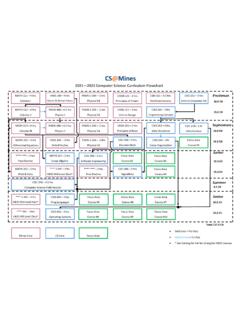
CS Curriculum Flow Chart 2021-22 - Computer Science
cs.mines.eduCS@Mines Focus Area Courses ^ CS Electives may be chosen from any CSCI 400-level course, any CSCI 500-level course (with approval), MATH 307, or EENG 383. EDNS 491 and EDNS 492, when taken together, can both be counted as a CS Elective. A course required for a focus area cannot also be counted for a CS Elective.

3.5 Canonical Forms - cs.ucr.edu
www.cs.ucr.eduSection 3.5 - Minterms, Maxterms, Canonical Form & Standard Form Page 2 of 5 A maxterm, denoted as Mi, where 0 ≤ i < 2n, is a sum (OR) of the n variables (literals) in which each variable is complemented if the