
Key Points - BAUS
arrange the first catheter change at the hospital • after that, catheter changes can be performed by your District Nurse or GP every three months For further information about living with a suprapubic catheter, leaflets are available on the BAUS website for suprapubic catheter care in men and in women.
Download Key Points - BAUS

Information
Domain:
Source:
Link to this page:
Documents from same domain

0 1 2 3 4 5 0 1 2 3 4 5 - Home | The British Association ...
www.baus.org.ukindicating increasing severity of the particular symptom. The total score can therefore range from 0 to 35 (asymptomatic to very symptomatic). ... The International Consensus Committee (ICC) recommends the use of only a single question to assess the patient's quality of life.
Key Points - BAUS
www.baus.org.uknot a treatment for stress urinary incontinence (leakage of urine when you exercise, sneeze or strain). The procedure involves passing a telescope into your bladder, through your urethra (waterpipe), and giving several injections of Botox (botulinum Key Points • Botulinum toxin-A bladder injections are performed to treat overactive bladder

Information about your procedure from The British ...
www.baus.org.ukthrough your perineum (the skin between your scrotum and rectum). We usually perform it using local anaesthetic, as an outpatient procedure. Sometimes, we do it under a spinal or general anesthetic in theatre. You will often have an MRI scan first, to see if you need a biopsy, and to guide where we need to take samples from if biopsies are needed.
Key Points - BAUS
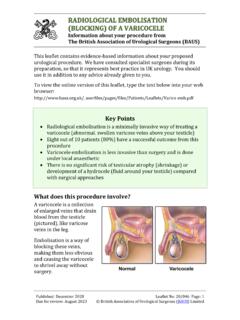
www.baus.org.uk• bleeding from the puncture site when you get home is very rare but, if it does happen, press firmly on the site for 10 to 20 minutes; this should stop the bleeding • if the bleeding does not stop, you should contact your GP or go to your local Accident & Emergency Department Recurrence of the varicocele Between 1 in 10 &
Information about your procedure from The British ...
www.baus.org.uk• the Information Standard; • the Patient Information Forum; and • the Plain English Campaign. Disclaimer We have made every effort to give accurate information but there may still be errors or omissions in this leaflet. BAUS cannot accept responsibility for any loss from action taken (or not taken) as a result of this information.
Information about your procedure from The British ...
www.baus.org.ukInformation about your procedure from The British Association of Urological Surgeons (BAUS) Published: December 2020 Leaflet No: 20/129 Page: 1
What are lower urinary tract symptoms? - BAUS
www.baus.org.ukbladder and bowel are close to each other, a full bowel can affect your bladder function. • Eat a balanced diet - include both soluble fibre (oats, barley, berries & fruit) and insoluble fibre (roughage such as wheat-based foods, cereal, vegetables & nuts) • Eat regular meals • Empty your bowel when you feel the need - delaying may lead to
Key Points - BAUS
www.baus.org.ukYour surgeon will try to preserve the muscle fibres and nerves that control continence. If you still leak some urine after a year (as 1 in 20 to 1 in 33 patients do), this can be corrected by another procedure such as an artificial urinary sphincter or a male sling. The erection nerves lie very close to your prostate, forming a cobweb of
Information about your procedure from The British ...
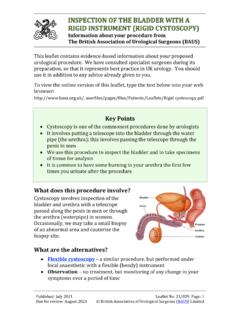
www.baus.org.ukKey Points • Cystoscopy is one of the commonest procedures done by urologists • It involves putting a telescope into the bladder through the water pipe (the urethra); this involves passing the telescope through the penis in men • We use this procedure to inspect the bladder and to take specimens of tissue for analysis
Key Points - BAUS
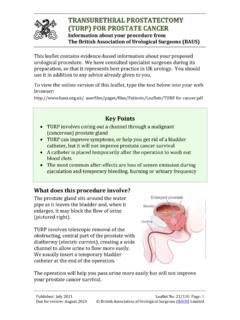
www.baus.org.uk• TURP involves coring out a channel through a malignant (cancerous) prostate gland • TURP can improve symptoms, or help you get rid of a bladder catheter, but it will not improve prostate cancer survival • A catheter is placed temporarily after the operation to wash out blood clots
Related documents

Emergency Department RN Assessment Content Outline
produsasmtsa01.blob.core.windows.netKnowledge of providing nursing care to the patients with urethral and supra-pubic catheter. p. Knowledge of providing nursing care to the patients requiring eye irrigation and body surface decontamination. IV. Professional Issues and Ethics a. Knowledge of best practices for communication with team members and patients
ACI Urology Network – Nursing
aci.health.nsw.gov.au• In an acute setting, if patient requires opioid medication before catheter change, the patient has to be monitored for a periodof time following the medication guidelines before discharge. • Another alternative for long term catheters, may need to consider supra pubic catheterisation.
Diagnosis and Management of Acute Pyelonephritis in Adults
www.aafp.orgMar 01, 2005 · bladder frequency and urgency, and supra-pubic pain) also may be present. ... Catheter-associated UTI (%) Escherichia coli 68 89 32 24 …
After care following insertion of suprapubic catheter
www.northdevonhealth.nhs.ukAfter care following insertion of suprapubic catheter. What is a Suprapubic catheter? A suprapubic catheter is a hollow flexible tube (catheter) that is used to drain urine from the bladder. It is inserted into the bladder through a cut in your lower tummy, a few inches below the navel (tummy button). This is done under a local, spinal or a general

Caring for and Changing your Supra-Pubic Catheter (SPC)
www.health.qld.gov.auA supra-pubic catheter is a tube that goes into your bladder through your abdominal wall which continuously drains urine from your bladder. It is held in place by an internal balloon that you cannot see. Your catheter is connected to a drainage bag that can be attached to your leg. Alternatively, you can

Catheter Care & Skin Integrity - learning.wm.hee.nhs.uk
learning.wm.hee.nhs.ukcatheter? • A catheter is an indwelling urinary device designed to drain urine from the bladder • A catheter is not be used for incontinence unless deemed necessary for other health needs (eg the healing of severe pressure damage) • Urinary catheters can be inserted through the lower abdomen (supra-pubic) or via the urethra

Catheter Care -A Patients Guide
www.wsh.nhs.ukCatheter Care - A Patient’s Guide What is a Catheter? A catheter is a hollow tube, inserted and retained within the bladder. It is inserted either via your urethra (water pipe) or through your abdominal wall (Supra-pubic). It is an aid to help you pass urine.