
Key Points - BAUS
catheter put in. Sometimes, we use a catheter to manage incontinence. The catheter is a small tube, made from latex or silicone, which stays in the bladder and allows urine to drain out. It has a balloon at the end which is filled with fluid and prevents it from falling out. Catheters are usually
Download Key Points - BAUS

Information
Domain:
Source:
Link to this page:
Documents from same domain
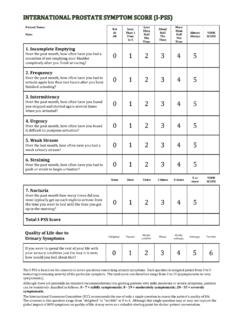
0 1 2 3 4 5 0 1 2 3 4 5 - Home | The British Association ...
www.baus.org.ukindicating increasing severity of the particular symptom. The total score can therefore range from 0 to 35 (asymptomatic to very symptomatic). ... The International Consensus Committee (ICC) recommends the use of only a single question to assess the patient's quality of life.
Key Points - BAUS
www.baus.org.uknot a treatment for stress urinary incontinence (leakage of urine when you exercise, sneeze or strain). The procedure involves passing a telescope into your bladder, through your urethra (waterpipe), and giving several injections of Botox (botulinum Key Points • Botulinum toxin-A bladder injections are performed to treat overactive bladder

Information about your procedure from The British ...
www.baus.org.ukthrough your perineum (the skin between your scrotum and rectum). We usually perform it using local anaesthetic, as an outpatient procedure. Sometimes, we do it under a spinal or general anesthetic in theatre. You will often have an MRI scan first, to see if you need a biopsy, and to guide where we need to take samples from if biopsies are needed.
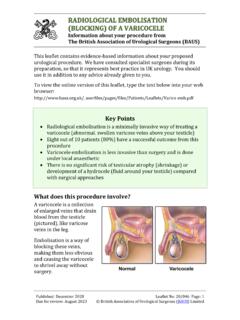
Key Points - BAUS
www.baus.org.uk• bleeding from the puncture site when you get home is very rare but, if it does happen, press firmly on the site for 10 to 20 minutes; this should stop the bleeding • if the bleeding does not stop, you should contact your GP or go to your local Accident & Emergency Department Recurrence of the varicocele Between 1 in 10 &
Information about your procedure from The British ...
www.baus.org.uk• the Information Standard; • the Patient Information Forum; and • the Plain English Campaign. Disclaimer We have made every effort to give accurate information but there may still be errors or omissions in this leaflet. BAUS cannot accept responsibility for any loss from action taken (or not taken) as a result of this information.
Information about your procedure from The British ...
www.baus.org.ukInformation about your procedure from The British Association of Urological Surgeons (BAUS) Published: December 2020 Leaflet No: 20/129 Page: 1

What are lower urinary tract symptoms? - BAUS
www.baus.org.ukbladder and bowel are close to each other, a full bowel can affect your bladder function. • Eat a balanced diet - include both soluble fibre (oats, barley, berries & fruit) and insoluble fibre (roughage such as wheat-based foods, cereal, vegetables & nuts) • Eat regular meals • Empty your bowel when you feel the need - delaying may lead to
Key Points - BAUS
www.baus.org.ukYour surgeon will try to preserve the muscle fibres and nerves that control continence. If you still leak some urine after a year (as 1 in 20 to 1 in 33 patients do), this can be corrected by another procedure such as an artificial urinary sphincter or a male sling. The erection nerves lie very close to your prostate, forming a cobweb of
Information about your procedure from The British ...
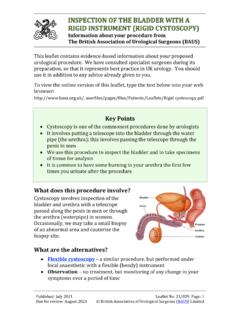
www.baus.org.ukKey Points • Cystoscopy is one of the commonest procedures done by urologists • It involves putting a telescope into the bladder through the water pipe (the urethra); this involves passing the telescope through the penis in men • We use this procedure to inspect the bladder and to take specimens of tissue for analysis
Key Points - BAUS
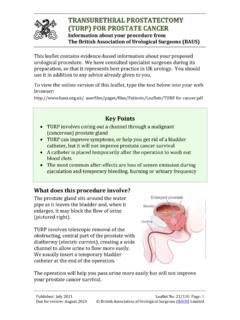
www.baus.org.uk• TURP involves coring out a channel through a malignant (cancerous) prostate gland • TURP can improve symptoms, or help you get rid of a bladder catheter, but it will not improve prostate cancer survival • A catheter is placed temporarily after the operation to wash out blood clots
Related documents
“Catheter-Associated Urinary Tract Infecion”
www.cdc.govcatheter-associated urinary tract infecion (or “CA-UTI”). What is a urinary catheter? A urinary catheter is a thin tube placed in the bladder to drain urine. Urine drains through the tube into a bag that collects the urine. A urinary catheter may be used:
Central Vascular Access Drvice Insertion
www.health.qld.gov.authe heart. The catheter does not go into your heart. When the catheter is in the correct place a chest x-ray will be taken to confirm its placement. Non-Tunnelled Catheter The catheter is inserted directly into the vein and is held in place with sutures and a dressing. This type of catheter can stay in for about a week. Tunnelled Catheter

CENTRAL VENOUS CATHETER CARE AND MAINTENANCE …
www.dhcs.ca.gov- Post-insertion after verifying correct placement with chest x-ray by physician - If blood reflux is present in the tubing See catheters without valve . See catheters without valve • Use only >10 ml syringes • Place fluids running into other ports on hold prior to withdrawing blood (Exception: vasoactive drugs) • Adult:

Prevention of Central Line- Associated Bloodstream ...
www.cdc.govexternal surface of the catheter from the skin entry site. Thus, skin pathogens are a common cause of CLABSI, especially within the first seven days of CVC insertion. Appropriately preparing the insertion site can dramatically reduce the risk of catheter-related infections. This antisepsis both prevents transmission during insertion and reduces the
Central Venous Catheter - American Thoracic Society
www.thoracic.orgcatheter? The catheter may be infected if you have: Redness, tenderness, or swelling where the catheter enters the skin Fever or chills The catheter may be blocked if it is difficult or impossible to flush. The catheter may be coming out of the vein if …
PICC- Peripherally Inserted Central Catheter
www.health.qld.gov.auOnce the catheter has entered into your vein, it is passed along the vein using X-ray guidance. At this time, you may be asked to turn your head to face the arm where the PICC is being inserted. This helps guide the catheter into the right place. The tip of the PICC will be positioned in one of the major blood vessel next to the heart. The catheter
Foley Catheter Insertion and Removal Sample Procedure ...
www.urotoday.comFoley Catheter Insertion and Removal Sample Procedure. Purpose: To increase clinical knowledge of the BARD® ADVANCE Foley Catheter Tray designed to follow the CDC Guidelines for Appropriate Indications for Indwelling Urethral Catheter Use. This sample procedure is not intended as a replacement for the IFU.

2021 BILLING AND CODING GUIDE PERITONEAL DIALYSIS …
asiapac.medtronic.comportion of the catheter. Typically, the external exit site is created during the same procedure as the catheter insertion. Alternately, the peritoneal catheter may be “buried” within the abdominal wall when initially implanted to avoid potential peritoneal infection.

Antibiotic Lock Therapy for Catheter Related Blood Stream ...
www.childrens.health.qld.gov.aucatheter related blood stream infections Antibiotic Lock therapy is indicated for patients with catheter related blood stream infections involving long-term catheters with no signs of exit site or tunnel infection, where catheter salvage is the goal. The paediatric