LABORATORY GENERAL CHECKLIST
optimize laboratory performance. The laboratory should document how it addresses these goals. The inspector should pay particular attention to checklist questions that address the above patient safety goals, and communicate any findings to the inspection team leader, who will address patient safety goal issues with the laboratory director.
Download LABORATORY GENERAL CHECKLIST

Information
Domain:
Source:
Link to this page:
Documents from same domain

Bacteriology - webapps.cap.org
webapps.cap.org124 Bacteriology College of American Pathologists 800-323-4040 Option 1 for Customer Contact Center Handle with Care Specimens included in the Bacteriology Surveys may contain pathogens and must be …

The Laboratory Quality Management Plan - webapps.cap.org
webapps.cap.orgThe Laboratory Quality Management Plan 169 Chapter 7 work environment in which employees are encouraged to discuss quality and safety concerns without fear of retribution.
LABORATORY GENERAL CHECKLIST - webapps.cap.org
webapps.cap.orgCollege of American Pathologists Revised: 09/27/2007 LABORATORY GENERAL (Web File) Page 6 of 130 The checklists contain multiple questions that deal with the above goals.

CAP Personnel Requirements by Testing Complexity
webapps.cap.orgException - If annual test volume exceeds 500,000, the CAP requires the laboratory director to meet the qualifications of Director for high complexity testing.

ASCO–CAP HER2 Test Guideline Recommendations
webapps.cap.orgASCO–CAP HER2 Test Guideline Recommendations Summary of Guideline 2007 and 2013 Recommendations cap.org Topic 2007 Recommendation 2013 Recommendation

College of American Pathologists - webapps.cap.org
webapps.cap.org27 Verify Precision • Ideally take samples with clinically important results (e.g., for TSH, should select low and high values, not both in reference range)
Analytical Measurement Range: Examples and Approaches ...
webapps.cap.orgaccuracy of the instrument or test system measurement response. o CLIA ’88, Sec. 493.2, Definitions ... • Mayyy decrease the lower limit of the analytical measurement range by: ... o May use precision data for control material near the target

Laboratory General Checklist
webapps.cap.orgAssist in inspection preparation and for managing ongoing compliance Drive consistent understanding of requirements If a policy or procedure is referenced within a requirement, it is only repeated in the Evidence of Compliance if such statement adds clarity. All policies or procedures covered in the CAP checklists must be documented. A

All Common Checklist
webapps.cap.orgAssist in inspection preparation and for managing ongoing compliance ... specifications before routine use, at prescribed intervals, or after minor adjustment (e.g. base line calibration, balancing/zero adjustment, thermometer calibration, reagent delivery).
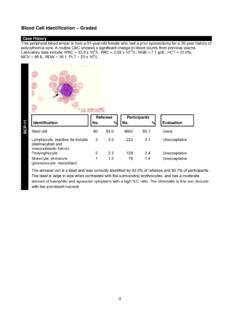
Blood Cell Identification Graded
webapps.cap.orgBlood Cell Identification ... common feature found in blood smears from patients with myeloproliferative neoplasms. 5 ... the nucleus exhibits segmentation with two or more lobes connected by a thin filament. An increased number of eosinophils may occur associated with drug reactions, parasitic infections, allergic conditions, ...
Related documents

Laboratory Design for Today's Technologies
medtechnet.comLaboratory Design for Today’s Technologies Karen K. Mortland, M.Arch, MT(ASCP) Burt Hill Kosar Rittelmann Associates ... more ceiling space, and reduce energy consumption. When the ideal location for the lab is a considerable distance from an existing air handler it may prove more.

LABORATORY 2 SOIL DENSITY I Objectives II Introduction
www.agronomy.lsu.eduLABORATORY 2 SOIL DENSITY I Objectives Measure particle density, bulk density, and moisture content of a soil and to relate to total pore space. II Introduction A Particle Density Soil particle density (g / cm3) is mass of soil solids (oven-dry) per unit volume of soil solids. Particle density depends on the densities of the various constituent ...

Clinical Laboratory Technologist Checklist
www.op.nysed.govLaboratory Technology or its substantial equivalent from a college or university credit-bearing program D. Limited Permit To request authorization to practice under the general supervision of the director of a clinical laboratory for up to one (1) year** while waiting to pass the ASCP Medical Laboratory Scientist (MLS) examination Graduate of a

Space Planning Guidelines - University of Connecticut
updc.uconn.eduAppendix III – Space Guidelines to the University Design Standards Page 6 of 19 Revised September 2016 200 Laboratory Facilities II. A laboratory is a facility characterized by special purpose equipment or a specific space configuration

Section 2 - Laboratory Equipment and Functions
www.oxfordsd.orgSection 2: Laboratory Equipment and Functions!4 of !5 ! Answer the following questions on a separate sheet of paper. Remember to use the following formatting: - If typed, use size 12 Times New Roman font and single spacing. - If handwritten, print your responses neatly. - Leave one line of blank space between each response.
CHAPTER 8 LABORATORY SERVICES - WHO
www.who.intLABORATORY SERVICES INTRODUCTION Laboratory (lab) services form an essential component of HIV services. It is important to know how to collect specimens and perform tests correctly in order to obtain correct results. Regular quality management is important. Th e lab space will need to be large enough for all the equipment and staff required
Content Sheet 1-1: The Importance of Laboratory Quality
www.who.intfrom entering the laboratory space. • Containment —which seeks to minimize risks and prevent hazards from leaving the laboratory space and causing harm to the community. • Safety —which includes policies and procedures to prevent harm to workers, visitors, and the community.