LABORATORY METHODOLOGIES FOR BACTERIAL …
resistant bacterial strains or resistance determinants in different bacterial species. The selection of a particular AST method is based on many factors such as validation data, practicality, flexibility, automation, cost, reproducibility, accuracy, and individual preference.
Download LABORATORY METHODOLOGIES FOR BACTERIAL …

Information
Domain:
Source:
Link to this page:
Documents from same domain
Description and importance of the disease - Home: …
www.oie.intDescription and importance of the disease: Pullorum disease of chickens is a bacterial infection caused by Salmonella enterica subspecies enterica serovar Gallinarum biovar …
occurs, known as ‘farcy’. - Home: OIE
www.oie.intDescription and importance of the disease: Glanders is a contagious and fatal disease of horses, donkeys, and mules, caused by infection with the bacterium Burkholderia mallei.
Management of Veterinary Laboratories Code - …
www.oie.intLaboratory risk assessments are used to identify the specific biosafety and biosecurity measures needed to contain and work safely with specific biological agents and toxins in a laboratory or animal facility.
Livestock and food production in Africa: challenge …
www.oie.intRev. sci. tech. Off. int. Epiz., 1989, 8 (3), 591-606. Livestock and food production in Africa: challenge and opportunity for the national livestock and veterinary services *

Veterinary Education Core Curriculum - Home: OIE
www.oie.int6 Model Core Veterinary Curriculum Course or course content Sequence in VEE Curriculum Day 1 Competencies addressed Description General Specifi c Advanced Immunology Early Immunology is the study of the structure and function of the
Virus survival in the environment - Home: OIE - …
www.oie.int734 This review of the survival of viruses in the environment attempts to consolidate data from reported studies. Further investigation of how numerous viruses survive
Classification of the causative agent Resistance to ...
www.oie.int1 LUMPY SKIN DISEASE Aetiology Epidemiology Diagnosis Prevention and Control References AETIOLOGY Classification of the causative agent Lumpy skin disease (LSD) is caused by lumpy skin disease virus (LSDV), a virus from the family
INFECTION WITH FOOT AND MOUTH DISEASE VIRUS
www.oie.intTerrestrial Animal Health Code - 26/07/2017 Chapter 8.8.- Infection with foot and mouth disease virus should: disease; no evidence of ;; the The .;; 8);
Avian Influenza Importance - Home: OIE
www.oie.intAvian Influenza . HPAI viruses are eradicated from all domesticated birds, whenever possible, and developed countries are usually HPAI-free. Asian lineage H5N1 HPAI viruses are
Identification of the agent: Serological tests ...
www.oie.intAujeszky’s disease, also known as pseudorabies, is caused by an alphaherpesvirus that infects the central nervous system and other organs, such as the respiratory tract, in a variety of mammals
Related documents
Bacterial Classification, Structure and Function
www.columbia.edusame species are the same or different. For example, if there is an outbreak of infections that appear due to the same bacterial species, the hospital epidemiologist will want to know if all of the infections are due to the same strain. Clues can be obtained by examining the biochemical studies or the antibiotic susceptibility profile, but a more

Carbon and Nitrogen Cycles - Weber State University
faculty.weber.edu" In soil, one species oxidizes NH 4 + to NO 2-! Nitrosomas " 2nd species oxidizes NO 2-to NO 3 - ! Nitrobacter ! ... " Reduced by bacterial assimilation to Fe2+ ! Accumulated via bacterial siderophores ! Anaerobic respiration to Fe2+ " Fe2+ used by almost all creatures

Major Classes of Antibiotics - Mt. San Antonio College
instruction2.mtsac.eduBinds to bacterial ribosome causing misreading of mRNA resulting in inappropriate amino acid insertion Streptomyces griseus (streptomycin), Micromonospora spp (gentamicin) Quinolones Fluoroquinolones Ciprofloxacin, Moxifloxacin, Marbofloxacin, Enrofloxacin Greatest efficacy against gram -negative organisms Less effective against gram-positive
LAB 3 Bacterial Staining Techniques II I. Differential ...
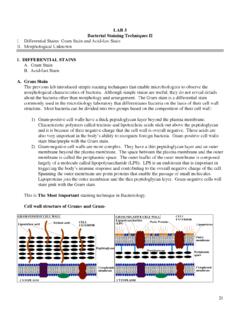
www.uwyo.eduMycobacterium and many Nocardia species are called acid-fast because during an acid-fast staining procedure they retain the primary dye carbol fuchsin despite decolorization with the powerful solvent acid-alcohol (95% ethanol with 3% HCl). Nearly all other genera of bacteria are nonacid-fast. The acid-