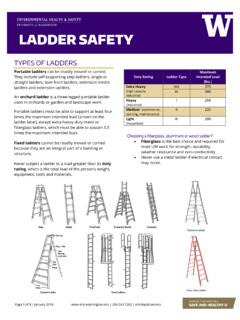
LADDER SAFETY - EHS
LADDER SAFETY . TYPES OF LADDERS . Portable ladders can be readily moved or carried. They include self-supporting step ladders, single or straight ladders, twin front ladders, extension trestle ladders, extension ladders and stepstools (ladder-type). An orchard ladder is a three-legged portable ladder used in orchards or garden and landscape work.
Download LADDER SAFETY - EHS

Information
Domain:
Source:
Link to this page:
Documents from same domain
ACCIDENT PREVENTION PLAN - University of Washington
www.ehs.washington.eduUW Accident Prevention Plan │ Revised July 2019 Page 4 of 21. PURPOSE, SCOPE AND RESPONSIBILITIES PURPOSE This document serves as the University of Washington Accident Prevention Plan (the
GUIDELINES FOR PERSONAL PROTECTIVE EQUIPMENT (PPE)
www.ehs.washington.eduWorking with low hazard chemicals when a low probability of splash exists Skin and eye irritation Fume hood, local exhaust, good general ventilation, enclose process Safety glasses Light chemical resistant gloves Lab coat, closed shoes, long pants, long skirt …
COVID-19 CLEANING AND DISINFECTION PROTOCOL
www.ehs.washington.eduThis protocol reflects requirements and guidelines set forth by the Washington State Department of Labor and Industries, the Centers for Disease Control and Prevention (CDC), and the Washington State Proclamation 20 -12 for Higher Education. Appendix Table 1. at the end of this protocol summarizes the recommended cleaning and
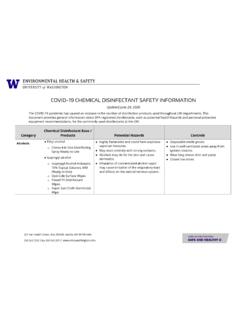
COVID-19 CHEMICAL DISINFECTANT SAFETY INFORMATION
www.ehs.washington.eduRefer to product safety data sheet for hazard communication information. Additional controls and procedures may be necessary when applying products with a mechanical sprayer. This includes garden sprayers, foggers, and ionizing sprayers. Consult with EH&S prior to utilizing mechanical devices to apply disinfectant.
LABORATORY SAFETY DESIGN GUIDE - EHS
www.ehs.washington.eduThe guide is a resource document to be used by design professionals during the planning, design and commissioning phases of a project. It is applicable to all facilities occupied by UW
Laser Safety Fundamentals - EHS
www.ehs.washington.edu7.2 Accident Prevention . 7.3 Examples of Laser Accidents . 7.4 Laser Accident Emergency Procedures . 8. References. 8.1 Texts . 8.2 Web Sources . 8.3 Laser Terminology . 8.4 Laser Warning Signs . 8.5 Control Measures for the Seven Laser Classes (ANSI) Acknowledgment . Thanks to Ken Barat for the use of several photographs and diagrams from his
UNIVERSITY OF WASHINGTON COVID-19 FACE COVERING …
www.ehs.washington.eduWhile actively engaged in a performing arts performance. e. University personnel verified to befully vaccinated in accordance with the University’s COVID-19 Vaccination Policy may temporarily remove their face coverings when formally presenting to or instructing a group or class in a large space from behind a podium or in a stage-like setting.

Eating Space Guidance - University of Washington
www.ehs.washington.edueating/drinking space” and detailing expectations for use of the space. Signage should include face covering requirements, hand hygiene , user responsibility for cleaning/disinfe cting high-touch and shared surfaces, and staying home if sick. Include signage that encourages users to …
LITHIUM BATTERY SAFETY - EHS
www.ehs.washington.eduPage 2 of 6 | November 2021 | www.ehs.washington.edu | Lithium-Ion Battery Safety There are four basic cell designs; button/coin cells, polymer/pouch cells, cylindrical cells, and
BIOSAFETY MANUAL - EHS
www.ehs.washington.eduEnvironmental Health and Safety Staff-On-Call Page through 206-685-UWPD WHEN REPORTING A BIOHAZARD EMERGENCY 1. State that this is a Biohazard Emergency 2. Give Your Name 3. Give Your Location (Room and Building) 4. Give the Phone Number You Are Using 5. Describe the Nature of the Emergency 6.
Related documents

5-minute talk Slips, Trips and Falls
ehs.okstate.eduhazard. Employers should examine floor surfaces and install slip-resistant material in work areas that can become wet, oily or dirty. The Occupational Safety and Health Administration (OSHA) also recommends workers wear slip-resistant footwear. Some employers issue shoes for employees because the importance of footwear cannot be overstated.

SUBJECT Footwear Policy - Environmental Health & Safety
ehs.ucr.eduJan 22, 2014 · Supervisor: Please verify the safety shoes purchased comply with the ANSI or ASTM requirements/rating minimum standards for the employee’s classification, except for slip resistant shoes. If the shoes meet approved footwear requirements, sign the form below and submit to Business Processing Center for employee reimbursement of up to one-hundred
Slip, Trip, and Fall Prevention
www.cdc.govSlip, Trip, and Fall Prevention ... National Institute for Occupational Safety and Health. Slip, Trip, and Fall Prevention for Healthcare Workers DEPARTMENT OF HEALTH AND HUMAN SERVICES Centers for Disease Control and Prevention ... and slip-resistant shoes will help to minimize the risk of slipping (ANSI 2001).
Preventing Slips, Trips, and Falls in Wholesale and Retail ...
www.cdc.govslip-resistant shoes and keeping floor surfaces clean and dry. Mats are used to provide slip-resistant walking surfaces by absorbing liquid and removing dirt, debris, and liquid from shoes. Provide water-absorbent mats near entrances and other areas where water, ice, or snow may drip or be tracked onto the floor.

What is this leaflet about? - HSE
www.hse.gov.uksafety equipment provided. The Management of Health and Safety at Work Regulations 1999 require employers to assess risks (including slip and trip risks) and, where necessary, take action to address them. The Workplace (Health, Safety and Welfare) Regulations 1992 require floors to be suitable, in good condition and free from obstructions.
OSHA 3221-12N 2004
www.osha.govOccupational Safety and Health Administration Use special HEPA vacuums to clean up dust instead of dry sweeping. Reduce silica exposures during chipping, drilling and sawing of concrete materials with engineering controls, such as wet methods and local exhaust ventilation. Fall Hazards Identify and fix fall hazards, such as slip-

Slip, Trip & Fall Prevention Handbook
www.ppsa.orgslip or trip hazards in their path. Adequate light levels without glare or shadowing is required to highlight potential slip or trip hazards. Other distractions, like those mentioned, should be minimized as much as possible. People and activity . Work activities, the way the work is organized and attitudes to safety can affect the
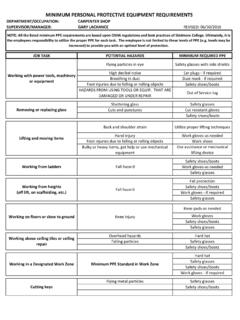
MINIMUM PERSONAL PROTECTIVE EQUIPMENT …
www.skidmore.eduSlip and fall from wet floor Slip resistant work shoes High decibel noise Ear plugs Splashes from or exposure to floor chemicals Safety glasses and nitrile gloves Slip and fall from wet floor Slip resistant work shoes Wet floor Wet floor sign Safety shoes/boots Work gloves‐as needed