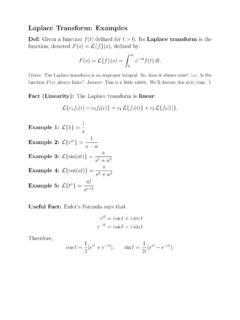
Laplace Transform: Examples
Inverse Laplace Transform: Existence Want: A notion of \inverse Laplace transform." That is, we would like to say that if F(s) = Lff(t)g, then f(t) = L1fF(s)g. Issue: How do we know that Leven has an inverse L1? Remember, not all operations have inverses. To see the problem: imagine that there are di erent functions f(t) and
Download Laplace Transform: Examples

Information
Domain:
Source:
Link to this page:
Documents from same domain

SPECTRAL SEQUENCES: FRIEND OR FOE? - Stanford University
math.stanford.eduSPECTRAL SEQUENCES: FRIEND OR FOE? RAVI VAKIL Spectral sequences are a powerful book-keeping tool for proving things involving com-plicated commutative diagrams. They were introduced by Leray in the 1940’s at the same time as he introduced sheaves. They have a …

Outline of Galois Theory Development - Stanford University
math.stanford.edu10. De ne E=Fto be a Galois extension if and only if Eis separable AND normal over F. (This is the ’right’ de nition, because the conditions separable and normal are easily understood in terms of individual
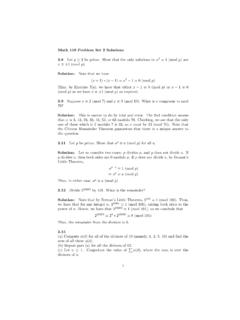
Math 110 Problem Set 2 Solutions - Stanford University
math.stanford.eduMath 110 Problem Set 2 Solutions ... the Chinese Remainder Theorem guarantees that there is a unique answer to the question. 3.11 Let p be prime. Show that ap · a (mod p) for all a. Solution: Let us consider two cases: p divides a, and p does not divide a. If p divides a, then both sides are 0 modulo p.
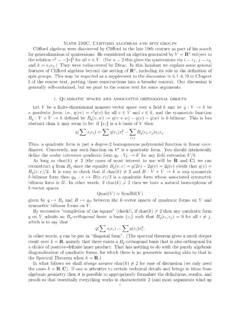
Math 210C. Clifford algebras and spin groups
math.stanford.eduClifford algebras For our initial construction of the Cli ord algebra associated to (V;q) we make no non-degeneracy hypothesis; the best properties occur only when (V;q) is non-degenerate, but for the purpose of some early examples the case q= 0 (with V 6= 0!) is worth keeping in mind.

Homework 3 Solutions - Stanford University
math.stanford.eduHomework 3 Solutions Math 171, Spring 2010 Please send corrections to henrya@math.stanford.edu 17.4. Let fa ngbe a sequence with positive terms such that lim n!1a n= L>0.Let xbe a real number. Prove that lim n!1a x= Lx. Solution.
THE RISING SEA Foundations of Algebraic Geometry
math.stanford.eduTHE RISING SEA Foundations of Algebraic Geometry math216.wordpress.com November 18, 2017 draft ⃝c 2010–2017 by Ravi Vakil. Note to reader: the index and formatting have yet to be properly dealt with.

The Topology of Fiber Bundles Lecture Notes
math.stanford.edumatics. A fiber bundle with base space Band fiber F can be viewed as a parameterized family of objects, each “isomorphic” to F, where the family is parameterized by points in B. For example a vector bundle over a space Bis a parameterized …

1. Math 113 Homework 3 Solutions
math.stanford.edu1. Math 113 Homework 3 Solutions By Guanyang Wang, with edits by Prof. Church. Exercises from the book. Exercise 3B.2 Suppose V is a vector space and S;T2L(V;V) are such that
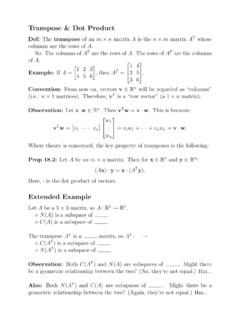
Transpose & Dot Product - Stanford University
math.stanford.eduDef: Let Q: Rn!R be a quadratic form. We say Qis positive de nite if Q(x) >0 for all x 6= 0. We say Qis negative de nite if Q(x) <0 for all x 6= 0. We say Qis inde nite if there are vectors x for which Q(x) >0, and also vectors x for which Q(x) <0. Def: Let Abe a symmetric matrix. We say Ais positive de nite if Q A(x) = xTAx >0 for all x 6= 0.
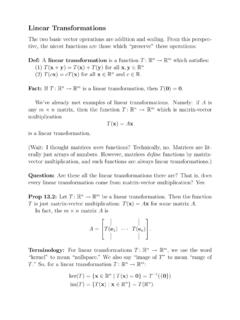
Linear Transformations - Mathematics
math.stanford.eduTwo Examples of Linear Transformations (1) Diagonal Matrices: A diagonal matrix is a matrix of the form D= 2 6 6 6 4 d 1 0 0 0 d 2 0. .. 0 0 0 d n 3 7 7 7 5: The linear transformation de ned by Dhas the following e ect: Vectors are...
Related documents
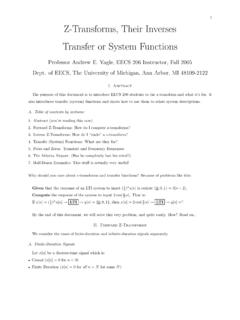
1 Z-Transforms, Their Inverses Transfer or System Functions
web.eecs.umich.eduIf you know what a Laplace transform is, this should look like a discrete-time version of it, as indeed it is. ... Inverse Z-Transforms As long as x[n] is constrained to be causal (x[n] = 0 for n < 0), then the z-transform is invertible: There is only one x[n] having a given z-transform X(z). Inversion of the z-transform (getting x[n] back from ...
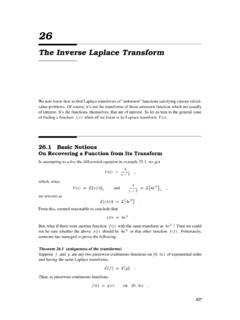
The Inverse Laplace Transform
howellkb.uah.eduLinearity of the Inverse Transform The fact that the inverse Laplace transform is linear follows immediately from the linearity of the Laplace transform. To see that, let us consider L−1[αF(s)+βG(s)] where α and β are any two constants and F and G are any two functions for which inverse Laplace …
Laplace Transform Methods
www.unf.edu2 1. LAPLACE TRANSFORM METHODS Due the uniqueness, we can define the inverse Laplace transform L¡1 as L¡1(fb)(t) = f(t): Theorem 1.3. If both fb(s) and bg(s) exist for all s > c, then af(t)+ bg(t) has Laplace transform for all constant a and b and af\+bg(s) = afb(s)+bbg(s);for all s > c So to find Laplace transform of summation, we just need to find
Laplace Transform solved problems - cuni.cz
matematika.cuni.czLaplace transform for both sides of the given equation. For particular functions we use tables of the Laplace transforms and obtain sY(s) y(0) = 3 1 s 2 1 s2 From this equation we solve Y(s) y(0)s2 + 3s 2 s3 and invert it using the inverse Laplace transform and the same tables again and obtain t2 + 3t+ y(0)
Differentiation and the Laplace Transform
howellkb.uah.eduWe will confirm that this is valid reasoning when we discuss the “inverse Laplace transform” in the next chapter. In general, it is fairly easy to find the Laplace transform of the solution to an initial-value problem involving a linear differential equation with constant coefficients and a ‘reasonable’ forcing function1. Simply take ...
Solving Differential Equations
learn.lboro.ac.ukthe inverse Laplace transform: y(t) = L−1{Y(s)} = L−1{1 s+1}−L−1{s+1 (s+1)2 +1} = (e−t −e−t cost)u(t) which is the solution to the initial value problem. Exercises Use Laplace transforms to solve: 1. dx dt +x = 9e2t x(0) = 3 2. d2x dt2 +x = 2t x(0) = 0 x0(0) = 5 Answers 1. x(t) = 3e2t 2. x(t) = 3sint+2t 38 HELM (2008): Workbook 20 ...
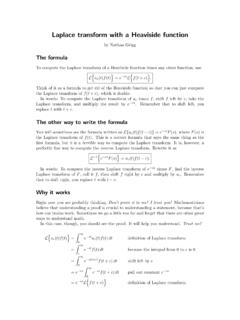
Laplace transform with a Heaviside function
archive.nathangrigg.comthe Laplace transform of f(t). This is a correct formula that says the same thing as the rst formula, but it is a terrible way to compute the Laplace transform. It is, however, a perfectly ne way to compute the inverse Laplace transform. Rewrite it as L 1 n e csF(s) o = u c(t)f(t c):