
Learning About Learning Agility - Innovation
An essential leadership attribute is the ability to re-main open to new ways of thinking and to continu-ously learn new skills. We have long known that a major difference between successful people and those whose careers falter is their ability to make meaning from their experiences. CCL research shows us that leaders who refuse to let go
Download Learning About Learning Agility - Innovation

Information
Domain:
Source:
Link to this page:
Documents from same domain

Empathy in the Workplace A Tool for Effective Leadership*
cclinnovation.orgto leadership. Many leadership theories suggest the ability to have and display empathy is an important part of leadership. Transformational leaders need empathy in order to show their followers that they care for their needs and achievement (Bass, 1985). Authentic leaders also need to have empathy in order to be aware of others (Walumbwa,

Boundary Spanning Leadership Mission Critical Perspectives ...
cclinnovation.orgthe Leadership at the Peak program between September 2008 and April 2009. Leadership at the Peak is designed for senior executives who have more than 15 years of management experience, work in the top three tiers of their organizations, and have leadership responsibility for 500 or more people. Admission to the program is by application only.

Addressing the Leadership Gap in Healthcare What’s …
cclinnovation.orgLeadership gaps—the disparities between leadership priorities and current skills—provide valuable information. With this insight, healthcare companies can develop meaningful leader development strategies, take steps to build the capability of people in key roles, and begin to grow the leadership capacity of the organization.

Using Political Skill to Maximize and Leverage Work ...
cclinnovation.orggetting employees to collaborate effectively across multiple stakeholder groups (functions, teams, and divisions) and developing talent (identifying, developing, and rewarding others). Both of these require leaders to maximize and leverage relationships—they require political skill. Indeed, when we view political skill through this

What You Need, And Still Don’t Have, When It Comes To ...
cclinnovation.orgnonpro t and one of the world’s leading proponents of business benchmarking, best practices, and knowledge management research. This study explored the potential ... need; however, the data from the CCL study indicate that organizations today are experiencing a current leadership de cit and can expect a leadership gap in
Corporate Social Responsibility and Sustainable Business
cclinnovation.orgCorporate responsibility or sustainability is therefore a prominent fea-ture of the business and society literature, addressing topics of business ethics, corporate social performance, global corporate citizenship, and stakeholder management. Management education can be an important source of new ideas
Related documents
Leadership Program Outcomes - Leadership Learning …
leadershiplearning.orgLeadership Program Outcomes Over the past year the Leadership Learning Community has been actively trying to learn more about the leadership outcomes that programs are seeking for individuals, organizations, and communities; and the tools and methods programs are using to evaluate these outcomes. This

Analysis of the Relationship between Shared Leadership and ...
files.eric.ed.govDec 10, 2013 · relationship between shared leadership and distributed leadership, which, despite having many similar aspects in theory and practice, are defined as ... learning organizations (Bakir, 2013). The need for distributed leadership arises from the fact that the approach of a “hero
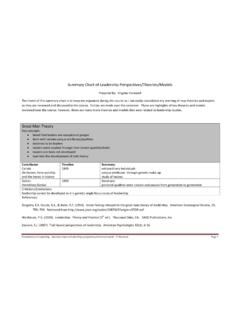
Summary Chart of Leadership Perspectives/Theories/Models
vharwood-fol-portfolio.weebly.comThe intent of this summary chart is to keep me organized during the course so I can easily consolidate my learning of new theories and models ... Relationship between leadership style and the favourableness of the situation – three dimensions: 1. the leader-member relationship – degree to which leader is accepted and
TRAITS, SKILLS, AND STYLES OF LEADERSHIP
account.ache.orgbetween personal traits and successful leadership, and studies of effective lead - ers suggested that leadership ability was not genetically based. 3. By midcentury, researchers were using aptitude and psychological tests to study personality traits, as well as social and work-related characteristics. In a seminal literature review, Stogdill. 4
Situational Leadership Theory as a Foundation for a ...
files.eric.ed.govtransform the situational leadership model into a teaching-learning model for blended learning. In SLT, the task-relevant maturity level of the follower is the major situational determinant of leader behaviour (Graeff, 1984, p. 285). Figure 1: The Situational Leadership Model adapted from Hersey and Blanchard (1977).
Organizational and Leadership Structure
www.npaonline.orgLearning Objectives Understand the development of a management structure within a large and well-established PACE program with multiple PACE centers. Become familiar with the various leadership models/options. Improve the management structure to support the growth and changes within a PACE organization due to the economic
LEADERSHIP, DIVERSITY AND INCLUSION
wagner.nyu.eduintegrative framework for understanding the relationship between race and leadership. In a report based on an RCLA-facilitated action learning inquiry, leaders of color committed to social justice offer strategies for community-based leaders of color to maintain the integrity of their work and remain accountable to

Successful School Leadership What It Is and How It ...
www.nysed.govreview of educational leadership effects on pupil learning reported almost 10 years ago by Hallinger and Heck (1996) included about 40 studies. And many more have been reported since then. 8 One source of confusion in sorting out what we know about successful school leadership