Lecture 03 - Bits Bytes and Data Types
Each data byte can be represented using an ASCII (or extended ASCII) value. An ASCII table is given below. Standard ASCII table assigns each character to a numerical value. For example ‘A’ = 65 and ‘a’ = 97. Printable standard ASCII values are between 32 and 126. The 8 th bit in the byte may be used for parity checking in communication ...
Download Lecture 03 - Bits Bytes and Data Types

Information
Domain:
Source:
Link to this page:
Documents from same domain
b r a c e - Carnegie Mellon School of Computer …
www.cs.cmu.eduApproaches to inference Exact inference algorithms The elimination algorithm Belief propagation The junction tree algorithms (but will not cover in detail here)
Sponsored Search Acution Design Via Machine …
www.cs.cmu.eduMaria-Florina Balcan 03/30/2015 Semi-Supervised Learning Readings: • Semi-Supervised Learning. Encyclopedia of Machine Learning. Jerry Zhu, 2010

2 Information and Communications Technology (ICT)
www.cs.cmu.edu2 Information and Communications Technology ... Perspectives of Information and Communication Technologies in Development.” Swiss Agency for Development and
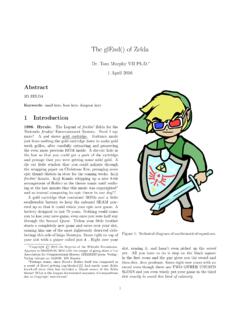
The glEnd() of Zelda
www.cs.cmu.eduThe glEnd() of Zelda Dr. Tom Murphy VII Ph.D. 1 April 2016 Abstract 3D ZELDA ... and the PPU is the Legend of Zelda. It’s just an anal-ogy.
Understanding Understanding Source Code with …
www.cs.cmu.eduUnderstanding Understanding Source Code with Functional Magnetic Resonance Imaging Janet Siegmundˇ, Christian Kästner!, Sven Apelˇ, Chris Parnin , Anja Bethmann , Thomas Leich , Gunter Saake˙, and André Brechmann ˇUniversity of Passau, Germany!Carnegie Mellon University, USA
Automatic Database Management System Tuning …
www.cs.cmu.eduAutomatic Database Management System Tuning Through Large-scale Machine Learning Dana Van Aken Andrew Pavlo Geoffrey J. Gordon Bohan Zhang Carnegie Mellon University Carnegie Mellon University Carnegie Mellon University Peking University
www.cs.cmu.edu
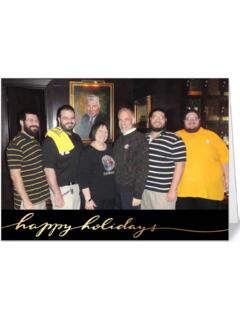
www.cs.cmu.eduHappy Holidays from the Myers Family, 2014 Ryan, Reid, Bernita, Brad, Grant and Ethan. (posing in front of a Portrait of Art Rooney, founding owner of the Steelers.)
Model Selection - Carnegie Mellon School of …
www.cs.cmu.eduModel Selection Machine Learning • Def: (loosely) a modeldefines the hypothesis space over which learning performs its search • Def: model parameters are the numeric values or structure selected by the learning algorithm

Sample Invitation to participate in the research …
www.cs.cmu.eduSample Invitation to participate in the research project titled: “Understanding and Broadening the Images of Computing” Dear (computer science student),
15-381 Artificial Intelligence Henry Lin
www.cs.cmu.edu1 Clustering 15-381 Artificial Intelligence Henry Lin Modified from excellent slides of Eamonn Keogh, Ziv Bar-Joseph, and Andrew Moore • …
Related documents
C programming for embedded system applications
www.eng.auburn.edu• Character: character in single quotes, or ASCII value following “slash” m = ‘a’; //ASCII value 0x61 n = ‘\13’; //ASCII value 13 is the “return” character
TextPad Quick Reference Card - John Bokma
johnbokma.comcharacter class operator (see below). [^] Any characters except for those after the caret "^". ^ The start of a line (column 1). $ The end of a line (not the line break characters). \< The start of a word. \> The end of a word. \t The tab character. \f The page break (form feed) character. \n A new line character, for matching expressions that span
MEMORY STORAGE CALCULATIONS - Rutgers University
eckstein.rutgers.eduEach character have a unique representation, so the larger the character set, the larger the memory requirement for each character in the set. Early character sets (containing 26 capital letters, 10 numbers, a space character, and assorted punctuation) allowed 64 characters. A popular example is “ASCII 64”. These sets require 6 bits per ...
MIPS Assembly Language Guide - University of Northern Iowa
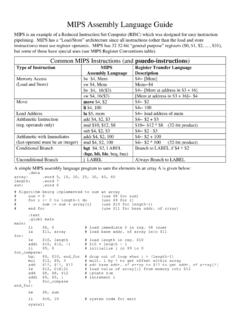
www.cs.uni.eduTo determine if a specific ASCII character, say ‘C’ (67 10) is in the set, you would need to build a “mask” containing a single “1” in bit position 2. The sequence of instructions “li $3, 1” followed by “sll $3, $3, 2” would build the needed mask in $3. If the bit-string set of letters is in register $5, then we can check ...

Australia Post Data Guide
auspost.com.auEach record in the PAF has a fixed length and is terminated with two ASCII characters: ^13 and 10 (carriage return and linefeed). The record also carries an ^action code _: (RECORD_ACTN_CODE), which indicates whether the record …

Using GNU Fortran - GNU Compiler Collection
gcc.gnu.orgUsing GNU Fortran For gcc version 12.0.1 (pre-release) (GCC) The gfortran team
Logix 5000 Controllers ASCII Strings, 1756-PM013G-EN-P
literature.rockwellautomation.comCommunicating with an ASCII device You can exchange ASCII data with a device through the serial port of the controller. For example, you can use the serial port to: • Read ASCII characters from a weigh scale module or bar code reader. • Send and receive messages from an ASCII triggered device, such as a MessageView terminal.

symbol NULL SOH STX ETX EOT ENQ ACK - ASCII
theasciicode.com.ar³ www.theasciicode.com.ar Format: PDF file symbol ascii code 0 NULL (Null character) ascii code 1 SOH (Start of Header) ascii code 2 STX (Start of Text) ascii code 3 ETX (End of Text) ascii code 4 EOT (End of Transmission) ascii code 5 ENQ (Enquiry) ascii code 6 ACK (Acknowledgement) ascii code 7 BEL (Bell) ascii code 8 BS (Backspace) ascii code 9 HT …