
Lecture 13: Generative Models
Supervised vs Unsupervised Learning K-means clustering This image is CC0 public domain. Fei-Fei Li & Justin Johnson & Serena Yeung Lecture 13 - 11 May 18, 2017 Unsupervised Learning ... Examples: Clustering, dimensionality reduction, feature learning, density estimation, etc. 14 Supervised vs Unsupervised Learning Supervised Learning
Download Lecture 13: Generative Models

Information
Domain:
Source:
Link to this page:
Documents from same domain
NaveenAppiah SagarVare - Stanford University
cs231n.stanford.eduNaveenAppiah Mechanical Engineering nappiahb@stanford.edu SagarVare Stanford ICME svare@stanford.edu ... the popular mobile game - Flappy Bird. It involves navi-gating a bird through a bunch of obstacles. Though, this ... the game emulator and learns to make good decisions over time. It is this simple learning framework and their

Fei-Fei Li & Justin Johnson & Serena Yeung Lecture 2 ...
cs231n.stanford.eduFei-Fei Li & Justin Johnson & Serena Yeung Lecture 2 - April 6, 2017 Administrative: Piazza For questions about midterm, poster session, projects,

Lecture 9: CNN Architectures
cs231n.stanford.eduLecture 9 - 22 May 2, 2017 ImageNet Large Scale Visual Recognition Challenge (ILSVRC) winners First CNN-based winner. Fei-Fei Li & Justin Johnson & Serena Yeung Lecture 9 - 23 May 2, 2017 ImageNet Large Scale Visual Recognition Challenge (ILSVRC) winners ZFNet: Improved hyperparameters over AlexNet. Fei-Fei Li & Justin Johnson & Serena Yeung ...

Attention and Transformers Lecture 11
cs231n.stanford.edugraph with shared weights h 0 f W h 1 f W h 2 f W h 3 x 3 y T ... Extract spatial features from a pretrained CNN Image Captioning using spatial features 11 CNN Features: H x W x D h 0 [START] Xu et al, “Show, Attend and Tell: Neural Image Caption Generation with Visual Attention”, ICML 2015 z 0,0 z 0,1 z 0,2 z 1,0 z 1,1 z 1,2 z 2,0 z 2,1 z ...

CNNs for Face Detection and Recognition
cs231n.stanford.edudevelopment of object classification, localization and detec-tion techniques. 2.1. Sliding Window In the early development of face detection, researchers tended to treat it as a repetitive task of object classifica-tion, by imposing sliding windows and performing object classification with the neural networks on the window re-gion.
Vector, Matrix, and Tensor Derivatives
cs231n.stanford.eduErik Learned-Miller The purpose of this document is to help you learn to take derivatives of vectors, matrices, and higher order tensors (arrays with three dimensions or more), and to help you take ... At this point, we have reduced the original matrix equation (Equation 1) …
Lecture 14: Reinforcement Learning
cs231n.stanford.eduFei-Fei Li & Justin Johnson & Serena Yeung Lecture 14 - May 23, 2017 Markov Decision Process 19 - Mathematical formulation of the RL problem - Markov property: Current state completely characterises the state of the

Convolutional Neural Networks for Visual Recognition
cs231n.stanford.eduProgressive GAN, Karras 2018. Models from Single RGB Images”, ECCV 2018 Beyond recognition: Segmentation, 2D/3D Generation. Fei-Fei Li, Ranjay Krishna, Danfei Xu Lecture 1 - 15 March 30, 2021 Scene Graphs Krishna et al., Visual Genome: Connecting Vision and Language using Crowdsourced Image Annotations, IJCV 2017

Lecture 11: Detection and Segmentation
cs231n.stanford.eduFei-Fei Li & Justin Johnson & Serena Yeung Lecture 11 - 1 May 10, 2017 Lecture 11: Detection and Segmentation

Lecture 10: Recurrent Neural Networks
cs231n.stanford.eduimage -> sequence of words. Fei-Fei Li & Justin Johnson & Serena Yeung Lecture 10 - 13 May 4, 2017 Recurrent Neural Networks: Process Sequences e.g. Sentiment Classification sequence of words -> sentiment. Fei-Fei Li & Justin Johnson & Serena Yeung Lecture 10 - 14 May 4, 2017
Related documents

An Introduction to the WEKA Data Mining System - CCSU
cs.ccsu.edu• K-nearest neighbor (KNN, IBk) Take the class of the nearest neighbor or the majority class among K neighbors K=1 -> no K=3 -> no K=5 -> yes K=14 -> yes (Majority predictor, ZeroR) • Distance is calculated as the number of different attribute values • Euclidean distance for numeric attributes • Weighted K-nearest neighbor K=5 -> undecided

POST GRADUATE PROGRAM IN ARTIFICIAL INTELLIGENCE
d9jmtjs5r4cgq.cloudfront.netSupervised learning • Linear Regression • Multiple Variable Linear Regression • Logistic Regression • Naive Bayes Classifiers • k-NN Classification • Support Vector Machines MODULE 2 Ensemble Techniques • Decision Trees • Bagging • Random Forests • Boosting MODULE 3 Unsupervised learning • K-means Clustering
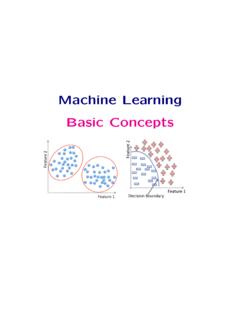
Machine Learning Basic Concepts - edX
courses.edx.orgK-nearest neighbors Training algorithm: Add each training example (x;y) to the dataset D. x2Rd, y2f+1; 1g. Classi cation algorithm: Given an example xqto be classi ed. Suppose Nk(xq) is the set of the K-nearest neighbors of xq. ^yq= sign(X xi2Nk(xq) yi)
Unsupervised Deep Embedding for Clustering Analysis
proceedings.mlr.pressSeveral variants of k-means have been proposed to address issues with higher-dimensional input spaces.De la Torre & Kanade(2006);Ye et al.(2008) perform joint dimension-ality reduction and clustering by first clustering the data with k-means and then projecting the data into a lower di-mensions where the inter-cluster variance is maximized.

MACHINE LEARNING LABORATORY MANUAL - JNIT
www.jnit.orgfor clustering using k-Means algorithm. Compare the results of these two algorithms and comment on the quality of clustering. You can add Java/Python ML library classes/API in the program. 9. Write a program to implement k-Nearest Neighbour algorithm to classify the iris data set. Print both correct and wrong predictions.
Survey of Clustering Data Mining Techniques
faculty.cc.gatech.edu3.1. Probabilistic Clustering 3.2. K-Medoids Methods 3.3. K-Means Methods 4. Density-Based Partitioning 4.1. Density-Based Connectivity 4.5. Density Functions 5. Grid-Based Methods 6. Co-Occurrence of Categorical Data 7. Other Clustering Techniques 7.1. Constraint-Based Clustering 7.2. Relation to Supervised Learning 7.3.

DetCo: Unsupervised Contrastive Learning for Object Detection
arxiv.orglearning and online clustering, e.g. MoCo v1/v2 [19,5], BYOL [18], and SwAV [3], have achieved great progress to bridge the performance gap between unsupervised and fully-supervised methods for image classification. How-ever, their transferring ability on object detection is not sat-isfactory. Concurrent to our work, recently DenseCL [39],