LECTURE NOTES ON APPLIED MATHEMATICS
Jun 17, 2009 · such as the compressible Euler equations for the ow of an inviscid compressible uid [47]. Example 1.2. Suppose that the ux is a linear function of the density gradient, (1.3) ~q= Aru; where A is a second-order tensor, that is a linear map between vectors. It is represented by an n nmatrix with respect to a choice of nbasis vectors. Then,
Download LECTURE NOTES ON APPLIED MATHEMATICS

Information
Domain:
Source:
Link to this page:
Documents from same domain

LECTURE 5 - UC Davis Mathematics
www.math.ucdavis.eduLECTURE 5. STOCHASTIC PROCESSES 133 We say that random variables X 1;X 2;:::X n: !R are jointly continuous if there is a joint probability density function p(x
A concise introduction to quantum probability, …
www.math.ucdavis.eduA concise introduction to quantum probability, quantum mechanics, and ... precepts of quantum mechanics are sometimes called ... This article is a concise introduction to quantum probability theory, quantum mechanics, and quan-tum computation for the mathematically prepared
An introduction to quantum probability, quantum …
www.math.ucdavis.eduAn introduction to quantum probability, quantum mechanics, and quantum computation Greg Kuperberg∗ UC Davis (Dated: October 8, 2007) Quantum mechanics is one of the most surprising
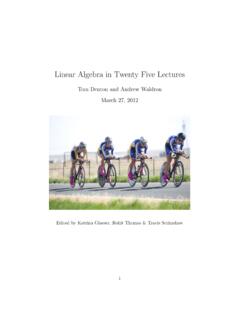
Linear Algebra in Twenty Five Lectures
www.math.ucdavis.eduThese linear algebra lecture notes are designed to be presented as twenty ve, fty minute lectures suitable for sophomores likely to use the material for applications but still requiring a solid foundation in this fundamental branch
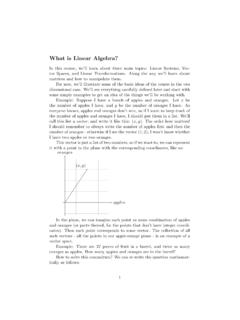
What is Linear Algebra? - University of California, …
www.math.ucdavis.eduWhat is Linear Algebra? In this course, we’ll learn about three main topics: Linear Systems, Vec-tor Spaces, and Linear Transformations. Along the way we’ll learn about
Twenty problems in probability - UC Davis …
www.math.ucdavis.eduTwenty problems in probability This section is a selection of famous probability puzzles, job interview questions (most high- tech companies ask their applicants math questions) and math competition problems.
Complex Analysis Lecture Notes - UC Davis Mathematics
www.math.ucdavis.edu\entropy"), and lots of applications to things that seem unrelated to complex numbers, for example: Solving cubic equations that have only real roots (historically, this was the
David Cherney, Tom Denton, Rohit Thomas and Andrew …
www.math.ucdavis.eduLinear algebra is the study of vectors and linear functions. In broad terms, vectors are things you can add and linear functions are functions of vectors that respect vector addition.
Power Series - UC Davis Mathematics :: Home
www.math.ucdavis.eduThe power series in Definition 6.1 is a formal expression, since we have not said anything about its convergence. By changing variables x→ ( x−c ), we can assume

Math 22B, Homework #8 - UC Davis Mathematics
www.math.ucdavis.eduMath 22B, Homework #8 4 Plugging y p and its derivatives into the ODE we get u0 1 e t+ u0 2 = 2(1 t)e t (2) Putting (1) and (2) together we have et t et 1 u0 1 u0 2 = 0 2(1 tt)e Inverting gives u0 1 u0 2 = 2te 2t 2e t Thus, after integrating, we get
Related documents

A First Course in Linear Algebra
linear.ups.eduMost students taking a course in linear algebra will have completed courses in di erential and integral calculus, and maybe also multivariate calculus, and will typically be second-year students in university. This level of mathematical maturity is expected, however there is little or no requirement to know calculus itself to use this book ...

18.04 Complex analysis with applications
math.mit.edu18.04 Complex analysis with applications Spring 2020 lecture notes Instructor: R. R. Rosales These notes are an adaption and extension of the original notes for 18.04 by Andre Nachbin

2.080 Structural Mechanics Lecture 5: Solution Method for ...
ocw.mit.eduThe second set of equations, derived in Lecture 3, is the equilibrium requirement dV dx + q(x) = 0 force equilibrium (5.3) dM dx ... In order to prevent the rigid body translation, one end of the beam, say x= 0, must ... linear ordinary di erential
ORDINARY DIFFERENTIAL EQUATIONS
users.math.msu.eduSummary. This is an introduction to ordinary di erential equations. We describe the main ideas to solve certain di erential equations, like rst order scalar equations, second order linear equations, and systems of linear equations. We use power series methods to solve variable coe cients second order linear equations. We introduce Laplace trans-

Numerical Methods for Solving Systems of Nonlinear …
www.lakeheadu.caSecond, we will examine a Quasi-Newton which is called Broyden’s method; this method has been described as a generalization of the Secant Method. And third, to s solve for nonlin-ear boundary value problems for ordinary di erential equations, we will …

The Wronskian - math.usm.edu
www.math.usm.eduWe de ne a second-order linear di erential operator Lby L[y] = y00+ p(t)y0+ q(t)y: Then, a initial value problem with a second-order homogeneous linear ODE can be stated as L[y] = 0; y(t 0) = y 0; y0(t 0) = z 0: We state a result concerning existence and uniqueness of solutions to such ODE, analogous to the Existence-Uniqueness Theorem for rst ...